This problem may be a embarrassed one, but I even could not prove it for the 1 dimensional case.
Here is the problem:
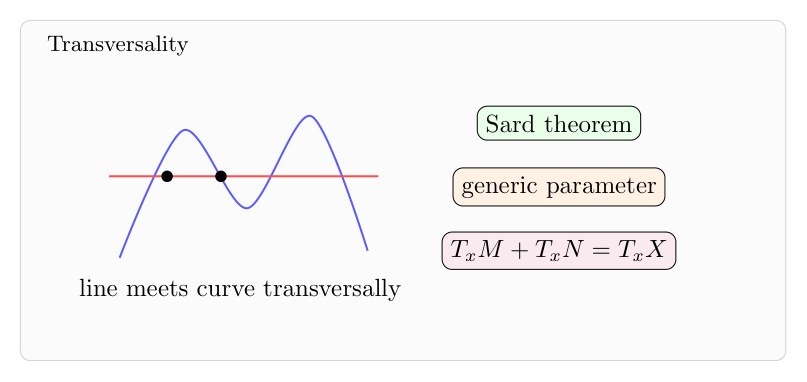
>**Question 1** is a compact -dimensional smooth manifold in , take a point $p\notin M$. prove there is always a line pass and , and intersect transversally with .
You can naturally generated it to:
>**Qusetion 2** is a compact $n$-dimensional smooth manifold in , take a point . Prove $\forall 1\leq k\leq m$, there is always a hyperplane pass $p$ and , and intersect transversally with .
Thanking for Piotr pointed out, assuming “transverse” means “the tangent spaces intersect only at 0”.
We focus on question 1 for simplified.
Even in 1 dimension it is not easy at least for me, **warning**: a line pass may be intersect $M$ at several points combine a set , could be finite, countable or even it is not countable (consider is induced by a smooth function for which the zeros set is Cantor set.)… And if there is one point , $l$ is tangent with the tangent line of at , then is not intersect transversally with .
**My attempt**:
I could use a dimensional argument and Sard’s theorem to establish a similar result but instead of a fix point , we proof for generic point in which is not in we can choose such a line.
So it seems reasonable to develop the dimensional technique to attach the question 1, in 1 dimensional, it will relate to investigate the ordinary differential equation:
Where , have a parameterization . If there is a counterexample for the question 1, then there is another solution which satisfied the ODE in the sense:
at least for every line there is a intersection point , satisfied ODE at .
This is just like the uniqueness of the solution of such a ODE is destroyed at some subspace of a line which have some special linear structure, I do not know if this point of view with be helpful.
I will appreciate for any useful answers and comments.
Proof 1(provided by fedja)
Area trick.(weakness:it seems we could not proof the transtivasally intersection point have positive measure by this way).
Proof 2(provided by Piotr)
#For the codimension 1 case.#
###Using Thom transversality theorem.###
Consider the maps parametrized by and given by . The map , is clearly transverse to , thus Thom’s transversality says that is transverse to for almost all . Now it suffices to prove that for an open set in , the line given by intersects . Proven below.
###Using Sard’s theorem directly.###
Thom’s transversality is usually proven using Sard’s theorem. Here is the idea.
Consider the projection onto a sphere centered at . A line through intersects transversally if the two points are regular values of (indeed, the critical points of are exactly the points at which the normal is perpendicular to the radial direction (with respect to $p$)). By Sard’s theorem, the set of regular values is dense in .
We need to choose any point on the sphere for which both and are regular values, and the line through and actually intersects . It suffices to prove that the set of points for which this line intersects contains an open set. We could now use the Jordan-Brouwer Separation Theorem and we would be done, but we can do it more directly (and in a way that seems to generalize).
###The set of points for which intersects has nonempty interior.###
For each point the projection onto the sphere centered at , of radius small enough so that the sphere does not intersect , has some (topological) degree . It is easy to check that if one takes any point and considers the points for small , the degrees of the corresponding maps differ by . It follows that we can find a point for which , which guarantees that for every point in a small open ball around (all these points have same degree ), the line joining and intersects . Projection of on is an open set which we sought.
#For the general case (partial solution).
I think a similar reasoning should work, however, notice that for we cannot make intersect transversally with because of dimensional reasons: the dimensions of and don’t add up to at least . Recall that transversality implies Thus, either (1) you want to consider , or (2) define “transversal intersection” for such manifolds saying that the tangent spaces have to intersect at an empty set.
Also, for we can just take any plane which works for and just extend it to a -dimensional plane.
###Assuming .###
A similar reasoning should work for with going over all families of pairwise perpendicular unit vectors, and . Thom’s transversality says that for almost all choices of , the plane is transverse to .
### The nonempty interior issue. ###
The only thing left is to prove that the set of for which the intersection is nonempty has nonempty interior. Last time we proved that there is a zero-dimensional sphere containing , namely , which has nonzero linking number with , and by deforming if to spheres and taking lines through pairs , we got an open set of parameters for which the line intersects .
Here should be able to do a similar trick by finding a -dimensional sphere with nonzero linking number with . The ball that bounds that sphere has to intersect , thus the plane containing the sphere has to intersect . By perturbing the sphere we get spheres with the same linking numbers, and get all the planes that lie in a neighbourhood of ; in particular, we get an open set of parameters for which intersects .
Well, we don’t actually need a *round* sphere, but we do need a *smooth* sphere that lies in a -dimensional plane. There’s some trickery needed to do this, but I am sure something like this can be done.
Maybe somebody else can do it better?
### For ###
I don’t really know how to attack this case, assuming “transverse” means “the tangent spaces intersect only at “.