分类: Elliptic curve

  • BSD 猜想入门:椭圆曲线、L 函数与 Mordell-Weil rank

    旧博客原文

    原题:A crash introduction to BSD conjecture

    The pdf version is A crash introduction to BSD conjecture .

    We begin with the Weierstrass form of elliptic equation, i.e. look it as an embedding cubic curve in {\mathop{\mathbb P}^2}.

    Definition 1 (Weierstrass form) {E \hookrightarrow \mathop{\mathbb P}^2 }, In general the form is given by,

    \displaystyle E: y^2+a_1xy+a_3y=x^3+a_2x^2+a_4x+a_6 \ \ \ \ \ (1)

    If {char F \neq 2,3}, then, we have a much more simper form,

    \displaystyle y^2=x^3+ax+b, \Delta:=4a^3+27b^2\neq 0. \ \ \ \ \ (2)

    Remark 1

    \displaystyle \Delta(E)=\prod_{1\leq i,\neq j\leq 3}(z_i-z_j)

    Where {z_i^3+az_i+b=0, \forall 1\leq i\leq 3}.

    We have two way to classify the elliptic curve {E} living in a fix field {F}. \paragraph{j-invariant} The first one is by the isomorphism in {\bar F}. i.e. we say two elliptic curves {E_1,E_2} is equivalent iff

    \displaystyle \exists \rho:\bar F\rightarrow \bar F

    is a isomorphism such that {\rho(E_1)=E_2}.

    Definition 2 (j-invariant) For a elliptic curve {E}, we have a j-invariant of {E}, given by,

    \displaystyle j(E)=1728\frac{4a^3}{4a^3+27b^2} \ \ \ \ \ (3)

    Why j-invariant is important, because j-invariant is the invariant depend the equivalent class of {E} under the classify of isomorphism induce by {\bar F}. But in one equivalent class, there also exist a structure, called twist.

    Definition 3 (Twist) For a elliptic curve {E:y^2=x^3+ax+b}, all elliptic curve twist with {E} is given by,

    \displaystyle E^{(d)}:y^2=x^3+ad^2x+bd^3 \ \ \ \ \ (4)

    So the twist of a given elliptic curve {E} is given by:

    \displaystyle H^1(Gal(\bar F/ F), Aut(E_{\bar F})) \ \ \ \ \ (5)

    Remark 2 Of course a elliptic curve {E:y^2=x^3+ax+b} is the same as {E:y^2=x^3+ad^2x+bd^4}, induce by the map {\mathop{\mathbb P}^1\rightarrow \mathop{\mathbb P}^1, (x,y,1)\rightarrow (x,dy,1)}.

    But this moduli space induce by the isomorphism of {F} is not good, morally speaking is because of the abandon of universal property. see \cite{zhang}. \paragraph{Level {n} structure} We need a extension of the elliptic curve {E}, this is given by the integral model.

    Definition 4 (Integral model) {s:=Spec(\mathcal{O}_F)}, {E\rightarrow E_s}. {E_s} is regular and minimal, the construction of {E_s} is by the following way, we first construct {\widetilde{E_s} } and then blow up. {\widetilde E_s} is given by the Weierstrass equation with coefficent in {\mathcal{O}_F}.

    Remark 3 The existence of integral model need Zorn’s lemma.

    Definition 5 (Semistable) the singularity of the minimal model of {E} are ordinary double point.

    Remark 4 Semistable is a crucial property, related to Szpiro’s conjecture.

    Definition 6 (Level {n} structure)

    \displaystyle \phi: ({\mathbb Z}/n{\mathbb Z})_s^2\longrightarrow E[N] \ \ \ \ \ (6)

    {P=\phi(1,0), Q=\phi(o,1)} The weil pairing of {P,Q} is given by a unit in cycomotic fields, i.e. {<P,Q>=\zeta_N\in \mu_{N}(s)}

    What happen if {k={\mathbb C}}? In this case we have a analytic isomorphism:

    \displaystyle E({\mathbb C})\simeq {\mathbb C}/\Lambda \ \ \ \ \ (7)

    Given by,

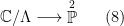
    \displaystyle {\mathbb C}/\Lambda \longrightarrow \mathop{\mathbb P}^2 \ \ \ \ \ (8)

    \displaystyle z\longrightarrow (\mathfrak{P}(z), \mathfrak{P}'(z), 1 ) \ \ \ \ \ (9)

    Where {\mathfrak{P(z)}=\frac{1}{z^2}+\sum_{\lambda\in \Lambda,\lambda\neq 0}(\frac{1}{(z-\lambda)^2}-\frac{1}{\lambda^2})}, and the Weierstrass equation {E} is given by {y^2=4x^3-60G_4(\Lambda)x-140G_6(\Lambda)}. The full n tructure of it is given by {{\mathbb Z}+{\mathbb Z}\lambda} and the value of {P,Q}, i.e.

    \displaystyle P=\frac{1}{N}, Q=\frac{\tau}{N} \ \ \ \ \ (10)

    Where {\tau} is induce by

    \displaystyle \Gamma(N):=ker(SL_2({\mathbb Z})\rightarrow SL_2({\mathbb Z}/n{\mathbb Z})) \ \ \ \ \ (11)

    The key point is following:

    Theorem 7 {k={\mathbb C}}, the moduli of elliptic curves with full level n-structure is identified with

    \displaystyle \mu_N^*\times H/\Gamma(N) \ \ \ \ \ (12)

    Now we discuss the Mordell-Weil theorem.

    Theorem 8 (Mordell-Weil theorem)

    \displaystyle E(F)\simeq {\mathbb Z}^r\oplus E(F)_{tor}

    The proof of the theorem divide into two part:

    1. Weak Mordell-Weil theorem, i.e. {\forall m\in {\mathbb N}}, {E(F)/mE(F)} is finite.
    2. There is a quadratic function,

      \displaystyle \|\cdot\|: E(F)\longrightarrow {\mathbb R} \ \ \ \ \ (13)

      {\forall c\in {\mathbb R}}, {E(F)_c=\{P\in E(F), \|P\|<c\}} is finite.

    Remark 5 The proof is following the ideal of infinity descent first found by Fermat. The height is called Faltings height, introduce by Falting. On the other hand, I point out, for elliptic curve {E}, there is a naive height come from the coefficient of Weierstrass representation, i.e. {\max\{|4a^3|,|27b^2|\}}.

    While the torsion part have a very clear understanding, thanks to the work of Mazur. The rank part of {E({\mathbb Q})} is still very unclear, we have the BSD conjecture, which is far from a fully understanding until now.

    But to understanding the meaning of the conjecture, we need first constructing the zeta function of elliptic curve, {L(s,E)}.

    \paragraph{Local points} We consider a local field {F_v}, and a locally value map {F\rightarrow F_{\nu}}, then we have the short exact sequences,

    \displaystyle 0\longrightarrow E^0(F_{\nu})\longrightarrow E(F_{\nu})=E_s(\mathcal{O}_F)\longrightarrow E_s(K_0)\longrightarrow 0 \ \ \ \ \ (14)

    Topologically, we know {E(F_{\nu})} are union of disc indexed by {E_s(k_{\nu})},

    \displaystyle |E_s(k_{\nu})| \sim q_{\nu}+1=\# \mathop{\mathbb P}^1(k_{\nu})

    . Define {a_{\nu}=\# \mathop{\mathbb P}^1(k_{\nu})-|E_s(k_{\nu})|}, then we have Hasse principle:

    Theorem 9 (Hasse principle)

    \displaystyle |a_{\nu}|\leq 2\sqrt{q_{\nu}} \ \ \ \ \ (15)

    Remark 6 I need to point out, the Hasse principle, in my opinion, is just a uncertain principle type of result, there should be a partial differential equation underlying mystery.

    So count the points in {E(F)} reduce to count points in {H^1(F_{\nu},E(m))}, reduce to count the Selmer group {S(E)[m]}. We have a short exact sequences to explain the issue.

    \displaystyle 0\longrightarrow E(F)/mE(F) \longrightarrow Sha(E)[m] \longrightarrow E(F)/mE(F)\longrightarrow 0 \ \ \ \ \ (16)

    I mention the Goldfold-Szipiro conjecture here. {\forall \epsilon>0}, there {\exists C_{\epsilon}(E)} such that:

    \displaystyle \# (E)\leq c_{\epsilon}(E)N_{E/{\mathbb Q}}(N)^{\frac{1}{2}+\epsilon} \ \ \ \ \ (17)

    \paragraph{L-series} Now I focus on the construction of {L(s,E)}, there are two different way to construct the L-series, one approach is the Euler product.

    \displaystyle L(s,E)=\prod_{\nu: bad}(1-a_{\nu}q_{\nu}^{-s})^{-1}\cdot \prod_{\nu:good}(1-a_{\nu}q_{\nu}^{-s}+q_{\nu}^{1-2s})^{-1} \ \ \ \ \ (18)


    Where {a_{\nu}=0,1} or {-1} when {E_s} has bad reduction on {\nu}.

    The second approach is the Galois presentation, one of the advantage is avoid the integral model. Given {l} is a fixed prime, we can consider the Tate module:

    \displaystyle T_l(E):=\varprojlim_{l^n} E[l^n] \ \ \ \ \ (19)

    Then by the transform of different embedding of {F\hookrightarrow \bar F}, we know { T_{l}(E)/Gal(\bar F/F)}, decompose it into a lots of orbits, so we can define {D_{\nu}}, the decomposition group of {w}(extension of {\nu} to {\bar F}). We define {I_{\nu}} is the inertia group of {D_{\nu}}.

    Then {D_{\nu}/I_{\nu}} is generated by some Frobenius elements

    \displaystyle Frob{\nu}x\equiv x^{q_{\nu}} (mod w),\forall x\in \mathcal{O}_{\bar Q} \ \ \ \ \ (20)

    So we can define

    \displaystyle L_{\nu}(s,E)=(1-q_{\nu}^{-s}Frob_{\nu}|T_{l}(E)^{I_{\nu}})^{-1} \ \ \ \ \ (21)

    And then {L(s,E)=\prod_{\nu}L_{\nu}(s,E)}.

    Faltings have proved {L_{\nu}(s,E)} is the invariant depending the isogenous class in the follwing meaning:

    Theorem 10 (Faltings) {L_{\nu}(s,E)} is an isogenous ivariant, i.e. {E_1} isogenous to {E_2} iff {\forall a.e. \nu}, {L_{\nu}(s,E_1)=L_{\nu}(s,E_2)}.

    \displaystyle L(s,E)=L(s-\frac{1}{2},\pi ) \ \ \ \ \ (22)

    Where {\pi} come from an automorphic representation for {GL_2(A_F)}. Now we give the statement of BSD onjecture. {R} is the regulator of {E}, i.e. the volume of fine part of {E(F)} with respect to the Neron-Tate height pairing. {\Omega} be the volume of {\prod_{v|\infty}F(F_v)} Then we have,

    1. {ord_{s=1}L(s,E)=rank E(F)}.
    2. {|Sha(E)|<\infty}.
    3. {\lim_{s\rightarrow 0}L(s,E)(s-1)^{-rank(E)}=c\cdot \Omega(E)\cdot R(E)\cdot |Sha(E)|\cdot |E(F)_{tor}|^{-2}}

    Here {c} is an explictly positive integer depending only on {E_{\nu}} for {\nu} dividing {N}.


    补充说明

    以下是新整理的中文说明;上方旧博客原文保持不变。

    Birch and Swinnerton-Dyer 猜想把椭圆曲线的有理点群和它的 $L$ 函数在 $s=1$ 处的零点阶联系起来。它是数论中最核心的桥之一:一边是 Diophantine 方程的解,另一边是解析函数的特殊值。
    BSD 猜想入门:椭圆曲线、L 函数与 Mordell-Weil rank
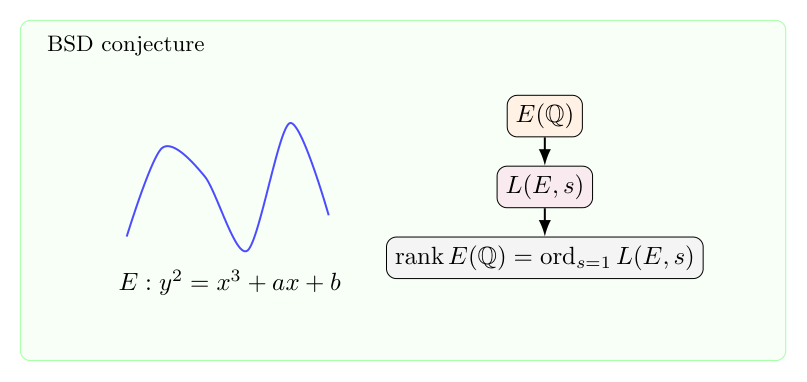
    BSD 猜想连接椭圆曲线有理点群的 rank 与 $L$ 函数在 $s=1$ 的零点阶。

    1. Weierstrass 形式

    在特征不是 $2,3$ 的域上,椭圆曲线常写成

    $$E:y^2=x^3+ax+b,$$

    并要求判别式

    $$\Delta=-16(4a^3+27b^2)\ne0.$$

    非零判别式保证曲线光滑。椭圆曲线不仅是代数曲线,它的点还带有 Abelian group 结构。

    2. $j$-invariant 与 twist

    $j$-invariant 分类椭圆曲线在代数闭包上的同构类:

    $$j(E)=1728\frac{4a^3}{4a^3+27b^2}.$$

    但在固定域 $K$ 上,同一个 $j$-invariant 可能对应不同的 twists。twist 说明“几何上同构”和“在基域上同构”之间有差别。

    3. Mordell-Weil theorem

    若 $E$ 定义在 $\mathbb Q$ 上,则 Mordell-Weil theorem 说

    $$E(\mathbb Q)\cong E(\mathbb Q)_{\operatorname{tors}}\oplus\mathbb Z^r.$$

    整数 $r$ 称为 Mordell-Weil rank。求 $r$ 是理解有理点结构的核心问题。

    4. Hasse-Weil L 函数

    对每个好素数 $p$,令

    $$a_p=p+1-\#E(\mathbb F_p).$$

    椭圆曲线的 $L$ 函数由 Euler product 组成:

    $$L(E,s)=\prod_p(1-a_pp^{-s}+p^{1-2s})^{-1}$$

    再在坏素数处加入修正因子。模性定理保证这个 $L$ 函数有解析延拓和函数方程。

    5. BSD 猜想

    BSD 猜想最核心的断言是

    $$\operatorname{rank}E(\mathbb Q)=\operatorname{ord}_{s=1}L(E,s).$$

    更精细的版本还给出 $L(E,s)$ 在 $s=1$ 处首项系数,涉及 regulator、Tate-Shafarevich group、Tamagawa numbers 和 torsion subgroup。

    这个猜想的意义在于,它把有理点这个离散、代数的问题,转化成了 $L$ 函数特殊值这个解析问题。许多数论现代方法都在这座桥上来回移动。