旧博客原文
原题:Geometric intuition of mean value property of nonlinear elliptic equation
I wish to gain some understanding of the MVP of nonlinear elliptic equation by geometric intuition.
Linear elliptic equation case
First of all, I have a very good geometric explain of the MVP of Laplace equation, i.e.
MVP of laplace equation
in
,
is a Ball, we have following identity:

I need to point out first, this property is not difficult to proof by standard integral by part method, but the following method have more geometric intuition. And in some sense explain why this property holds.
The proof is not very difficult to explain by mathematic formula, but I wish to divide the proof into two part, explain one part by graph and literal interpretation.
part 1 of the proof:
we consider a 1-parameter group of foliation, and consider the integral identity with this foliation.

Part 2 of the proof:
and we have:

by the pointwise equation 
This approach cloud easily to transform to the general elliptic equation case and it seems a little difficult to transform to Possion equation, the non-hemomorphism case.
Nonlinear elliptic equation case
A-B-P estimate for general nonlinear uniformly elliptic equation
ABP estimate is the most basic estimate in fully nonliear elliptic equation.
The ABP maximum principle states (roughly) that, if

Then (assuming sufficient regularity of the coefficients),
\sup _{\Omega} u \leq \sup _{\partial \Omega} u + C (\int _{\Omega} \vert f \vert^n )^{1/n} ………. (*)
I will give an intuitive explanation of the proof of (*) .
Usually, in order to prove maximum principles, the key idea is to use that at a local max the second derivative is negative-definite, then choose a good basis and get some identity of 1-order drivative and inequality for 2-order’s. This process is used in such like the proof of the Hopf lemma, and some inter gradient estimate, consider some flexiable function like 
But in the proof of ABP we need more geometric intution and more trick.
First we do a rescaling:
if
then:


And then We explain what is the contact set. It is the subset 



Then we look at every point in 

The determination of hessian matrix could be view as a determination of Jacobe matrix of the map 

It is easy to see for a constant 



so we have:

and the classical matrix inequality for every positive definite matrix A we have
:

combine (***),(****) ,we have:

graph
General approach to get MVP for elliptic equation which is come from geometry
MVP for K-hessian equation, with geometric explanation
MVP for K-curvature equation, with geometric explanation
MVP for p-Laplace equation, with geometric explanation
补充说明
以下是新整理的中文说明;上方旧博客原文保持不变。
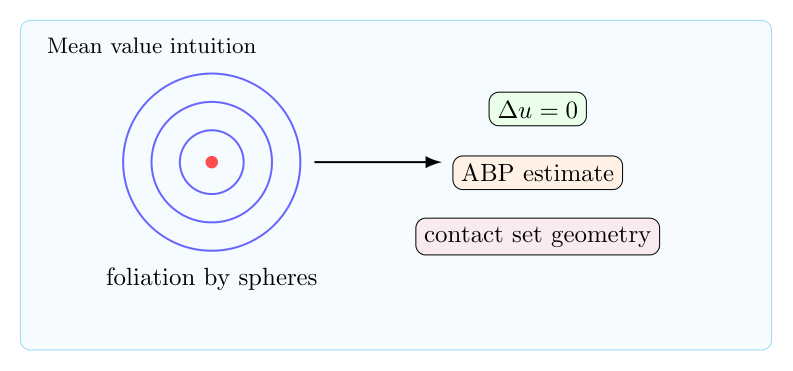
调和函数的平均值性质是椭圆方程最漂亮的几何现象之一。在线性情形,它来自球面对称和分部积分;在非线性椭圆方程中,真正的替代物往往不是严格平均值公式,而是 ABP estimate、contact set 和凸包几何。
1. Laplace 方程的平均值性质
若 $\Delta u=0$,则对球 $B_r(x)$,
$$u(x)=\frac1{|\partial B_r|}\int_{\partial B_r(x)}u\,d\sigma.$$
证明可用 Green identity,也可以看成沿同心球 foliation 的通量守恒。
2. 几何解释
令
$$A(r)=\frac1{|\partial B_r|}\int_{\partial B_r(x)}u.$$
对 $r$ 求导后,$\Delta u=0$ 让通量项消失,于是 $A(r)$ 为常数。球面对称和散度结构共同产生平均值性质。
3. 非线性情形的问题
对一般 fully nonlinear elliptic equation
$$F(D^2u,x)=f,$$
没有线性叠加,也没有简单的球面平均公式。我们需要用比较原理和接触几何替代平均值。
4. ABP estimate
ABP 最大值原理粗略地说给出
$$\sup_\Omega u\le \sup_{\partial\Omega}u+C\|f\|_{L^n(\Omega)}.$$
其证明看 $u$ 的凸包和 contact set。梯度映射的面积公式把函数的最大值和右端 $f$ 的积分联系起来。
5. 一条直觉
线性平均值性质说:每个点由周围平均决定。非线性椭圆理论说:最大值由接触集合和 Monge-Ampere 型几何控制。二者背后的共同点是椭圆性阻止信息沿单一方向集中,迫使解受到周围区域的整体约束。
 be a domain in
  ,bounded most of the time.
 be defined in
  .where
  .
. given by,
 is defined for any
  .
.
 ,where
  is a positive constant.
 norm,
norm,![\displaystyle |u|^*_{C^{k,\alpha}(B_R)}=\sum_{i=0}^k R^i|D^iu|_{L^{\infty}(B_R)}+R^{k+\alpha}[D^ku]_{C^{\alpha}(B_R)}](https://s0.wp.com/latex.php?latex=%5Cdisplaystyle+%7Cu%7C%5E%2A_%7BC%5E%7Bk%2C%5Calpha%7D%28B_R%29%7D%3D%5Csum_%7Bi%3D0%7D%5Ek+R%5Ei%7CD%5Eiu%7C_%7BL%5E%7B%5Cinfty%7D%28B_R%29%7D%2BR%5E%7Bk%2B%5Calpha%7D%5BD%5Eku%5D_%7BC%5E%7B%5Calpha%7D%28B_R%29%7D&bg=ffffff&fg=000000&s=0&c=20201002)
 come from a scaling.


 is constant. in this case we proof the estimate:
 ,for some
  ,and
,and  be a constant symmetric
  matrix satisfying
 . suppose
  satisfies:
 ,moreover,
![\displaystyle |u|^*_{C^{2,\alpha}(B_{\frac{R}{2}})}\leq C[|u|_{L^{\infty}(B_R)}+R^2|f|^*_{C^{\alpha}(B_R)}]](https://s0.wp.com/latex.php?latex=%5Cdisplaystyle+%7Cu%7C%5E%2A_%7BC%5E%7B2%2C%5Calpha%7D%28B_%7B%5Cfrac%7BR%7D%7B2%7D%7D%29%7D%5Cleq+C%5B%7Cu%7C_%7BL%5E%7B%5Cinfty%7D%28B_R%29%7D%2BR%5E2%7Cf%7C%5E%2A_%7BC%5E%7B%5Calpha%7D%28B_R%29%7D%5D&bg=ffffff&fg=000000&s=0&c=20201002)
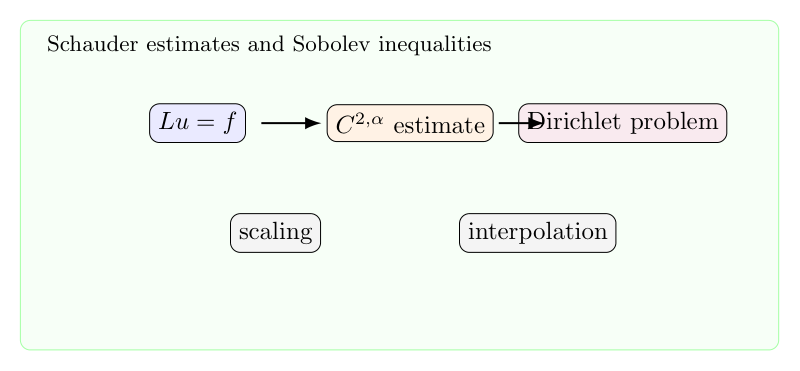
 to continue,we prove an interpolation inequality for Holder continuous functions.
 and
and  be a ball of radius
  ,
,![\displaystyle \mu^{\alpha}R^{\alpha}[u]_{C^{\alpha}(B_R)}\leq C[\mu R |\nabla u|_{L^{\infty}(B_R)}+|u|_{L^{\infty}(B_1)}]](https://s0.wp.com/latex.php?latex=%5Cdisplaystyle+%5Cmu%5E%7B%5Calpha%7DR%5E%7B%5Calpha%7D%5Bu%5D_%7BC%5E%7B%5Calpha%7D%28B_R%29%7D%5Cleq+C%5B%5Cmu+R+%7C%5Cnabla+u%7C_%7BL%5E%7B%5Cinfty%7D%28B_R%29%7D%2B%7Cu%7C_%7BL%5E%7B%5Cinfty%7D%28B_1%29%7D%5D&bg=ffffff&fg=000000&s=0&c=20201002)
![\displaystyle \mu R |\nabla u|_{L^{\infty}(B_R)} \leq C[\mu^{1+\alpha}R^{1+\alpha}|\nabla u|_{C^{\alpha}(B_R)}+|u|_{L^{\infty}(B_1)}]](https://s0.wp.com/latex.php?latex=%5Cdisplaystyle+%5Cmu+R+%7C%5Cnabla+u%7C_%7BL%5E%7B%5Cinfty%7D%28B_R%29%7D+%5Cleq+C%5B%5Cmu%5E%7B1%2B%5Calpha%7DR%5E%7B1%2B%5Calpha%7D%7C%5Cnabla+u%7C_%7BC%5E%7B%5Calpha%7D%28B_R%29%7D%2B%7Cu%7C_%7BL%5E%7B%5Cinfty%7D%28B_1%29%7D%5D&bg=ffffff&fg=000000&s=0&c=20201002)
 ,
,![\displaystyle \mu R|\nabla u|_{L^{\infty}(B_R)}\leq C[\mu^2R^2|\nabla^2 u|_{L^{\infty}(B_R)}+|u|_{L^{\infty}(B_R)}]](https://s0.wp.com/latex.php?latex=%5Cdisplaystyle+%5Cmu+R%7C%5Cnabla+u%7C_%7BL%5E%7B%5Cinfty%7D%28B_R%29%7D%5Cleq+C%5B%5Cmu%5E2R%5E2%7C%5Cnabla%5E2+u%7C_%7BL%5E%7B%5Cinfty%7D%28B_R%29%7D%2B%7Cu%7C_%7BL%5E%7B%5Cinfty%7D%28B_R%29%7D%5D+&bg=ffffff&fg=000000&s=0&c=20201002)
 is a positive constant depending on n and
  .
. and
and  ,
,![\displaystyle \sum_{i=0}^2(\mu R)^i|\nabla^i u|_{L^{\infty}(B_R)}+\sum_{i=0}^1(\mu R)^{i+\alpha}[\nabla^i u]_{C^{\alpha}(B_R)}\leq C[(\mu R)^{2+\alpha}[\nabla^2 u]_{C^{\alpha}(B_R)}+|u|_{L^{\infty}(B_R)}]](https://s0.wp.com/latex.php?latex=%5Cdisplaystyle+%5Csum_%7Bi%3D0%7D%5E2%28%5Cmu+R%29%5Ei%7C%5Cnabla%5Ei+u%7C_%7BL%5E%7B%5Cinfty%7D%28B_R%29%7D%2B%5Csum_%7Bi%3D0%7D%5E1%28%5Cmu+R%29%5E%7Bi%2B%5Calpha%7D%5B%5Cnabla%5Ei+u%5D_%7BC%5E%7B%5Calpha%7D%28B_R%29%7D%5Cleq+C%5B%28%5Cmu+R%29%5E%7B2%2B%5Calpha%7D%5B%5Cnabla%5E2+u%5D_%7BC%5E%7B%5Calpha%7D%28B_R%29%7D%2B%7Cu%7C_%7BL%5E%7B%5Cinfty%7D%28B_R%29%7D%5D&bg=ffffff&fg=000000&s=0&c=20201002)
 -norms of solutions of uniformly elliptic equations.The trick is to freeze coefficients.
 ,
,  ,
,



 .
.

 to prove the situation
  .
. .
. .
.



![{\leq \frac{c}{n}\sum_{i=1}^n\tilde C p[(\int_{\Omega} (|u|^{p-1})^{\frac{p}{p-1}})^{\frac{p-1}{p}}+(\int_{\Omega} |D_iu|^p)^{\frac{1}{p}}]^{\frac{1}{p}} }](https://s0.wp.com/latex.php?latex=%7B%5Cleq+%5Cfrac%7Bc%7D%7Bn%7D%5Csum_%7Bi%3D1%7D%5En%5Ctilde+C+p%5B%28%5Cint_%7B%5COmega%7D+%28%7Cu%7C%5E%7Bp-1%7D%29%5E%7B%5Cfrac%7Bp%7D%7Bp-1%7D%7D%29%5E%7B%5Cfrac%7Bp-1%7D%7Bp%7D%7D%2B%28%5Cint_%7B%5COmega%7D+%7CD_iu%7C%5Ep%29%5E%7B%5Cfrac%7B1%7D%7Bp%7D%7D%5D%5E%7B%5Cfrac%7B1%7D%7Bp%7D%7D+%7D&bg=ffffff&fg=000000&s=0&c=20201002)
 . Q.E.D.

![{\mu\in (0,1]}](https://s0.wp.com/latex.php?latex=%7B%5Cmu%5Cin+%280%2C1%5D%7D&bg=ffffff&fg=000000&s=0&c=20201002) ,
,
 is well-defined by the following lemma:
 continously for any q,
 satisfy
  .
.

 directly calculate follows that :





 .
. constant depend only on
  ,such that
![\displaystyle \int_{\Omega} exp[\frac{g}{c_1||f||_p}]^{p^`}dx\leq c_2|\Omega|,p^`=\frac{p}{p-1}](https://s0.wp.com/latex.php?latex=%5Cdisplaystyle+%5Cint_%7B%5COmega%7D+exp%5B%5Cfrac%7Bg%7D%7Bc_1%7C%7Cf%7C%7C_p%7D%5D%5E%7Bp%5E%60%7Ddx%5Cleq+c_2%7C%5COmega%7C%2Cp%5E%60%3D%5Cfrac%7Bp%7D%7Bp-1%7D&bg=ffffff&fg=000000&s=0&c=20201002)


 suffice large. Q.E.D.

 to whole space.and we have
  .
.
 ,so
,so
 ,then there exists constant
 ![\displaystyle \int_{\Omega}exp[\frac{|u|}{c_1||Du||_n}]^{\frac{n}{n-1}}dx\leq c_2|\Omega|](https://s0.wp.com/latex.php?latex=%5Cdisplaystyle+%5Cint_%7B%5COmega%7Dexp%5B%5Cfrac%7B%7Cu%7C%7D%7Bc_1%7C%7CDu%7C%7C_n%7D%5D%5E%7B%5Cfrac%7Bn%7D%7Bn-1%7D%7Ddx%5Cleq+c_2%7C%5COmega%7C&bg=ffffff&fg=000000&s=0&c=20201002)
 ,then
,then  ,
, .
.