旧博客原文
原题:A determinantal formula
I see a similar formula I wish to be true and merely have a proof in mind occur as a MO’s problem:
In my research, I encounter the following formula which I believe is correct (checked for 
I am given a real symmetric matrix
where 


Let 


Remark that 

The case 

which I have seen under the names “Andreief identity” and also “Gram identity”. The proof is elementary using the Leibniz formula for the determinant.
补充说明
以下是新整理的中文说明;上方旧博客原文保持不变。
很多行列式公式可以理解为 Gram identity 或 Andreief identity 的变体。它们把矩阵的对称多项式、向量组的体积和积分中的 determinant 联系起来。
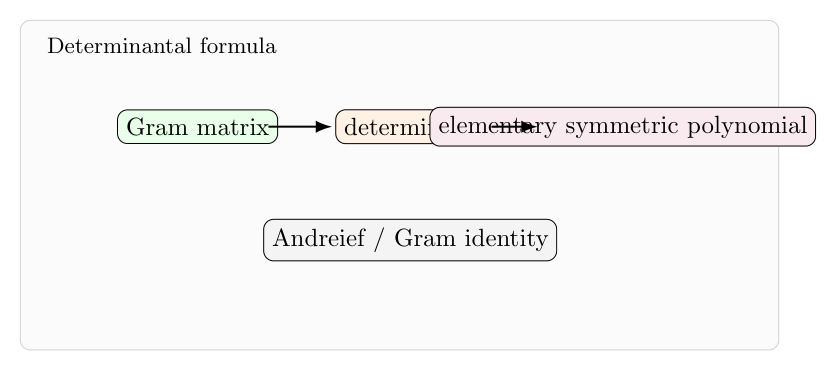
1. Gram matrix
给定向量 $v_1,\ldots,v_m$,Gram matrix 为
$$G_{ij}=\langle v_i,v_j\rangle.$$
$\det G$ 等于这些向量张成平行体体积的平方。因此 $G$ 半正定,且 $\det G=0$ 当且仅当向量线性相关。
2. Andreief identity
Andreief identity 的典型形式是
$$\int \det(f_i(x_j))\det(g_i(x_j))\prod_j d\mu(x_j)
=n!\det\left(\int f_i(x)g_j(x)d\mu(x)\right).$$
它是积分版的 Cauchy-Binet 公式。
3. 对称多项式
若 $A$ 是半正定矩阵,特征值为 $\lambda_1,\ldots,\lambda_n$,第 $k$ 个 elementary symmetric polynomial 是
$$e_k(A)=\sum_{i_1<\cdots 它也等于所有 $k\times k$ 主子式之和。 $e_k(A)$ 可以看成 $A$ 在所有 $k$ 维方向上的体积膨胀总和。若 $A$ 来自随机向量的 Gram matrix,那么对应公式会把 $e_k(A)$ 写成某种 determinant 的积分平均。 这类公式通常从 Leibniz determinant expansion 出发,交换求和和积分,再识别为 Cauchy-Binet 或 Andreief identity。核心不是计算技巧,而是“行列式等于体积平方”的几何含义。4. 几何解释
5. 证明方式