旧博客原文
原题:Analysis Qualifying Examination(UCLA 2009)
1.
Let 


Prove:

proof:
by Fubini theorem(cake representation theorem in fact):

(there is a geometric heuristic,strict proof is due to fubini theorem)
Q.E.D.
2.
Let 
a)Prove the unit sphere 

b)Prove there is a sequence 


proof:
by Zorn lemma there is a orthogonal bases 
to proof a),suffice to proof:
this can be done by look at the expansion 


b) is trivial due to a).
Q.E.D.
3.Let 

proof:
we know
for 





On the other hand,


Q.E.D.
5.Let ![I=I_{0,0}=[0,1]](https://s0.wp.com/latex.php?latex=I%3DI_%7B0%2C0%7D%3D%5B0%2C1%5D&bg=ffffff&fg=5e5e5e&s=0&c=20201002)


![I_{n,j}=[j2^{-n},(j+1)2^{-n}]](https://s0.wp.com/latex.php?latex=I_%7Bn%2Cj%7D%3D%5Bj2%5E%7B-n%7D%2C%28j%2B1%292%5E%7B-n%7D%5D&bg=ffffff&fg=5e5e5e&s=0&c=20201002)
For 

Prove that if 
proof:
…gap…
10.Let 


proof:maximum norm principle.to show 

Q.E.D.
补充说明
以下是新整理的中文说明;上方旧博客原文保持不变。
这组题表面上分散:有测度论、Hilbert 空间弱拓扑、Banach 空间可分性、函数空间闭性。但它们的共同核心是:把抽象对象转化为可数逼近、积分层分解或闭性问题。
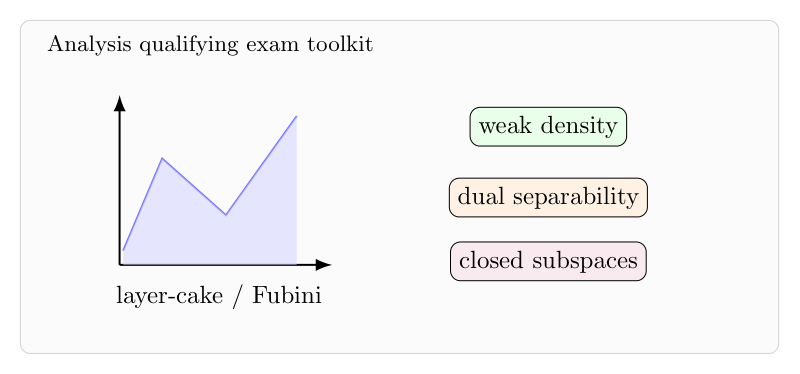
1. Layer-cake 与 Fubini
对非负函数 $f$,常用恒等式是
$$f(x)=\int_0^\infty \mathbf 1_{\{f(x)>t\}}\,dt.$$
积分后用 Fubini 交换次序,就得到 layer-cake representation。很多看似是范数不等式的题,其实都可以化成集合层面的包含关系。
2. Hilbert 空间单位球的弱拓扑
在无限维 Hilbert 空间中,单位球的弱闭包现象和强拓扑非常不同。给定 $\|x\|\le1$,可以在与有限多个测试向量正交的方向上添加一个小向量,使范数变成 $1$,同时不改变这些测试函数的值。于是单位球中的点可被单位球面弱逼近。
3. 可分性与对偶
若 $X^*$ 可分,则 $X$ 可分。证明思路是从 $X^*$ 中取可数稠密集 $\{f_n\}$,再为每个有限线性条件选择近似达到范数的点。Hahn-Banach 的思想隐藏在这里:对偶空间的可数信息足以区分 $X$ 中的点。
4. 闭子空间的完备性
若 $L^2(D)$ 中的全纯函数子空间在 $L^2$ 收敛下保持全纯,那么它就是闭子空间,从而完备。关键是用局部估计把 $L^2$ 收敛提升为紧子集上的一致收敛,再由 Weierstrass 定理保全全纯性。