分类: Rotation number

  • Rotation number:圆周同胚的提升、周期点与半共轭

    旧博客原文

    原题:Rotation number


    Consider compact 1 dimension dynamic system.

    We focus on S_1, it does not mean S_1 is the only compact 1 dimensional system , but it is a typical example.

    T: S_1\to S_1.

    If T is a homomorphism then T stay the order of S_1 (by continuous and the zero point theorem). That is just mean:

    img_0510.jpg

    (may be do a reflexion e^{2\pi i\theta}\to e^{-2\pi i\theta}).

    In the homomorphism case. We try to define the rotation number to describe the expending rate of the dynamic system.

    T: \mathbb S_1\to \mathbb S_1 i.e. T:\mathbb R/\mathbb Z\to \mathbb R/\mathbb Z. Lifting to,

    \hat T:\mathbb R\to \mathbb R.

    How to realize the lifting?

    Step1: Periodic extend T:\mathbb S_1\to \mathbb S_1 to T': \mathbb R\to \mathbb S_1. (Regard \mathbb S_1 as [0,2\pi]).

    Step2: Consider the “flow” of T':\mathbb R\to \mathbb S_1. we get \hat T:\mathbb R\to \mathbb R.

    The rotation number is defined as:

    \rho (T)=\limsup_{n\to \infty}\frac{\hat T^n(x)}{n}.

    Following we will shall it is independent of the choice of x and \rho (T)=\lim_{n\to \infty}\frac{\hat T^n(x)}{n} in fact.

    It is not difficult to proved the following property:

    Property:

    1.If T' is conjugate (in fact semi-conjugate is enough ). Then 1.If T' is conjugate (in fact semi-conjugate is enough ). Thenrotation number of T' equal to rotation number of T.

    2.If T' is conjugate to T. Then rotation number of T' equal to
    rotation number of T.


    img_0511

    T'(y)=\Psi\circ T\circ \Psi^{-1}(y)=\Psi(\Psi^{-1}(y)+t(\Psi^{-1}(y))))

    Example: T: x\to x+\alpha, \alpha\in \mathbb R. It is not difficult to prove the rotation number of T is \alpha.

    Propersion:

    1)For n\geq 1 we have that \rho(T^n)=\rho(T) (mod 1).

    2).If T has a periodic point, i.e. x\in S_1,\exists n\in \mathbb N^*, T^{n}(x)=x. Then $latex\rho (T)$ is rational.

    3) T:\mathbb R/\mathbb Z \to \mathbb R/\mathbb Z has no periodic point then \rho(T) is irrational.

    4) The limit actually exists and we have:  \rho(T)=\lim_{n\to \infty}\frac{\hat T^n(x)}{n} (mod 1).


    pf of 1):

    \rho(T^n)=\lim_{k\to \infty}\frac{(\hat T^n)^{k}(x)}{k}

    =\lim_{k\to \infty}n\frac{(\hat T)^{nk}(x)}{nk}

    =n\rho (T).

    Used the property |x-y|<k \leftrightarrow |T^{\omega}(x)-T^{\omega}(y)|<k+1, \forall \omega\in N^*, \forall k\in \mathbb Z^{+}.


    pf of 2):

    It is not difficult to prove \rho(T) is independent with the choice of x. So choose x to be the periodic point.

    Remark: but the inverse of 2) is not true. For example:

    x\to x+\frac{1}{2}+\frac{1}{100}sin(4\pi x).

    This dynamic system has both periodic points(\{0,\frac{1}{2}\},\{\frac{1}{4},\frac{3}{4}\}) and non-periodic pint (maybe orbits generated by \{\frac{1}{\sqrt{2}}\}).

    pf of 3):

    If not. Assume \rho(T) is rational number \frac{q}{p}. Take any point x\in \mathbb S_1, then:

    \lim_{n\to \infty}\frac{\hat T^n(x)}{n}=\frac{q}{p}.

    \Longrightarrow \lim_{n\to \infty}\frac{(\hat T^p)(x)}{n}=q.

    \Longrightarrow \lim_{n\to \infty}\frac{(\hat T^p-q)^n(x)}{n}=0.

    Now assume \hat T^p-q=\widetilde T.

    Then \widetilde x>x. $\forall x\in \mathbb S_1$ (if \widetilde x<x, \forall x\in \mathbb S_1, take reflection x\to -x).

    And there do not exists n\in \mathbb N^* such that \widetilde T^nx>x+1. If not, we could prove rotation number is large than \frac{1}{n} lead a contradiction.

    So \{\widetilde T^nx\}_{n=1}^{\infty} is a bounded monotonically increasing sequences in \mathbb S_1, it limits point z\in \mathbb S_1 must satisfied \widetilde T^n (z)=z.

    pf of 4):

    Using the point wise approximation inequality induced from the monotonically and stay ordering property of \mathbb S_1 by T.

    Corollary:

    Assume \rho(T) is irrational.

    1. Let n_1,n_2,m_1,m_2\in \mathbb Z, and x,y\in \mathbb R. If \hat T^{n_1}(x)+m_1<\hat T^{n_2}(x)+m_2, then hat T^{n_1}(y)+m_1<\hat T^{n_2}(y)+m_2.

    2. The bijection n\rho (T)+m\to \hat T^n(0)+m between the set \Omega=\{n\rho(T)+m| n,m\in \mathbb Z\} and \Gamma=\{\hat T^{n}(0)+m,n,m\in \mathbb Z\} precise the natural ordering on \mathbb R.


    This corollary is not difficult to prove use the established property.

     Denjoy’s theorem

    Proposition:

    If T: \mathbb R/\mathbb Z\to \mathbb R/\mathbb Z is a minimal orientation presenving homomorphism with irrational rotation number \rho then T is topologically conjugate to the standard rotation R_{\rho}: \mathbb R/\mathbb Z\to \mathbb R/\mathbb Z.

    leave as a ex.

    For T: \mathbb R/\mathbb Z\to \mathbb R/\mathbb Z, T': \mathbb R/\mathbb Z\to \mathbb R. We define the variation of log|T'|: \mathbb R/\mathbb Z\to \mathbb R by:

    Var(log(|T'|))=

    sup\{\sum_{i=0}^{n-1}|log|T'|(x_{i+1})-log|T'|(x_i)|: 0=x_0<x_1<...<x_n=1\}

    We say that the logarithm of |T'| has bounded variation if this value Var(log|T'|) is finite.

    Denjoy’s theorem:

    If T: \mathbb R/\mathbb Z\to \mathbb R/\mathbb Z is a C^1 orientation preserving homomorphism of the circle with derivative of standard variation and irrational rotation number \rho=\rho(T) then T:\mathbb R/\mathbb Z\to \mathbb R/\mathbb Z is topologically conjugate to the standard rotation :

    R_{\rho}:\mathbb R/\mathbb Z\to \mathbb R/\mathbb Z.

    Due to the upper proposition we only need show T:\mathbb R/\mathbb Z\to \mathbb R/\mathbb Z is minimal. Proof pf minimal is splitting to following two sub lemmas.

    Sublemma1:

    If T has irrational rotation number and there are a constant C>0 and a sequences of integers q_n\to \infty such that the map: T: \mathbb R/\mathbb Z\to \mathbb R/\mathbb Z Satisfy : |(T^{q_n})'(x)||(T^{-q_n})'(x)|\geq C Then T: \mathbb R/\mathbb Z\to \mathbb R/\mathbb Z is minimal.


    Sublemma2:

    Fix x\in \mathbb R/\mathbb Z and write x_n=T^n(x), for x\in \mathbb Z There exists an increasing sequences q_n\to \infty of natural number such that the intervals (x_0,x_{q_n}),(x_1,x_{q_n+1}),...,(x_i,x_{q_n+i}),...,(x_{q_n},x_{2q_n}) are all disjoint.


    Paradox and problem 

    Graph:img_0513.jpg

    \rho(T)>0 because of existence of fix point.

    T_{\alpha}=T+\alpha for \alpha< sup_x|T_x-x|.

    Is \rho(T_{\alpha})=0 always true for \alpha \in R?

    If it is right, then there is a contradiction with argument (*), but for what type of dynamic system T?

    T_{\alpha}=T+\alpha satisfied \rho(T_{\alpha})=\rho(T)+\alpha. for all \alpha\in \mathbb R?

    Problem:

    If T is not homomorphism but T:x\to x+g(x) induced g(x)=x-f(x), f(x) is striating increasing, Is the limit of \lim_{x\to \infty}\frac{\hat T(x)}{n} always exists? it could not be increase with x.


    补充说明

    以下是新整理的中文说明;上方旧博客原文保持不变。

    rotation number 是一维动力系统中最基本的不变量之一。它衡量圆周同胚平均每次迭代旋转多少。
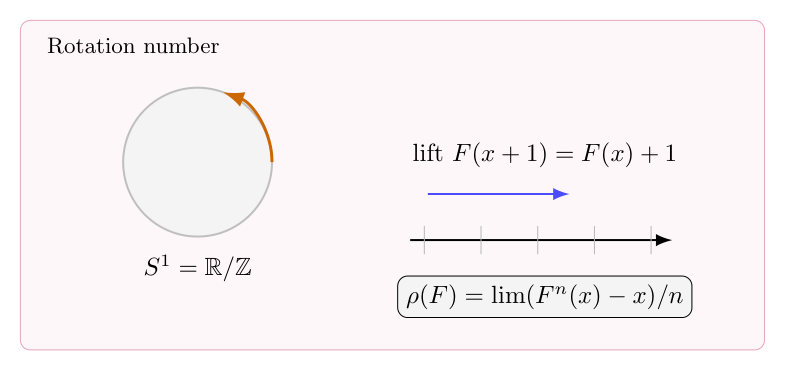
    Rotation number:圆周同胚的提升、周期点与半共轭
    圆周同胚提升到实线后,rotation number 是迭代平均位移的极限。

    1. 提升到实线

    把圆周写成 $S^1=\mathbb R/\mathbb Z$。若 $f:S^1\to S^1$ 是保向同胚,可以取一个 lift $F:\mathbb R\to\mathbb R$,满足

    $$F(x+1)=F(x)+1.$$

    rotation number 定义为

    $$\rho(F)=\lim_{n\to\infty}\frac{F^n(x)-x}{n}\pmod1.$$

    这个极限存在,并且与 $x$ 的选择无关。

    2. 基本性质

    若 $f$ 与 $g$ 共轭,则它们有相同 rotation number。更弱的半共轭在很多情形下也保留 rotation number。标准旋转

    $$R_\alpha(x)=x+\alpha$$

    的 rotation number 就是 $\alpha$。

    3. 周期点与有理数

    如果 $f$ 有周期点,即 $f^q(x)=x$,那么

    $$\rho(f)=\frac pq\in\mathbb Q.$$

    反过来,对保向圆周同胚,若 rotation number 是有理数,则存在周期轨道。无理 rotation number 则排除周期点。

    4. Denjoy 图像

    若 rotation number 无理,系统常与无理旋转相关。足够光滑且导数变差有限时,Denjoy theorem 给出与刚性旋转的半共轭,甚至在更强条件下共轭。

    5. 为什么它重要

    rotation number 把一个非线性圆周动力系统压缩成一个算术量。这个量同时控制周期轨道、轨道排序和与刚性旋转的关系,是一维动力系统从拓扑进入数论的入口。



