旧博客原文
原题:Two stupid question
The story of the infinite dimensional space of $\Delta$ is following, we eliminate ourself with compact smooth non-boundary manifold $M$ with metric $g$, then we have Betrami-Laplace operator $\Delta_g$. We could instead $\Delta_g$ by hodge laplace $dd^*+d^*d$, but let we consider $\Delta_g$ the eigenvalue problem:
$$\Delta_g u=\lambda u$$
A classical way to investigate the eigenvalue problem is according to consider variational principle and max-min principle. We equip the path integral on the function space $C^{\infty}(M)$:
$$E(f)=\frac{\int_M |\nabla u|^2}{\int_M |u|^2 }$$
Then it have a sequences of eigenvalue, negative of course: $$0<-\lambda_1<-\lambda_2<…<\lambda_k<…$$
Then things become interesting, the morse theory of infinite space involve, called the infinite space as $X$, so at least, shrink the far place of $X$ as a point, in physics, this mean, cut off at fix scale. And we can take the scale to infinite small, we use the cutoff one to approximation the real one. What I can do is the following, I can proof the eigenvalue function is uniformly distributed in $L^2(M_g)$ (after rescaling of course) and the classical weyl law(although can not give a good error term estimate), but thing become more complicated when I try to consider the infinite space $X_{M_g}$’s topology, at finite scale at least, i.e. $X_{M_g}^{h}$ which is the cut off at scale $h$. Among the other thing, I believe the following issue is true, but without ability to proof it:
>**Problem**
for every manifold $M$ and metric $g$ on $M$, the topology of infinite space $X_{M_g}$ is the same, beside this, the inverse could be true, i.e. If $X_{M_1},X_{M_2}$ is not homomorphism for some scale $h$ then $M_1,M_2$ is not homomorphism.
By intuition, I think it is depend by the underling manifold’s topology. But I do not have a rigorous proof, I definitely have a non-rigorous one, if ignore the coverage…
As I find this problem when I try to give a proof of weyl law, I do not check the reference, may be this problem is a classical one? As always, I will appreciate to any interesting comments and answers, thanks a lots!A
2.
We begin with our favorite situation, the Dirchlet problem on bounded simple-connected domain $\Omega$ in $\mathbb R^n$. Let $\lambda_1$ be the first eigenvalue of $$\Delta u=\lambda u \ in\ \Omega$$
$$u=0\ \ on\ \partial\Omega$$
Rescaling $u$ such that $\sup_{\Omega} u=1$, I think the following property of the first eigenvalue is true.
>**Problem**
We have, the Minkowski functional of $\Omega$, called $M_{\Omega}$ and the Minkowski functional with the ball $B$ such that $vol(B)=vol(\Omega)$, then along the level set of $u$, i.e. the fiber: $$\Omega=\cup_{t\in [0,1]}l_t, l_t:=\{t|x\in \Omega, u(x)=t\}$$
We pretend for the isolate point $l_1$ to be a ball with radius 0, so equipped it with the uniformly density at every direction in $S^1$, i.e. the mass distribution given by $M_B$ and the total mass coincide with the total mass induce by $M_{\Omega}$ in $l_0$, i.e.
$$\int_{e\in S_1}M_{\Omega}(e)d\mu=\int_{e\in S_1}M_{B}(e)d\mu$$
The measure $d\mu$ equipped on $S^1$ is the natural Haar measure. And the cost function is given by $c(x,y)=\|x-y\|^2$. Then, among this setting,
I wish the following property to be true:
Along the direction $1\to 0$, the transport of density $\partial_{t_0} M_{\cup_{t=t_0}^1l_t}$ given the unique optimal transport of the natural measure induce by $M(\Omega)$ and $M(B)$.
**Remark 1** As point out by SebastianGoette, the multiplicity of the first eigenvalue must be one, thanks to the eigenfunction never change the symbol, so we are in the best case.
**Remark 2**:I am not very sure this property could always true, there may be a center example when $\Omega$ is not convex, but I tend to believe it is true at least when $\Omega$ is convex.
**Remark 3**: As point out by Dirk, when you try to consider the optimal transport problem, you always need to point out the cost function $c(x,y)$ defined on $\Omega \times \Omega$, for there, I think the naive choice is $c(x,y)=\|x-y\|^2$
The thing I can proof is the following, the level set of $u$ should be convex by brunn-minkowski inequality, and some type of monotonically property, i.e. more and more like a ball when the level set is more and more shirking smaller form $\partial \Omega$ to the point $f$ arrive maximum.
I will appreciate for any relevant comments and answer, thanks!
补充说明
以下是新整理的中文说明;上方旧博客原文保持不变。
Laplace 特征值问题可以看成无限维函数空间上的变分问题。Rayleigh quotient 的临界点给出 eigenfunctions,min-max principle 给出 eigenvalues。这种图像很像 Morse theory,只是空间变成了无限维。
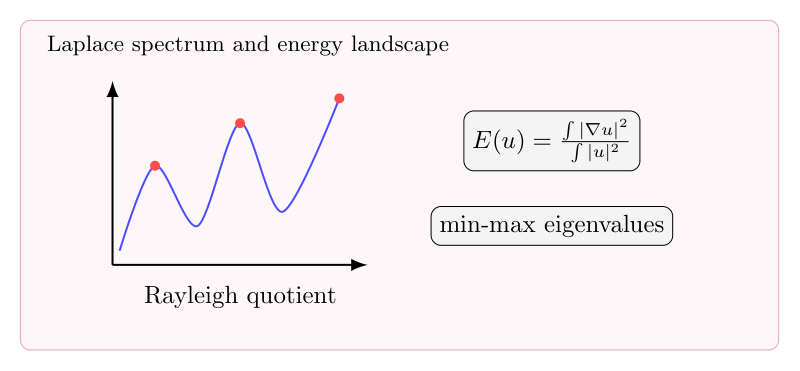
1. Laplace 特征值问题
在紧无边界 Riemannian manifold 上,考虑
$$-\Delta_g u=\lambda u.$$
谱离散,特征值可以排成
$$0=\lambda_0<\lambda_1\le\lambda_2\le\cdots\to\infty.$$
2. Rayleigh quotient
定义
$$E(u)=\frac{\int_M|\nabla u|^2\,dV_g}{\int_M|u|^2\,dV_g}.$$
在 $L^2$ 单位球上,$E$ 的临界点正是 Laplace eigenfunctions。第一非零特征值是与常数正交的函数中 $E$ 的最小值。
3. Min-max principle
第 $k$ 个特征值可由
$$\lambda_k=\inf_{\dim V=k+1}\sup_{u\in V\setminus\{0\}}E(u)$$
给出。这个公式把谱问题转成函数空间中的拓扑/变分问题。
4. 无限维 Morse 图像
在有限维 Morse theory 中,临界点和拓扑变化有关。Laplace 特征函数也可以看成 Rayleigh quotient 的临界点;其 Morse index 与低于该特征值的谱空间维数相关。
5. 与 Weyl law 的关系
Weyl law 告诉我们高能临界点的数量增长率。变分图像解释 eigenfunctions 从哪里来,Weyl law 则解释这些临界点在高频区域有多密。