旧博客原文
原题:Linear to Multi-linear
The technique that transform a problem which is in a linear setting to a multilinear setting is very powerful.
such like:
1.The renormalization technique in complex dynamic system, and the generalization
this is mainly the Ostrowoski representation,and something else.
2.Fouriour analysis
this can be view when it is difficult to investigate a quality about a function 


3.Multi-scales theory
this is used in the improve of Minkowski dimension of 3-dim kakeya set by Katz-Tao.
4.The proof of Bourgain-Sarnak-Ziegler theorem
Theorem(B-S-Z). Let 


Then for N large enough

this theorem is not difficult to prove by bilinear method and Cauchy-Schwarz,you can see the detail in https://arxiv.org/abs/1110.0992v1.
According to this theorem,to get a good approximation of 


5.The multiplier restriction theorem(Tao)
6.Some special construction in additive Combitriocs
Such like when we want to consider some set 


补充说明
以下是新整理的中文说明;上方旧博客原文保持不变。
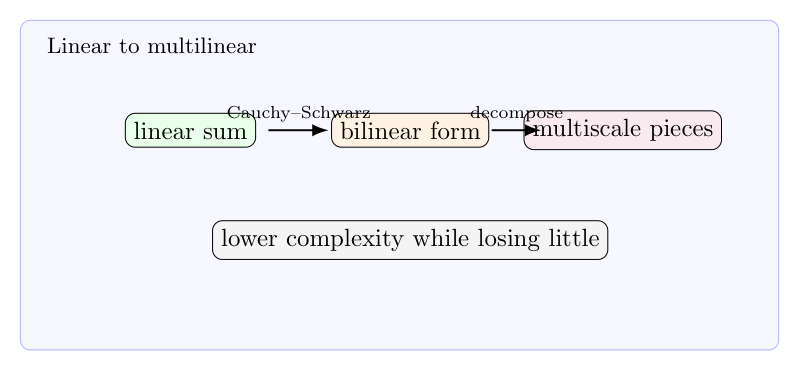
很多问题直接估计一个线性量很难,但把它平方、分解或转成多线性形式后,结构反而清楚。这就是从 linear 到 multilinear 的基本哲学。
1. Cauchy-Schwarz 的真正作用
Cauchy-Schwarz 不只是让估计变粗。好的使用方式是:降低复杂度,同时几乎不损失主要信息。例如
$$\left|\sum_n a_n b_n\right|^2\le \left(\sum_n|a_n|^2\right)\left(\sum_n|b_n|^2\right).$$
如果右边的两个平方和更容易理解,这一步就是有效的。
2. Fourier 分解
在调和分析中,一个函数被切成频率块:
$$f=\sum_\theta f_\theta.$$
线性估计可能无法直接控制 $\sum_\theta f_\theta$,但双线性或多线性估计能利用不同 $\theta$ 之间的 transversal 结构。
3. Multiscale 理论
Kakeya 和 restriction 中,多尺度分解把一个集合或函数切成不同尺度上的 pieces。每一层可能只给出局部信息,但层与层之间的递归关系能产生全局维数或范数估计。
4. BSZ 准则
Bourgain-Sarnak-Ziegler 准则就是线性到双线性的典型例子。要证明
$$\sum_{n\le N}\mu(n)a_n=o(N),$$
可以转而控制
$$\sum_{n\le N}a_{pn}\overline{a_{qn}}$$
对不同素数 $p\ne q$ 的相关。这把乘法函数的线性相关转成序列自身的双线性相关。
5. 方法的边界
多线性化不是免费午餐。右边的量可能更复杂,分解后还要重新 glue 回整体估计。好的多线性方法,总是在“降低复杂度”和“保持信息”之间找到平衡。
发表回复