$SL_2(\mathbb Z)$ 与 congruence subgroups:分式线性作用和 modular curves

旧博客原文

原题:SL_2(Z) and its congruence subgroups

The pdf version is SL_2(Z) and its congruence subgroups.

We know we can always do the following thing:

\displaystyle R\ commutative\ ring \longrightarrow \ "general\ linear\ group" \ GL_2(R) \ \ \ \ \ (1)

Where

\displaystyle GL_2(R):=\{\begin{pmatrix} a & b \\ c & d \end{pmatrix}: det \begin{pmatrix} a & b \\ c & d \end{pmatrix}=R^*, a,b,c,d\in R\} \ \ \ \ \ (2)


Remark 1 Why it is {R^*} but not 1? if it is 1, then the action {R/GL_2(R)} distribute is not trasitive on {R}, i.e. every element in unite group present a connected component

Now we consider the subgroup {SL_2(R)\subset GL_2(R)}.

\displaystyle SL_2(R)=\{\begin{pmatrix} a & b\\ c & d \end{pmatrix}: det \begin{pmatrix} a & b\\ c & d \end{pmatrix}=1, a,b,c,d\in R \} \ \ \ \ \ (3)

We are most interested in the case {R={\mathbb Z}, {\mathbb Z}/n{\mathbb Z}}. So how to investigate {SL_2({\mathbb R})}? We can look at the action of it on something, for particular, we look at the action of it on Riemann sphere, i.e. { \hat {\mathbb C}/({\mathbb R})} given by fraction linear map:

\displaystyle g(z):=\frac{az+b}{cz+d}, g(\infty)=\frac{a}{c} \ \ \ \ \ (4)

Remark 2 What is fraction linear map? This action carry much more information than the action on vector, thanks for the exist of multiplication in {{\mathbb C}} and the algebraic primitive theorem. Due to I always looks the fraction linear map as something induce by the permutation of the roots of polynomial of degree 2, this is true at least for fix points, and could natural extension. So how about the higher dimension generate? consider the transform of {k-1} tuples induce by polynomial with degree {k}?

Remark 3

  1. {SL_2({\mathbb R})/\pm I:=PSL_2({\mathbb R})}, then {PSL_2({\mathbb R}) } action faithful on {\hat C}, i.e. except identity, every action is nontrivial. This is easy to be proved, observed,

    \displaystyle \frac{az+b}{cz+d}=z,\forall z\in \hat{\mathbb C}\Longrightarrow \begin{pmatrix} a & b\\ c & d \end{pmatrix}=\begin{pmatrix} 1 & 0\\ 0&1 \end{pmatrix} or \begin{pmatrix} -1&0\\ 0&-1 \end{pmatrix} \ \ \ \ \ (5)

  2. Up half plane {H} is invariant under the action of {PSL_2({\mathbb R})}, i.e. {\forall g\in PSL_2({\mathbb R})}, {gH=H}. The proof is following,
  3. \displaystyle \begin{array}{rcl} Im(\frac{az+b}{cz+d}) & = & Im(\frac{(az+b)(c\bar z+d)}{|cz+d|^2})\\ & = & Im(\frac{ac|z|^2+bc\bar z+adz+bd}{|cz+d|^2})\\ & > & 0,\ due\ to\ ad=bc+1. \end{array}


Now we focus on {SL_2({\mathbb Z})} or the same,{PSL({\mathbb Z})}. All the argument for {SL_2(R)} make sense for

\displaystyle \Gamma:= SL_2({\mathbb Z}), \bar \Gamma:=SL_2({\mathbb Z})/\pm I \ \ \ \ \ (6)

Fix {N\in {\mathbb N}}, define,

\displaystyle \Gamma(N):=\{\begin{pmatrix} a &b\\ c&d \end{pmatrix}, a,d \equiv 1(mod N), b,c\equiv 0(mod N)\} \ \ \ \ \ (7)

Then {\Gamma(N)} is the kernel of map {SL_2({\mathbb Z})\rightarrow SL_2({\mathbb Z}/n{\mathbb Z})}, i.e. we have short exact sequences,

\displaystyle 0\longrightarrow \Gamma(N)\longrightarrow \Gamma\longrightarrow SL_2({\mathbb Z}/n{\mathbb Z})\longrightarrow 0 \ \ \ \ \ (8)

Remark 4 The relationship of {\Gamma(N)\subset \Gamma} is just like {N{\mathbb Z}+1\subset {\mathbb Z}}.

Definition 1 (Congruence group) A subgroup of {\Gamma} is called a congruence group iff {\exists n\in {\mathbb N}}, {\Gamma(N)\subset G}.

Example 1 We give two examples of congruence subgroups here.

  1. \displaystyle \Gamma_1(N)=\{\begin{pmatrix} 1& *\\ 0 &1 \end{pmatrix} mod N\} \ \ \ \ \ (9)

  2. \displaystyle \Gamma_0(N)=\{\begin{pmatrix} * & *\\ 0 & * \end{pmatrix}mod N\} \ \ \ \ \ (10)


Definition 2 (Fundamental domain)

\displaystyle F=\{z\in H:-\frac{1}{2}\leq Re(z)\leq \frac{1}{2}\ and |z|\geq 1\} \ \ \ \ \ (11)

Now here is a theorem charistization the fundamental domain.

Theorem 3 This domain {F} is a fundamental domain of {\hat {\mathbb H}/({\mathbb R})}

Proof: Ths key point is {SL_2({\mathbb Z})} have two generators,

  1. {\tau_a: z\rightarrow z+a, \forall a\in {\mathbb Z}}.
  2. {s: z\rightarrow \frac{1}{z}}.

Thanks to this two generator exactly divide the action of {\Gamma} on {H} into a lots of scales, then {\Omega} is a fundamental domain is a easy corollary. \Box

Remark 5 This is not rigorous, {H} need be replace by {\hat H}, but this is very natural to get a modification to a right one.

Remark 6 {z_1,z_2\in \partial F} are {\Gamma} equivalent iff {Re(z)=\pm \frac{1}{2}} and {z_2=z_1\pm 1} or if {z_1} on the unit circle and {z_2=-\frac{1}{z_1}}

Remark 7 If {z\in F}, then {\Gamma_z=\pm I} expect in the following three case:

  1. {\Gamma=\pm \{\tau,s\}} if {z=i}.
  2. {\Gamma=\pm\{ I,s\tau, (s\tau)^2\}} if {z=w=-\frac{1}{2}+\frac{\sqrt{-3}}{2}}.
  3. {\Gamma=\pm\{I,\tau s, (\tau s)^2\}} if {z=-\bar w=\frac{1}{2}+\frac{\sqrt{-3}}{2}}.

Where {\tau=\tau_1}.

Remark 8 The group {\bar \Gamma=SL_2({\mathbb Z})/\pm I} is generated by the two elements {s}, {\tau}. In other word, any fraction linear transform is a “word” induce by {s,\tau,s^{-1}.\tau^{-1}}. But not free group, we have relationship {s^2=-I,(s\tau)^3=-I}.

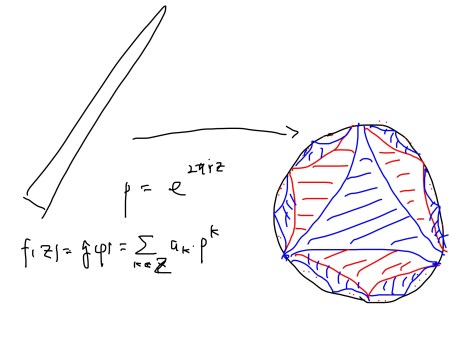
The natural function space on {F} is the memorphic function, under the map: {H\rightarrow D-\{0\}}, it has a {q}-expension,

\displaystyle f(q)=\sum_{k\in {\mathbb Z}}a_kq^k \ \ \ \ \ (12)

And there are only finite many negative {k} such that {a_k\neq 0}.


补充说明

以下是新整理的中文说明;上方旧博客原文保持不变。

$SL_2(\mathbb Z)$ 是 modular forms 和 modular curves 的基本群。它通过分式线性变换作用在上半平面上,而 congruence subgroups 则把模 $N$ 的算术信息放进几何商空间。
$SL_2(\mathbb Z)$ 与 congruence subgroups:分式线性作用和 modular curves
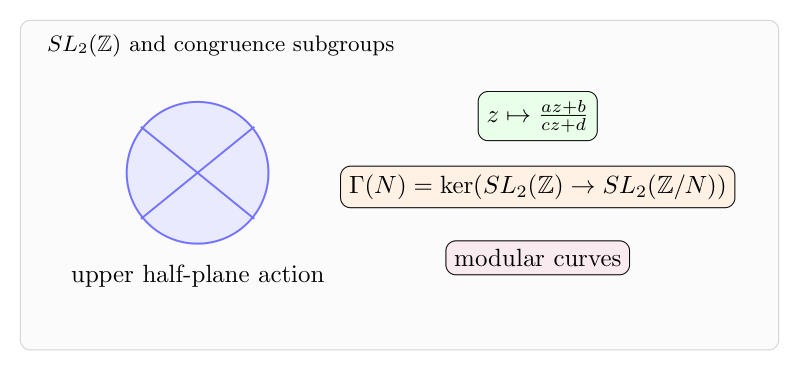
$SL_2(\mathbb Z)$ 通过分式线性变换作用在上半平面,congruence subgroups 对应 modular curves 的 level structure。

1. 分式线性作用

$$\gamma=\begin{pmatrix}a&b\\ c&d\end{pmatrix}\in SL_2(\mathbb Z),$$

定义

$$\gamma z=\frac{az+b}{cz+d}.$$

若 $\operatorname{Im}z>0$,则 $\operatorname{Im}(\gamma z)>0$,所以上半平面 $\mathbb H$ 在作用下不变。

2. 为什么是 $PSL_2$

$I$ 和 $-I$ 给出同一个分式线性变换。因此真正忠实作用的是

$$PSL_2(\mathbb Z)=SL_2(\mathbb Z)/\{\pm I\}.$$

3. Congruence subgroups

主同余子群定义为

$$\Gamma(N)=\ker\bigl(SL_2(\mathbb Z)\to SL_2(\mathbb Z/N\mathbb Z)\bigr).$$

更常见的还有 $\Gamma_0(N)$ 和 $\Gamma_1(N)$,它们分别对矩阵的某些项加模 $N$ 条件。

4. Modular curves

商空间

$$Y(\Gamma)=\Gamma\backslash\mathbb H$$

是 modular curve 的开部分。补上 cusps 后得到紧化 $X(\Gamma)$。不同 congruence subgroup 对应不同 level structure。

5. 算术与几何

$SL_2(\mathbb Z)$ 的作用把矩阵、分式线性变换、椭圆曲线的 level structure 和 modular forms 连接起来。研究 congruence subgroups,就是研究模 $N$ 算术信息如何改变上半平面商的几何。

评论

发表回复

您的邮箱地址不会被公开。 必填项已用 * 标注