分类: Metric entropy

  • Metric entropy(二):entropy map 的上半连续性与 infinity entropy

    旧博客原文

    原题:Metric entropy 2

    I am reading the article “ENTROPY THEORY OF GEODESIC FLOWS”.

    Now we focus on the upper semi-continuouty of the metric entropy map. The object we investigate is (X,T,\mu), where \mu is a T-invariant measure.

    The insight to make us interested to this kind of problem is a part of variational problem, something about the existence of certain object which combine a certain moduli space to make some quantity attain critical value(maximum or minimum). The most simple example maybe Isoperimetric inequality and Dirichlet principle of Laplace. Any way, to establish such a existence result a classical approach is to proof the upper semi-continuouty and bounded for associate energy of the problem. In our case the semi-continuouty will be some thin about the regularity of the entropy map:

    E:M(X,T)\to h_{\mu}.

    We define the entropy at infinity:

    sup_{(\mu_n)}limsup_{\mu_n\to 0}h_{\mu_n}(T)

    Where (u_n)_{n=1}^{\infty} varies in all sequences of measure coverage to 0 in the sense for all A\subset M, A measurable then \lim_{n\to \infty} \mu_{n}(A)=0.

    Compact case

    we say some thing about the compact case, In this case we have finite partition with smaller and smaller cubes, this could be understand as a sequences of smaller and smaller scales. A example to explain the differences is \mathbb N^{\mathbb N},\sigma, shift map on countable alphabet.

    Because of this thing, there is a good sympolotic model, i.e.  h-expension, and it generalization  asymptotically  h-expension equipped on a compact metric space $X$ have been proved to be that the corresponding entropy map is upper semi-continous.

    In particular C^{\infty} diffeomorphisms on compact manifold is asymptotically h-expensive.


    Natural problem but I do not understand very well:

    Why it is natural to assume the measure to be probability measure in the non-compact space?


    Non-compact case

    (X,d) metric space

    T:X\longrightarrow X is a continuous map.

    d_n(x,y)=\sup_{0\leq k\leq n-1}d(T^kx,T^ky), then d_{n} is still a metric.

    Easy to see \frac{1}{n}h_{\mu}(T^n)=h_{\mu}(T). This identity could be proved by the cretition of entropy by \delta-seperate set and \delta-cover set.


    Kapok theorem:

    X compact, for every ergodic measure \mu the following formula hold:

    h_{\mu}(T)=\lim_{\epsilon \to 0}limsup_{n\to \infty}\frac{1}{n}logN_{\mu}(n,\epsilon,\delta).

    Where h_{\mu}(T) is the measure theoretic entropy of \mu.

    Riquelme proved the same formula hold for Lipchitz maps on topological manifold.


    Let M_e(X,T) defined the moduli space of T-invariant portability measure.

    Let M_(X,T) defined the moduli space of ergodic T-invariant probability measure.

    Simplified entropy formula:

    (X,d,T) satisfied simplified entropy formula if \forall \epsilon >0 surfaced small and \forall \delta\in (0,1), \mu\in M _e(X,T).

    h_{\mu}(T)=\limsup_{n\to \infty}\frac{1}{n}log(N_{\mu}(n,\epsilon,\delta)).

    Simplified entropy inequality:

    If \epsilon>0 suffciently small, \mu \in M_{e}(X,T), \delta\in (0,1).

    h_{\mu}(T)\leq \limsup_{n\to \infty}\frac{1}{n}log(N_{\mu}(n,\epsilon,\delta)).

    Weak entropy dense:

    M_e(X,T) is weak entropy dense in M(X,T). \forall \lambda>0, \forall \mu\in M(X,T), \exists \mu_n\in M_e(X,T), satisfied:

    1. \mu_n\to \mu weakly.
    2. h_{\mu_n}(T)>h_{\mu}(T)-\lambda, \forall \lambda>0.


    补充说明

    以下是新整理的中文说明;上方旧博客原文保持不变。

    entropy map 的上半连续性是变分问题中的关键正则性。若想证明某个 invariant measure 使 entropy 或 pressure 达到最大,通常需要紧性和上半连续性。
    Metric entropy(二):entropy map 的上半连续性与 infinity entropy
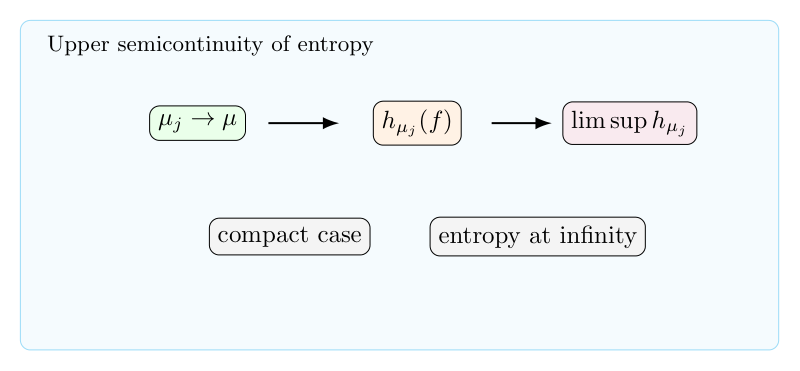
    entropy map 的上半连续性关系到最大熵测度存在性;非紧情形还要控制 entropy at infinity。

    1. Entropy map

    给定动力系统 $f:X\to X$,考虑 invariant measures 空间 $\mathcal M_f(X)$ 上的函数

    $$\mu\mapsto h_\mu(f).$$

    若 $\mu_j\to\mu$ 弱收敛,希望有

    $$\limsup_{j\to\infty}h_{\mu_j}(f)\le h_\mu(f).$$

    这就是上半连续性。

    2. 紧空间情形

    在紧空间上,可以用越来越细的有限 partition 近似 entropy。若系统具有 expansiveness 或 asymptotic h-expansiveness,entropy map 常有较好的上半连续性。

    3. 非紧空间的困难

    非紧空间中,测度可能逃向无穷远。即使 $\mu_j$ 弱收敛到某个极限,entropy 也可能在逃逸部分携带额外信息。这个额外损失可用 entropy at infinity 衡量。

    4. Entropy at infinity

    粗略地说,entropy at infinity 记录所有逃向无穷远的测度序列可能保留的 entropy:

    $$h_\infty=\sup_{\mu_j\to0}\limsup h_{\mu_j}(f).$$

    若 $h_\infty$ 小于系统的 topological entropy,就有机会证明最大熵测度存在。

    5. 几何动力系统中的意义

    在 geodesic flow 中,entropy 与轨道增长、曲率和测地线逃逸相关。上半连续性问题本质上是在问:复杂轨道是否可能全部跑到 cusp 或无穷远处。若不能,就能在内部找到达到最大 entropy 的测度。

  • Metric entropy(一):Ruelle 不等式、Pesin 公式与 Lyapunov 指数

    旧博客原文

    原题:Metric entropy 1

    Some basic thing, include the definition of metric entropy is introduced in my early blog.

    Among the other thing, there is something we need to focus on:

    1.Definition of metric entropy, and more general, topological entropy.

    2.Spanning set and separating set describe of entropy.

    3.amernov theorem:

    h_{\mu}(T)=\frac{1}{n}h_{\mu}(T^n).

    Now we state the result of Margulis and Ruelle:

    Let M be a compact riemannian manifold, f:M\to M is a diffeomorphism and \mu is a f-invariant measure.

    Entropy is always bounded above by the sum of positive exponents;i.e.,

    h_{m}(f)\leq \int_{i}\lambda_i^{+}(x)dimE_i(x)dm(x).

    Where dimE_i(x) is the multiplicity of \lambda_i(x) and a^{+}=max(a,0).

    Pesin show the inequality is in fact an equality if f\in C^2 and m is equivalent to the Riemannian measure on M. So this is also sometime known as Pesin’s formula.

    F.Ledrappier and L.S.Young generate the result of Pesin.

    One of their main result is:

    f:M\to M is a C^2 diffemoephism, where M is a compact riemanian manifold, f is compatible with the Lesbegue measure on M, and

    h_m({f,\mu})=\int_{M}\lambda_idim(V_i)dm

    If and only if on the canonical defined quation manifold $M/W_{\mu}$, i.e. the manifold mod unstable manifold $W_{\mu}$, the induced conditional measure m_{\xi} is absolute continuous.

    Remark: according to my understanding, the equality just mean in some sense we have the inverse estimate:

    h_{m}(f,\mu)\geq \int_{M}\lambda_idim(V_i)dm.

    This result maybe just mean near the fix point of f,i.e. the place charge the topology of the foliation, we have the inverse estimate. Such a inverse estimate will lead a control of the singularity of the push forward measure m_{\xi} on the quation manifold.  So m_{\xi} have good regularity. But this idea is not complete to solve the problem.

    Now we begin to get a geometric explain and which will lead a rigorous proof of the inequality:

    h_{m}(f)\leq \int_{i}\lambda_i^{+}(x)dimE_i(x)dm(x).

    At first we could observe that the long time average \lim_{n\to \infty}\frac{1}{n}log||Df^n|| of Df could be diagonal. Assume after diagonal the eigenvalue is

    \lambda_1\leq \lambda_2\leq \lambda_3\leq...\leq \lambda_{n-1}\leq \lambda_n.

    This eigenvalue could divide into 3 parts: <0,=0,>0.

    This will lead to a direct sum decomposition of the tangent bundle TM:

    TM\simeq E_{u}\otimes E_s\otimes E_c.

    Where $E_u$ is the part corresponding to the eigenvalue>0, For this part we consider the more refinement decomposition:

    E_u=\otimes_{k=1}^rV_k, V_k is the eigenvector space of \lambda_k. The dimension of $V_k$ is $dim V_k$.

    On the other hand, we have a equality of metric entropy:

    h_{m}(f)=\frac{1}{n}h_{m}(f^n)=\sup_{\alpha\in partition \ set}\frac{1}{n}h_m(f^n,\alpha).

    For the later one, \alpha is a measurable partition of M, then \alpha could always be refine to a smaller partition \beta, and we have:

    h_{m}(f,\alpha)\leq h_{m}(f,\beta).

    Now we arrive the central place of the proof:

    every partition could be refine by a partition with boundary of almost all cubes is parallel to the foliation. So  we focus ourselves on the portion \beta and all boundary of cubes in \beta is parallel to the eigenvector.

    Under this situation, we need only estimate the numbers of \vee_{i=1}^nT^i\beta. Estimate it is not very difficult. we need only observe the following two thing:

    1.

    \lim{n\to \infty} exists a.e. in M. So this lead to the definition of foliation almost everywhere, and except a measurable zero set. In fact this set is the set of fix point of M under f.

        2.

    After a rescaling, every point which is not a fix point of f could be understand as it is far away from fix points. Then the foliation could be understand as  a product space locally. The flow with the direction which the eigenvalue is less than 1 cold not change \vee_{i=1}^nT^i\beta. The direction with eigenvalue equal to 1 is just transition and just change the number of \vee_{i=1}^nT^i\beta with polynomial growth. But the central thing is the direction with eigenvalue large than one and will make \vee_{i=1}^nT^i\beta change with viscosity e^{\lambda_i}. and we product it and get :

    h_{m}(f,\mu)\leq \int_{M}\lambda_i dim(V_i)dm.

    In fact the proof only need f to be C^1


    补充说明

    以下是新整理的中文说明;上方旧博客原文保持不变。

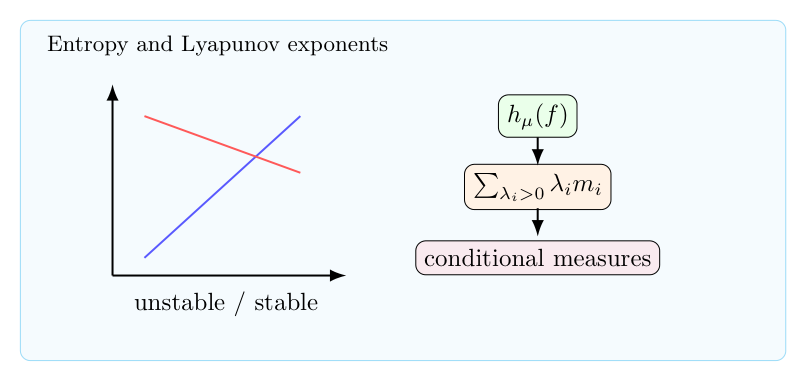
    metric entropy 衡量一个保测动力系统在可测意义下产生信息的速率。对光滑动力系统,它和 Lyapunov exponents 之间有深刻联系:正 Lyapunov 指数给出不稳定方向上的体积增长,而 entropy 记录可区分轨道的增长。

    Metric entropy(一):Ruelle 不等式、Pesin 公式与 Lyapunov 指数
    Ruelle 不等式和 Pesin 公式把 entropy 与正 Lyapunov 指数联系起来。

    1. Entropy 的基本图像

    给定有限 measurable partition $\mathcal P$,Shannon entropy 是

    $$H_\mu(\mathcal P)=-\sum_{A\in\mathcal P}\mu(A)\log\mu(A).$$

    迭代下的平均信息增长定义为

    $$h_\mu(f,\mathcal P)=\lim_{n\to\infty}\frac1n H_\mu\left(\bigvee_{j=0}^{n-1}f^{-j}\mathcal P\right).$$

    再对所有 partition 取上确界,得到 $h_\mu(f)$。

    2. Spanning 与 separating

    拓扑 entropy 可以用 $(n,\varepsilon)$-spanning set 或 separating set 描述。两个点若在前 $n$ 次迭代中始终很近,就被看作同一条轨道影子。entropy 记录为了覆盖所有轨道影子,需要多少个名字。

    这个图像和 metric entropy 的 partition 定义相互对应:一个是拓扑尺度,一个是测度尺度。

    3. Ruelle inequality

    设 $f$ 是紧 Riemannian manifold 上的 $C^1$ diffeomorphism,$\mu$ 是 $f$-invariant measure。Ruelle 不等式说

    $$h_\mu(f)\le \int \sum_{\lambda_i(x)>0}\lambda_i(x)m_i(x)\,d\mu(x).$$

    右端是正 Lyapunov exponents 的总和。直观上,系统能产生的信息不可能超过不稳定方向的体积膨胀能力。

    4. Pesin formula

    在更光滑并且测度与 Riemannian volume 绝对连续的情形,Pesin 公式给出等号:

    $$h_\mu(f)=\int \sum_{\lambda_i(x)>0}\lambda_i(x)m_i(x)\,d\mu(x).$$

    这说明所有不稳定方向上的 expansion 都真正转化成了信息增长,没有被 singular conditional measures 损失掉。

    5. Ledrappier-Young 的视角

    Ledrappier-Young 理论进一步解释等号何时成立:关键在于 unstable foliation 上的 conditional measures 是否绝对连续。若条件测度太奇异,几何膨胀不一定变成可测 entropy;若条件测度足够连续,膨胀就能被 entropy 读出来。

    因此 entropy、Lyapunov exponents 和 foliation 上的条件测度,实际上是同一件事的三个侧面。