旧博客原文
原题:Metric entropy 2
I am reading the article “ENTROPY THEORY OF GEODESIC FLOWS”.
Now we focus on the upper semi-continuouty of the metric entropy map. The object we investigate is 


The insight to make us interested to this kind of problem is a part of variational problem, something about the existence of certain object which combine a certain moduli space to make some quantity attain critical value(maximum or minimum). The most simple example maybe Isoperimetric inequality and Dirichlet principle of Laplace. Any way, to establish such a existence result a classical approach is to proof the upper semi-continuouty and bounded for associate energy of the problem. In our case the semi-continuouty will be some thin about the regularity of the entropy map:

We define the entropy at infinity:

Where 



Compact case
we say some thing about the compact case, In this case we have finite partition with smaller and smaller cubes, this could be understand as a sequences of smaller and smaller scales. A example to explain the differences is 
Because of this thing, there is a good sympolotic model, i.e. h-expension, and it generalization asymptotically h-expension equipped on a compact metric space $X$ have been proved to be that the corresponding entropy map is upper semi-continous.
In particular 
Natural problem but I do not understand very well:
Why it is natural to assume the measure to be probability measure in the non-compact space?
Non-compact case


Easy to see 

Kapok theorem:


Where 
Riquelme proved the same formula hold for Lipchitz maps on topological manifold.
Let 

Let 
Simplified entropy formula:


Simplified entropy inequality:
If 



Weak entropy dense:


weakly.
,
补充说明
以下是新整理的中文说明;上方旧博客原文保持不变。
entropy map 的上半连续性是变分问题中的关键正则性。若想证明某个 invariant measure 使 entropy 或 pressure 达到最大,通常需要紧性和上半连续性。
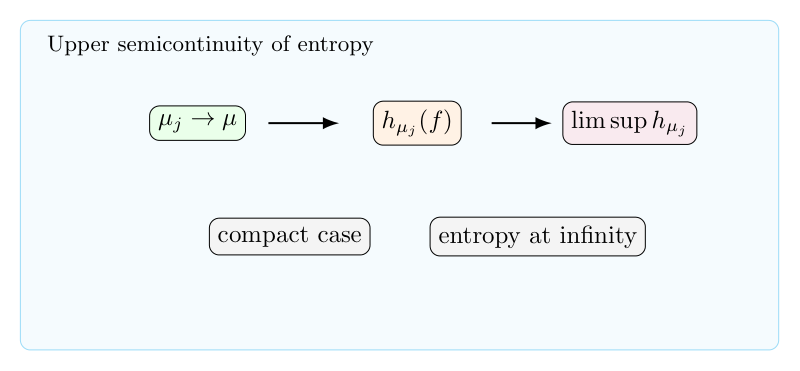
1. Entropy map
给定动力系统 $f:X\to X$,考虑 invariant measures 空间 $\mathcal M_f(X)$ 上的函数
$$\mu\mapsto h_\mu(f).$$
若 $\mu_j\to\mu$ 弱收敛,希望有
$$\limsup_{j\to\infty}h_{\mu_j}(f)\le h_\mu(f).$$
这就是上半连续性。
2. 紧空间情形
在紧空间上,可以用越来越细的有限 partition 近似 entropy。若系统具有 expansiveness 或 asymptotic h-expansiveness,entropy map 常有较好的上半连续性。
3. 非紧空间的困难
非紧空间中,测度可能逃向无穷远。即使 $\mu_j$ 弱收敛到某个极限,entropy 也可能在逃逸部分携带额外信息。这个额外损失可用 entropy at infinity 衡量。
4. Entropy at infinity
粗略地说,entropy at infinity 记录所有逃向无穷远的测度序列可能保留的 entropy:
$$h_\infty=\sup_{\mu_j\to0}\limsup h_{\mu_j}(f).$$
若 $h_\infty$ 小于系统的 topological entropy,就有机会证明最大熵测度存在。
5. 几何动力系统中的意义
在 geodesic flow 中,entropy 与轨道增长、曲率和测地线逃逸相关。上半连续性问题本质上是在问:复杂轨道是否可能全部跑到 cusp 或无穷远处。若不能,就能在内部找到达到最大 entropy 的测度。
发表回复