There are some interesting problem, I post them at there in case I forget them. Excuse me if they are trivial, I have not took enough time to consider them about I think they are valuable to be consider.
Problem 1:
This problem is stated by graph coloring. there are two prat of it, in fact the first part I heard from someone else and I try to generate it to high dimension.
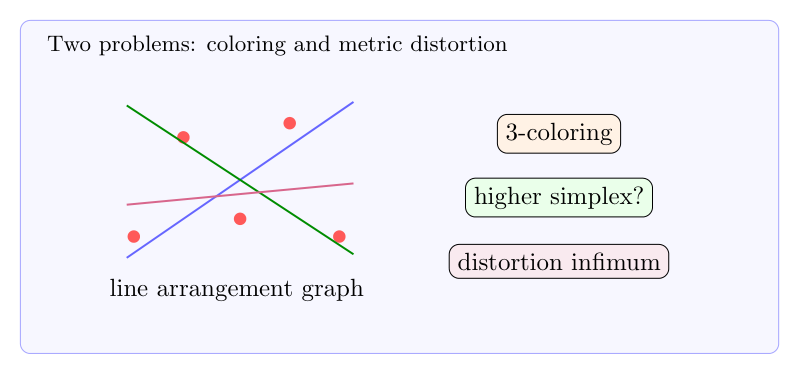
there are finite lines , crossing each other and the is a set of crossing point. for technique reason, assume the position of lines are generic, i.e. no three of them intersect at one point. Then we could use 3 different colors to color make Neighbor points have different color. And to proof 3 is smallest.
generate it to high dimension, to prove case, is the number.
This seems to be a graph problem, but the underlying structure is linear structure and some topological obstacle. I am not very sure. But it seems we can use an energy decrement argument with the obesevation:
The existence of a reasonable definition of “energy of correlation”.
the simplex arrive with the maximum of “correlation energy” in a very symmetric way, and this situation is easy to handle (coloring).
If make sense, this argument could also generate to high dimension.
Problem 2:
Let us consider some example of map between two metric space, a toy model is a line and two parallel lines, I called two parallel lines by , the single line by . The problem is try to find a tuple , where is a metric define on and . such that the distortion of and the standard metric on arrive at a infimum, this of course could not be the case, such like the situation of Yamabe problem on manifold with conners. So, let us ask a more general problem, could we describe the behavior of in some sense? what could we say with this kind of ?
原题:Linear metric on F2, free group with two generator.
I may have made a stupid mistake, but if not, we could construct a metric by pullback a metric on a suitable linear normalized space which we carefully constructed. Let we define the generators of free group by .
Step 1.
Constructed the linear normalized space . the space was spanned by basis , are defined by look at the Cayley graph of , there is a lot of vertical vector and horizontal vector in the Cayley graph, for every level set of vertical vector we put a basis in , because there is only countable many vertical vectors (for example, are in the same vertical level, are in the same vertical level, are not in the same vertical level), we put a basis in for every vertical level and claim we accomplished the construct of , we do the same operation for but only change the vertical level with horizontal level. Now we accomplished the construction of , We spanned this with coefficient and we get a linear space . by Zorn’s lemma there exists a norm on the space, take one norm we accomplished the construction of .
Step 2:
Pullback the norm on to the free group . In fact there is a natural bijection , which is given by following: On the Cayley graph (imaged it is embedding in ), identity in the group corresponding to the original, and more general every element in exactly identify with a point in the Cayley graph, thanks to there is no relation between . And then there is of course infinity many of path from original to the point, but there is only one shortest path , thanks to there is no loop in the Cayley graph. We identify the elements in with the point in Cayley graph with the shortest path. Now we could explain why the path lies . This path only across to finite vertical level and horizontal level and on every level it only pass finite step, this already given a representation , the key point is there is only finite . So we have defined the bijection , and we could use the bijection to pullback the norm on to a norm on .
Step 3:
Now we begin to proof the norm we get by pullback satisfied the condition we need. We need only to proof the condition of linear growth and triangle inequality. The conjugation invariance is automatically by linear growth by the comments of Tobias Fritz. The triangle inequality is automatically, due to the bijection stay the structure in fact, the multiplier of elements could be view as put the two path together but this is not true… merely because of the addition operation is not commutative.
The space we should consider is the path space equipped with the composition operation. I image there exists a “big space” such that the natural metric on the “big space” restrict on the embedding image of is a linear growth metric.
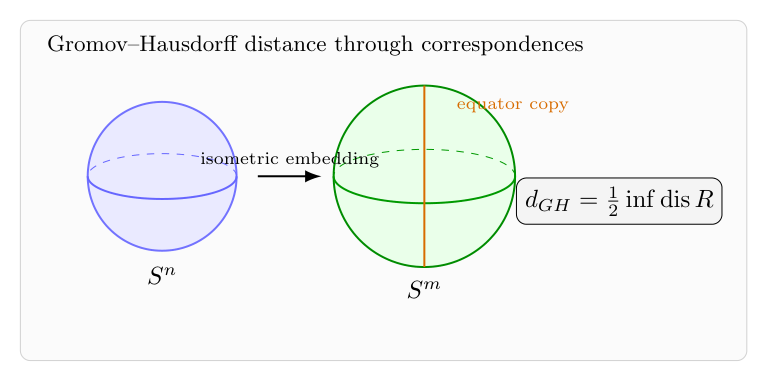
原题:How to compute the Gromov-Hausdorff distance between spheres $latex S_n$ and $latex S_m$?
There is the question, because when we consider the Gromov-Hausdorff distance, we must fix the metric, so we use the natural metric induced from the embedding . Is it possible for us to compute the Gromov-Hausdorff distance for two different spheres and , ?
For example if we want to calculate , where ranges over all possible metric space and and range over all possible isometric (distance-preserving) embeddings.
At least we can embed , into in a canonical way. This will lead to a upper bound: . And in general case we have . But it is difficult to get a lower bound control for me. Because we need to take the inf in all possible metric spaces . Especially I conjecture , where .
I only know the knowledge of Gromov-Hausdorff from Peterson’s Riemann Geometry. Unfortunately there is not enough information to compute the Gromov-Hausdorff distance, so this problem may be very stupid, I will appreciate any pointer.
And we know for the case , if is very near to each other,then the two space should be more near, and there is a canonical embed . So it is natural to conjecture if is very near then the distance is very small. I have a very rough strategy to prove the conjecture, that is inspired by the Nash embedding theorem. I just mean if we consider the problem in this frame then the difficult is the deformation space of is too large. so the first step is to establish a regular lemma, to prove the function is continues under the small perbutation of and reduced to the situation of space $M,g,f$ with very nice regularity. the second part is to embed to a big euclid space as subspace, and the embedding stay the length of geodesic.locally this is determine by a group of pde:,at least in the cut locus.but there should be some critical point,and I do not know how to deal with them.the third,i.e. the last step is to calculate in the very some deformation space .
@Mark Sapir,Appreciate for help!I am reading the article you point out,it seems this article mainly focus on investigating the Gromov-Hausdorff limit space of a sequence of hyperbolic group equipped with modified G-H metric defined in 2.A with some special condition to ensure the limit space exists.and take a sequences corvarage to the limit space,the hyperbolic property and some other thing is stayed by the process of take limit.
@Mark Sapir,So it is natural for us to investigate the original space by some information from the limit space.there is a series of bi-product state in 3.B.but I do not see where the author exactly calculate some groom-hausdorff distance of two different space,may you point out it?appreciate again!
@MarianoSuárez-Álvarez,Corrected, thanks.
Y:
I fixed numerous typos. In particular, you should use spacing after each punctuation mark; capitals to begin sentences and names.
H:
Thank you very much for helping me to correct the mistakes! I will know how to write in a correct style.
Y:
23.1k
Your conjecture would imply that the GH distance is unbounded. But it’s clearly bounded, since the GH distance of any sphere to a point is equal to 2 (when the sphere is endowed with the restriction of Euclidean distance, as you seem to assume, or when endowed with geodesic distance) and hence the GH distance between any two spheres is .
H:
73
You are right,In fact if we use the canonical embed, then we can get by another equivalent definition of GH distance.I confuse the geometry picture of the pairs with the pairs ,for case,I thick the seems correct conjecture will be .
Y:
16:37
Clearly from standard embeddings we get for all . Would it be reasonable to simply conjecture that it’s an equality whenever ?
H:
73
Yeah, you are right, for all .I find the interesting problem when I want to find a toy model of a kind of problem,roughly speaking is to investigate a map from low-dimensions space to high-dimension space stay some affine structure of the low-dimension space . This structure could have some control by the distance function on the low-dimension space, so if we can get some control on the variation of the Energy of distance function, this will share some line on the original problem I consider.
And we know for the case , if is very near to each other,then the two space should be more near, and there is a canonical embed . So it is natural to conjecture if is very near then the distance is very small. .
I have a very rough strategy to prove the conjecture, that is inspired by the Nash embedding theorem. I just mean if we consider the problem in this frame then the difficult is the deformation space of is too large. so the first step is to establish a regular lemma, to prove the function is continues under the small perbutation of and reduced to the situation of space with very nice regularity.
The second part is to embed to a big euclid space as subspace, and the embedding stay the length of geodesic.locally this is determine by a group of pde:,at least in the cut locus.but there should be some critical point,and I do not know how to deal with them.the third,i.e. the last step is to calculate in the very some deformation space .
I need come back to explain why we expect the groom-hausdorff distance should be much small than when is small.
Let consider a toy model of the problem,in a graph model,i.e. now we do not consider to take the Infimum in all space but in discrete space endow with metric. this can be view as a complete graph equipped metric, i.e. . So there is also some space very like ,$S_m$ in the Euclid space, Let remark them as .
, oberseve that then , is a scaling of so it is natural to consider a cut off of ,called which is just a subset of and satisfied if ,then .
Now,in the space let us consider a Distance distribution:. Then this distribution will give us some information of the distance of the two different set in .
(removed)
Now,in the space let us consider a Distance distribution:. Then this distribution will give us some information of the distance of the two different set in .
and obviously we will see that if is close,then the distribution of fuzzy approximation is near, and the reverse is also true. I think this can explain why the conjecture may be right.
, crossing each other and the is a set
of crossing point. for technique reason, assume the position of lines are generic, i.e. no three of them intersect at one point. Then we could use 3 different colors to color
case,
is the number.
, the single line by
. The problem is try to find a tuple
, where
is a metric define on
. such that the distortion of
and the standard metric on
in some sense? what could we say with this kind of

 which we carefully constructed. Let we define the generators of free group
  by
by  .
. ,
,  are defined by look at the Cayley graph of
  , because there is only countable many vertical vectors (for example,
  are in the same vertical level,
  are in the same vertical level,
  are not in the same vertical level), we put a basis in
  but only change the vertical level with horizontal level. Now we accomplished the construction of
  , We spanned this with coefficient
  and we get a linear space
  . by Zorn’s lemma there exists a norm on the space, take one norm
  we accomplished the construction of
  .
. , which is given by following: On the Cayley graph (imaged it is embedding in
  ), identity
  in the group
  , the key point is there is only finite
  . So we have defined the bijection
  , and we could use the bijection to pullback the norm on
  stay the structure in fact, the multiplier of elements
  could be view as put the two path together but this is not true… merely because of the addition operation is not commutative.
 is a linear growth metric.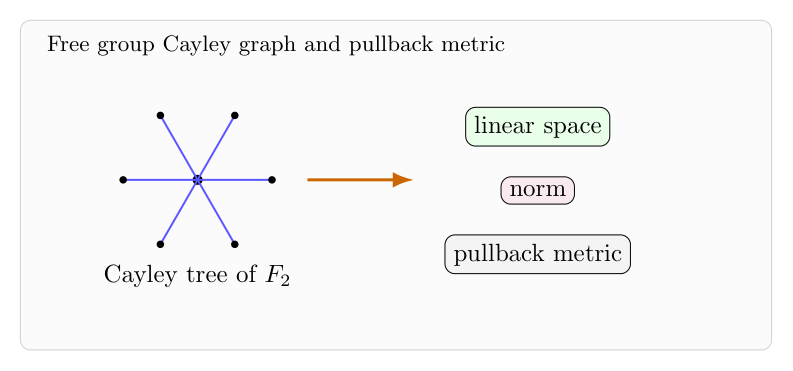
 . Is it possible for us to compute the Gromov-Hausdorff distance
  for two different spheres
  and
and  ,
,  ?
? , where
  ranges over all possible metric space and
  and
and  range over all possible isometric (distance-preserving) embeddings.
 ,
, into
into  in a canonical way. This will lead to a upper bound:
  . And in general case we have
  . But it is difficult to get a lower bound control for me. Because we need to take the inf in all possible metric spaces
  , where
  .
. , if
, if  is very near to each other,then the two space should be more near, and there is a canonical embed
  . So it is natural to conjecture if
  is very near then the distance
  is very small. I have a very rough strategy to prove the conjecture, that is inspired by the Nash embedding theorem. I just mean if we consider the problem in this frame
  then the difficult is the deformation space of
  is too large. so the first step is to establish a regular lemma, to prove the function
  is continues under the small perbutation of
  to a big euclid space
  as subspace, and the embedding stay the length of geodesic.locally this is determine by a group of pde:
 ,at least in the cut locus.but there should be some critical point,and I do not know how to deal with them.the third,i.e. the last step is to calculate
  .
. when endowed with geodesic distance) and hence the GH distance between any two spheres is
  .
. by another equivalent definition of GH distance.I confuse the geometry picture of the pairs
  with the pairs
  .
. for all
  . Would it be reasonable to simply conjecture that it’s an equality whenever
  ?
? for all
  .I find the interesting problem when I want to find a toy model of a kind of problem,roughly speaking is to investigate a map
  from low-dimensions space
  to high-dimension space
  stay some affine structure of the low-dimension space
  should be much small than
  when
when  is small.
 . So there is also some space very like
  ,$S_m$ in the Euclid space, Let remark them as
  .
. then
then  ,
, is a scaling of
  so it is natural to consider a cut off of
  which is just a subset of
  ,then
,then  .
. . Then this distribution will give us some information of the distance of the two different set
  in
in  may be right.
 .
.