旧博客原文
原题:Some interesting problems
There are some interesting problem, I post them at there in case I forget them. Excuse me if they are trivial, I have not took enough time to consider them about I think they are valuable to be consider.
Problem 1:
This problem is stated by graph coloring. there are two prat of it, in fact the first part I heard from someone else and I try to generate it to high dimension.
- there are finite lines
, crossing each other and the is a set
of crossing point. for technique reason, assume the position of lines are generic, i.e. no three of them intersect at one point. Then we could use 3 different colors to color
- generate it to high dimension, to prove
case,
is the number.
This seems to be a graph problem, but the underlying structure is linear structure and some topological obstacle. I am not very sure. But it seems we can use an energy decrement argument with the obesevation:
The existence of a reasonable definition of “energy of correlation”.
the simplex arrive with the maximum of “correlation energy” in a very symmetric way, and this situation is easy to handle (coloring).
If make sense, this argument could also generate to high dimension.
Problem 2:
Let us consider some example of map between two metric space, a toy model is a line and two parallel lines, I called two parallel lines by
, the single line by
. The problem is try to find a tuple
, where
is a metric define on
. such that the distortion of
and the standard metric on
in some sense? what could we say with this kind of
补充说明
以下是新整理的中文说明;上方旧博客原文保持不变。
这里记录两个表面上很初等、但背后可能带有线性结构和拓扑障碍的问题。第一个问题从直线排列的交点染色开始,第二个问题从度量空间之间的最佳畸变开始。它们的共同点是:单纯的图论语言可能太粗,真正控制问题的是隐藏的几何结构。
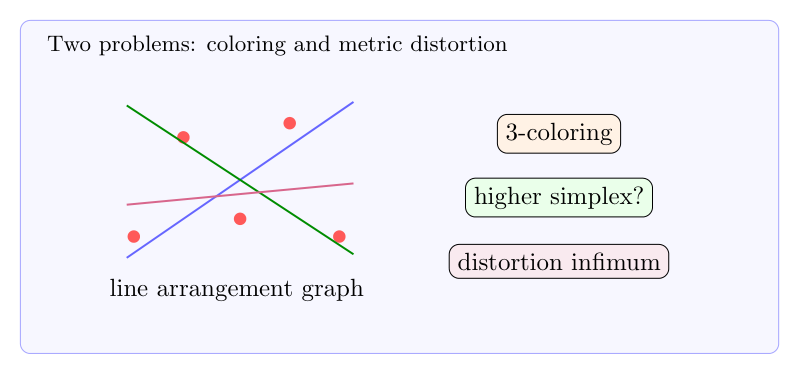
1. 直线排列上的三染色
考虑平面中有限条直线,并假设一般位置:没有三条直线共点。交点构成一个图,若两个交点在同一条直线上相邻,就连一条边。问题是:能否总用三种颜色给交点染色,使相邻交点颜色不同?
三色的必要性很容易从三角形构型看出来;困难在于证明三色总是足够。这个图不是任意平面图,它来自直线的全局排列,因此有额外的线性约束。
2. 高维推广
若把直线换成高维中的超平面,交点换成更高余维的相交胞腔,问题自然变成:需要多少种颜色?猜想的数目应当与单纯形的顶点数有关。
一种可能思路是定义某种“相关能量”。当能量接近最大时,构型应当逼近对称单纯形,而这种对称情形反而容易染色。若能建立能量递降,就可能把一般情形归约到对称模型。
3. 度量畸变问题
第二个问题是:给定一条直线 $L$ 和两条平行线 $L_1\sqcup L_2$,是否可以在两边选择合适度量,使某个自然映射的畸变达到最小?
这有点像带角点流形上的 Yamabe 型问题:最优对象可能不存在,但极小化序列会呈现某种退化形态。于是更合理的问题不是“是否达到最小”,而是“接近最优时几何如何坍缩或分裂”。
4. 可能的共同结构
染色问题和畸变问题都可以看作约束优化:前者优化颜色冲突,后者优化距离拉伸。若存在合适的能量或紧性定理,就能把直觉转化成证明。真正值得追问的是:这些模型中的对称构型是不是唯一的极值障碍。
发表回复