旧博客原文
原题:Symplectic geometry
1. Introduction
This is the first note of a series of notes concert on semiclassical analysis. Given the basic material on symplectic geometry. Including the following material,
- The case at a point, or we can look it as the case in
.
- The standard material in symplectic geometry, i.e. Hamiltonian mechanics, two approach, global one concentrating on lie derivative, and a locally one concentrating on the power of Darboux theorem, i.e. the existence of a canonical coordinate.
- The basic facts on Poission bracket.
- The basic facts on Lagrange sub-manifold, and the involve of Liouville measure.
2. Case of a point, or
Let 

express the trajectory start from 
Remark 1 There
. One the other hand, due to the locally existence theorem of ODE, if the regularity of
is enough, then the solution exist and is uniqueness.
Definition 1
or more convenient
. We call
the flow map or the exponential map generated by
Lemma 2 For flow map, we have following:
for all
.
for all
.
- for each time
, the mapping
is a diffeomorphism with

So it is a group action on 
This lemma is the direct corollary of the theory of ODE.

Now let us special to the case 


Definition 3
in
In a matrix form,
coincide with a
matrix

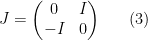
Following lemma given the basic property of 
Lemma 4 The following basic property are true.
,
- the bilinear form
and degenerate, i.e. if
for all
, then
.
,
.

Proof:
- trivial calculate get this.
- trivial.
, by basic linear algebra everything follows.
3. Hamiltonian mechanics
Definition 5 Symplectic form: non-degenerate closed 2 form in a standard coordinate(Darboux coordinate, coordinate like
, map
is an isomorphism.
is called the symplectic form.


There is locally coordinate for 
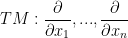

So 

Definition 6 We have the following definition,
- A symplectic manifold is a pair
where
is a smooth manifold and
is an isomorphism,
- If
is symplectic, and
is differentiable, the hamiltonian vector field of
is the field
on
. In other word,
- The flow of


Lemma 7 If
coordinate
and the symplectic form
then,
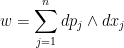
 is differentiable, then the integral curves of

 is a trajectory of the Hamiltonian flow of
Proof: 


Assume 

and also,
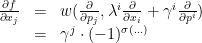
Combine with the definition of integral curve we derive the integral curves of 


Now we begin to proof the Newton second law for the force 
![\displaystyle \begin{array}{rcl} m\overset{\cdot\cdot}x & = & m(\overset{\cdot} {\frac{\partial f}{\partial p}})\\ & = & m\frac{\partial}{\partial t}(\frac{\partial f}{\partial p})\\ & = & m\frac{\partial}{\partial p}[\frac{\partial}{\partial t}(\frac{\|p\|^2}{m}+V(x))]\\ & = & m\frac{\partial }{\partial p}(\frac{2p\overset{\cdot}p}{m}+\frac{\partial V(x)}{\partial x}\cdot \frac{\partial f}{\partial p}) , due\ to \ -\frac{\partial f}{\partial x}=-\frac{\partial V(x)}{\partial x}.\\ & = & m\frac{\partial }{\partial p}(\frac{2p(-\frac{f}{\partial x})}{m}+\frac{\partial V(x)}{\partial x}\cdot \frac{\partial f}{\partial p})\\ & = &-\frac{\partial V(x)}{\partial x} \end{array}](https://s0.wp.com/latex.php?latex=%5Cdisplaystyle+%5Cbegin%7Barray%7D%7Brcl%7D+m%5Coverset%7B%5Ccdot%5Ccdot%7Dx+%26+%3D+%26+m%28%5Coverset%7B%5Ccdot%7D+%7B%5Cfrac%7B%5Cpartial+f%7D%7B%5Cpartial+p%7D%7D%29%5C%5C+%26+%3D+%26+m%5Cfrac%7B%5Cpartial%7D%7B%5Cpartial+t%7D%28%5Cfrac%7B%5Cpartial+f%7D%7B%5Cpartial+p%7D%29%5C%5C+%26+%3D+%26+m%5Cfrac%7B%5Cpartial%7D%7B%5Cpartial+p%7D%5B%5Cfrac%7B%5Cpartial%7D%7B%5Cpartial+t%7D%28%5Cfrac%7B%5C%7Cp%5C%7C%5E2%7D%7Bm%7D%2BV%28x%29%29%5D%5C%5C+%26+%3D+%26+m%5Cfrac%7B%5Cpartial+%7D%7B%5Cpartial+p%7D%28%5Cfrac%7B2p%5Coverset%7B%5Ccdot%7Dp%7D%7Bm%7D%2B%5Cfrac%7B%5Cpartial+V%28x%29%7D%7B%5Cpartial+x%7D%5Ccdot+%5Cfrac%7B%5Cpartial+f%7D%7B%5Cpartial+p%7D%29+%2C+due%5C+to+%5C+-%5Cfrac%7B%5Cpartial+f%7D%7B%5Cpartial+x%7D%3D-%5Cfrac%7B%5Cpartial+V%28x%29%7D%7B%5Cpartial+x%7D.%5C%5C+%26+%3D+%26+m%5Cfrac%7B%5Cpartial+%7D%7B%5Cpartial+p%7D%28%5Cfrac%7B2p%28-%5Cfrac%7Bf%7D%7B%5Cpartial+x%7D%29%7D%7Bm%7D%2B%5Cfrac%7B%5Cpartial+V%28x%29%7D%7B%5Cpartial+x%7D%5Ccdot+%5Cfrac%7B%5Cpartial+f%7D%7B%5Cpartial+p%7D%29%5C%5C+%26+%3D+%26-%5Cfrac%7B%5Cpartial+V%28x%29%7D%7B%5Cpartial+x%7D+%5Cend%7Barray%7D+&bg=ffffff&fg=000000&s=0&c=20201002)
The high dimension case is similar, thanks to the linearity of 
Remark 2 Two make Newton’s second law to be true, the form 6 play a crucial role. Is there some generalization of this type of result to more general case, roughly speaking, it is reasonable to expect this could still be true if the hamiltonian function could be divide into potential energy part and kinetic energy part. And the describe of potential energy part is that it is given by a quadratic form.
Lemma 8 In general, for any Hamilton field
, conservation of energy. In orther word,
, so the Hamiltonian flow of
.
General speaking, to proof a theorem on manifold, there always have two choice, coordinate free proof and proof in a careful choose coordinate. If we choose to believe the Darboux theorem 9 is true, the meaning of it is that locally the symplectic manifold are the same.
Proof: If we believe the Darboux theorem 9 is true. then consider in a standard coordinate 

So of course 

Remark 3 I need more understanding on the lie derivative, see wiki.
Theorem 9 (Darboux theorem) Near any point there exist coordinate:
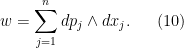
Remark 4 This theorem means there do not exist local invariant in symplectic manifold.
Proof:
\newpage
Theorem 10 If
is any smooth manifold, then its cotangent bundle
has a natural symplectic structure.
Proof: we have local coordinate on 



Remark 5 It need not be the case that
non-degenerate

non-degenerate. This case in the lemma is a example to show that could be the case:
Lemma 11 (The proof of
be local coordinates on
. Define a coordinate system
by the condition:
Prove that in Darboux coordinate,
and therefore
.

Proof:
Theorem 12 Let
be a smooth Riemann manifold and let
be one half of the square of the Riemann norm, so that in local coordinate,
Then the trajectorics of the hamiltonian flow of

Newton’s second law+ energy vanish.
Proof:

So second variation formula describe of geodesic give us the fact that the trajective is geodesic.
Remark 6 We could directly calculate in local coordinate.
4. Poisson brackets


Definition 13 If
, the poisson bracket of

Lemma 14 In canonical (Darboux) coordinate where
, one has,
In particular,
.

Proof:

Theorem 15 If
is a Lie algebra.
Proof: Bilinearty, skew-symmetric come form,


could be proved by calculate under a local coordinate.
补充说明
以下是新整理的中文说明;上方旧博客原文保持不变。
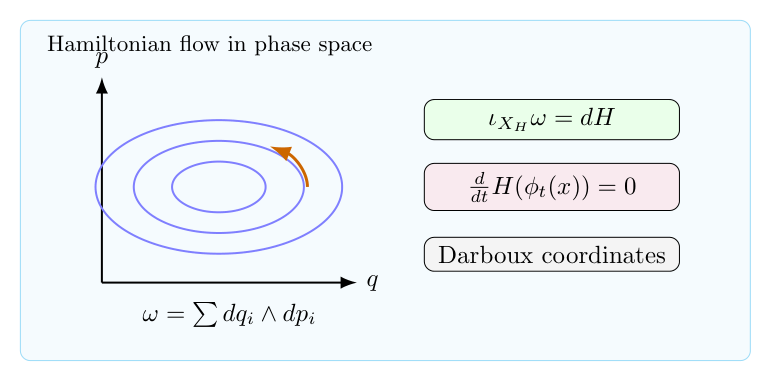
辛几何是半经典分析和 Hamiltonian mechanics 的共同语言。它研究的不是长度和角度,而是相空间中的面积形式、Hamiltonian flow 以及由此产生的守恒结构。这篇笔记从向量场的 flow 开始,逐步进入 symplectic form、Darboux theorem 和 Poisson bracket。
1. 从向量场到 flow
给定光滑向量场 $V$,它生成常微分方程
$$\frac{d}{dt}\phi_t(x)=V(\phi_t(x)),\qquad \phi_0(x)=x.$$
若解存在且唯一,那么 $\phi_t$ 满足群性质
$$\phi_{t+s}=\phi_t\circ \phi_s,\qquad \phi_0=\operatorname{id}.$$
因此一个向量场不仅给出每个点的速度,也给出整个空间上的一参数 diffeomorphism group。
2. 标准相空间
在 Hamiltonian mechanics 中,标准相空间是 $\mathbb R^{2n}$,坐标写成
$$(q_1,\ldots,q_n,p_1,\ldots,p_n),$$
其中 $q$ 是位置,$p$ 是动量。标准 symplectic form 是
$$\omega=\sum_{j=1}^n dq_j\wedge dp_j.$$
它是闭的、非退化的二形式。非退化性意味着每个一形式都可以唯一对应一个向量场。
3. Hamiltonian vector field
给定能量函数 $H$,Hamiltonian vector field $X_H$ 由
$$\iota_{X_H}\omega=dH$$
定义。在标准坐标下,这给出 Hamilton 方程
$$\dot q_j=\frac{\partial H}{\partial p_j},\qquad
\dot p_j=-\frac{\partial H}{\partial q_j}.$$
若 $H(q,p)=\frac12|p|^2+V(q)$,那么 Hamilton 方程化成 Newton 方程
$$\ddot q=-\nabla V(q).$$
所以经典力学可以看成辛几何中的一条 flow。
4. 守恒与 Darboux theorem
Hamiltonian flow 保持能量:
$$\frac{d}{dt}H(\phi_t(x))=dH(X_H)=\omega(X_H,X_H)=0.$$
它也保持 symplectic form,即 $\phi_t^\ast\omega=\omega$。这比保持体积更强,是 Hamiltonian 系统的基本刚性。
Darboux theorem 说,任意 symplectic manifold 在局部都可以选坐标,使得
$$\omega=\sum dq_j\wedge dp_j.$$
这说明辛流形没有类似曲率那样的局部不变量;它的困难主要来自全局拓扑和 Lagrangian 子流形的相互位置。
5. Poisson bracket
两个函数 $f,g$ 的 Poisson bracket 定义为
$$\{f,g\}=\omega(X_f,X_g).$$
在标准坐标下,
$$\{f,g\}=\sum_j\left(\frac{\partial f}{\partial q_j}\frac{\partial g}{\partial p_j}
-\frac{\partial f}{\partial p_j}\frac{\partial g}{\partial q_j}\right).$$
沿 Hamiltonian flow 的演化满足
$$\frac{d}{dt}f(\phi_t(x))=\{f,H\}(\phi_t(x)).$$
这就是从几何到动力系统、再到半经典分析的接口:量子力学里的 commutator 在半经典极限中对应 Poisson bracket。
发表回复