旧博客原文
原题:Isoperimetric inequality
Introduction
the statement go isometry inequality is very simple:


This is a classical problem in variation theory. The difficult is divide into two parts. The first is to create a “flow” which descrement the energy and the “flow” is compatible with the feature of a ball, i.e. every set under the flow will tend to like a “ball”. The second one is to proof there exist a unit in the space 

Combine this two property we can consult that ball is the set and definitely the only set make the
first difficulties
The energy $E(\Omega)$ is scaling invariance. The first difficult could divide into two part:
Restrict to convex set
the first is to deform a set into a convex set and proof this process would not lower

but this process is harder in higher dimension, for example:

Convex set to a ball
Steiner symmetric process.

Affine transform

Minkowski–Steiner formula
In mathematics, the Minkowski–Steiner formula is a formula relating the surface area and volume of compact subsets of Euclidean space. More precisely, it defines the surface area as the “derivative” of enclosed volume in an appropriate sense.
The Minkowski–Steiner formula is used, together with the Brunn–Minkowski theorem, to prove the isoperimetric inequality. It is named after Hermann Minkowski and Jakob Steiner.
Statement of the Minkowski-Steiner formula
Let 


where:

denotes the [[closed ball]] of [[radius]] 

is the [[Minkowski sum]] of $latexA$ and 

Surface measure
For “sufficiently regular” sets 

Convex sets
When the set
:
where the 


:
where 
==Example: volume and surface area of a ball==
Taking 


:
::
::

![= \lim_{\delta \to 0} \frac{[ (R + \delta)^{n} - R^{n} ] \omega_{n}}{\delta}](https://s0.wp.com/latex.php?latex=%3D+%5Clim_%7B%5Cdelta+%5Cto+0%7D+%5Cfrac%7B%5B+%28R+%2B+%5Cdelta%29%5E%7Bn%7D+-+R%5E%7Bn%7D+%5D+%5Comega_%7Bn%7D%7D%7B%5Cdelta%7D&bg=ffffff&fg=5e5e5e&s=0&c=20201002)
where 
The second difficulties
To establish a continue property of the Energy functional 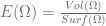
the continuous property is consider with all open set 
We need to proof the continuous of 
To remark,we need to observe that polygon approximation is just corresponding to the 
A second remark, we definitely need a definition of the 
Further remark, isoperimetric inequality is a general phenomenon.
补充说明
以下是新整理的中文说明;上方旧博客原文保持不变。
等周不等式说,在给定体积的集合中,球的边界面积最小。它是变分法、凸几何和几何测度论共同的基本定理。
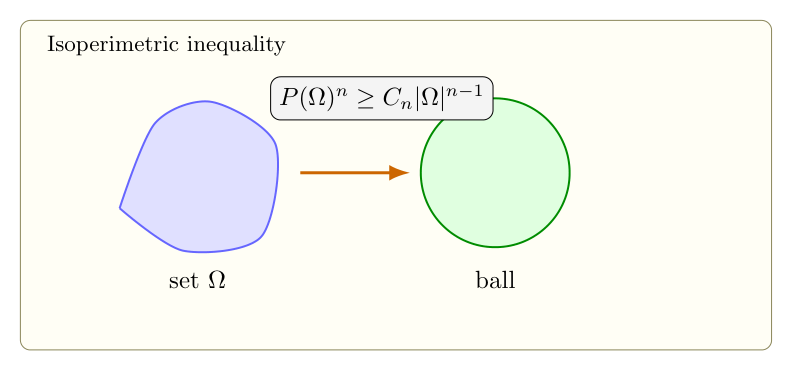
1. 基本陈述
在 $\mathbb R^n$ 中,等周不等式为
$$P(\Omega)^n\ge n^n\omega_n |\Omega|^{n-1},$$
等号当且仅当 $\Omega$ 是球。这里 $P(\Omega)$ 是 perimeter,$\omega_n$ 是单位球体积。
2. 变分图像
一个自然想法是构造能量下降 flow,使任意集合逐渐变圆,并且不增加 perimeter、不改变体积。真正困难在于:一般集合可能很粗糙,flow 的存在性和紧性都需要处理。
3. Steiner 对称化
Steiner symmetrization 沿一个方向把每条平行线上的截面替换成居中的区间。它保持体积,并且不增加 perimeter。重复对称化后,集合越来越接近球。
这提供了一个几何证明路线:先把集合变得越来越对称,再用紧性取极限。
4. Minkowski-Steiner 公式
对足够好的集合,考虑外平行体
$$\Omega_t=\Omega+tB.$$
Minkowski-Steiner 公式把 $|\Omega_t|$ 展开成 $t$ 的多项式,其一次项与 perimeter 相关:
$$\left.\frac{d}{dt}\right|_{t=0}|\Omega+tB|=P(\Omega).$$
配合 Brunn-Minkowski 不等式,可以推出等周不等式。
5. 核心困难
等周问题的困难可以分成两部分:一是证明极小值存在,二是证明极小者只能是球。前者需要紧性和 lower semicontinuity,后者需要对称化、Euler-Lagrange 方程或 Brunn-Minkowski 凹性。
发表回复