旧博客原文
原题:Eloquent theory
Consider matrix ODE:

Where 


Then the solution $\phi(t)$ satisfied identity:

This could be explained as 
Now we consider to solve the equation: 

(Unfortunately 


In fact matrix is not like numbers, the

So to solve 

But this type of identity only meaningful when 


The naive inspirit is wrong, the situation is similar to the 


always holds for 
![log[(1+Y)(1+Y)]=log(1+X)+log(1+Y)](https://s0.wp.com/latex.php?latex=log%5B%281%2BY%29%281%2BY%29%5D%3Dlog%281%2BX%29%2Blog%281%2BY%29&bg=ffffff&fg=5e5e5e&s=0&c=20201002)

![log[(1+X)(1+Y)]=log(1+X+Y+XY)](https://s0.wp.com/latex.php?latex=log%5B%281%2BX%29%281%2BY%29%5D%3Dlog%281%2BX%2BY%2BXY%29&bg=ffffff&fg=5e5e5e&s=0&c=20201002)
even when 


Now it is time to consider the rotation number, which is defined by 

And I do not know how to associated a dynamic system for the matrix
Consider 


Form the map 


By the way this approach wors in 
Maslov index of a holomorphic disk
A natural way to understand the rotation number here is according the way of maslov index, we have the following formula:


Proof sketch:
1.
2. The dynamic system is defined by : 

3. this dynamic system 


If 

This problem is not a good problem due to the philosophy, i.e. use rotation number to describe the information of a hamiltonian flow is not satisfied, in fact it is difficult to establish a suitable definition of “rotation number”! But this is the first crucial thing to establish a theorem!
Hamiltonian flow
In mathematics and physics, a Hamiltonian vector field on a symplectic manifold is a vector field, defined for any energy function or Hamiltonian. A Hamiltonian vector field is a geometric manifestation of Hamilton’s equations in classical mechanics. The integral curves of a Hamiltonian vector field represent solutions to the equations of motion in the Hamiltonian form. The diffeomorphisms of a symplectic manifold arising from the flow of a Hamiltonian vector field are known as canonical transformations in physics and (Hamiltonian) symplectomorphisms in mathematics.[1]
Hamiltonian vector fields can be defined more generally on an arbitrary Poisson manifold. The Lie bracket of two Hamiltonian vector fields corresponding to functions f and g on the manifold is itself a Hamiltonian vector field, with the Hamiltonian given by the Poisson bracket of f and g.
补充说明
以下是新整理的中文说明;上方旧博客原文保持不变。
Floquet theory 研究周期系数线性微分方程
$$\dot x=A(t)x,\qquad A(t+T)=A(t).$$
它告诉我们,周期系统的长期行为由一个周期部分和一个指数部分共同决定。
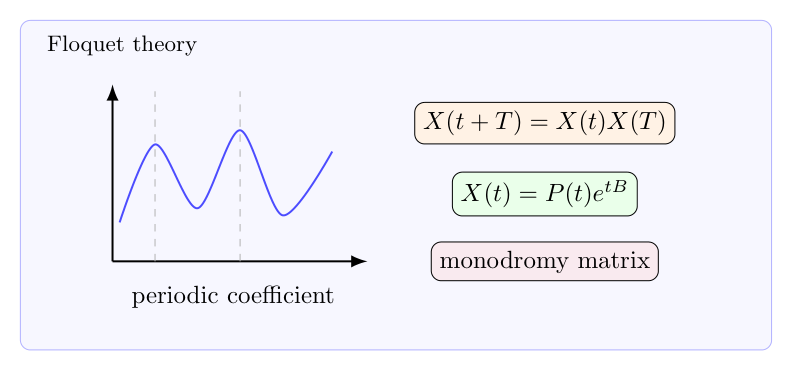
1. 基本解矩阵
令 $X(t)$ 是基本解矩阵,$X(0)=I$。周期性给出
$$X(t+T)=X(t)X(T).$$
矩阵 $X(T)$ 称为 monodromy matrix。它记录系统经过一个周期后的净变化。
2. Floquet 分解
Floquet theorem 说,在复数域上可以写成
$$X(t)=P(t)e^{tB},$$
其中 $P(t+T)=P(t)$,$B$ 是常矩阵。也就是说,周期系统可以拆成周期振荡和指数增长/衰减。
3. 矩阵对数的细节
形式上想令
$$B=\frac1T\log X(T).$$
但矩阵对数是多值的,而且实矩阵上未必能选到实对数。正确表述通常在复数域成立;若要实形式,需要加入额外周期或 Jordan 分解的讨论。
4. 稳定性
monodromy matrix 的特征值称为 Floquet multipliers。若所有 multiplier 的模都小于 $1$,零解渐近稳定;若有模大于 $1$ 的 multiplier,则出现不稳定方向。
5. 与 rotation number 的关系
二维或辛系统中,monodromy 的作用可能诱导圆周或射影线上的动力系统,此时 rotation number 可以描述方向的平均旋转。这把 Floquet theory 和一维动力系统联系起来。
发表回复