旧博客原文
原题:Multiplication function on short interval
The most important beakgrouth of analytic number theory is the new understanding of multiplication function on share interval, this result is established by Kaisa Matomäki & Maksym Radziwill. Two very young and intelligent superstars.
The main theorem in them article is :
Theorem(Matomaki,Radziwill) As soon aswhen
, one has:
for almost all
.
In my understanding of the result, the main strategy is:
Step 1:Parseval indetity, monotonically inequality
Parseval indetity, monotonically inequality, this is something about the 

as a fuzzy thing by a more chargeable quality:

In fact we do a cutoff, the quality we really consider is just:

established the monotonically inequality:

In my understanding, This is a perspective of the quality, due to the quality is a multiplicative function integral on a domain (
But at once we get the monotonically inequality, we could look it as a compactification process and this process still carry most of the information so lead to the inequality.
It seems something similar occur in the attack of the moments estimate of zeta function by the second author. And it is also could be looked as something similar to the spectral decomposition with some basis come from multiplication unclear, i.e. primes.
Step 2: Involved by multiplication property, spectral decomposition
I called it is “spectral decomposition”, but this is not very exact. Anyway, the thing I want to say is that for multiplication function 
Euler-product formula:

But anyway, we do not use the whole power of multiplication just use it on primes, i.e. 

This is a identity about the function 
Step 3:from linear to multilinear , Cauchy schwarz
Now, we do not use one sets 

![[X,2X]=\amalg_{i=1}^n (I_i\times J_i) \amalg U](https://s0.wp.com/latex.php?latex=%5BX%2C2X%5D%3D%5Camalg_%7Bi%3D1%7D%5En+%28I_i%5Ctimes+J_i%29+%5Camalg+U&bg=ffffff&fg=5e5e5e&s=0&c=20201002)
On every 


Now we just use a Cauchy-Schwarz:
\sum_{i=1}^n\int_{I_i\times J_i} \frac{1}{X^2}\int_{|log(X)|^{100}}^{\frac{X}{H}}|\sum_{n\leq X}\lambda(n)n^{it}|^2dt +\int_N |\sum_{n\leq X}\lambda(n)n^{it}|^2dt$
Step 4: major term estimate
step 5:minor term estimate
step 6: estimate the contribution of area which is not filled
补充说明
以下是新整理的中文说明;上方旧博客原文保持不变。
Matomaki-Radziwill 的工作改变了我们对乘法函数短区间平均的理解。它说明,有界乘法函数在几乎所有短区间中的平均,通常接近其长区间平均。
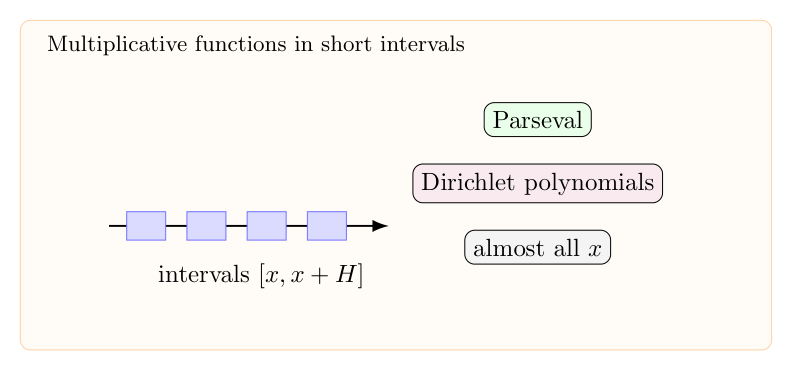
1. 基本问题
设 $f$ 是有界乘法函数。我们关心
$$\frac1H\sum_{x 对多数 $x$ 的行为。传统解析数论更擅长长区间平均,而短区间要求理解局部波动。 粗略地说,只要 $H\to\infty$ 不太慢,对几乎所有 $x\le X$,短区间平均可以由长区间信息控制。这一结果为 Chowla、Sarnak 和 pretentious multiplicative functions 提供了关键输入。 把乘法函数平均转化成 Dirichlet polynomial: $$\sum_{n\le X}\frac{f(n)}{n^{1+it}}.$$ Parseval 型恒等式把短区间均方问题变成 $t$-空间上的积分估计。这是从 additive intervals 进入 multiplicative Fourier analysis 的桥。 证明中需要去掉某些坏尺度,并建立类似单调性的控制:截断后的对象仍然保留主要信息。这个过程有点像 compactification,把原来粗糙的短区间平均换成更可估的频率对象。 短区间乘法函数估计让“乘法随机性”可以在局部尺度上使用。Sarnak 和 Chowla 的许多对数平均进展,都依赖这种把局部平均、Dirichlet polynomial 和 entropy decrement 结合起来的能力。2. Matomaki-Radziwill 定理
3. Dirichlet polynomial 视角
4. Cut-off 与单调性
5. 为什么它重要
发表回复