Fourier restriction problem 的自然性:从 Hausdorff-Young 到曲率

旧博客原文

原题:Natural of the restriction problem


1.

the most natural problem in harmonic analysis may be:

investigate for what pair (p,q) we have :

L^p(R^n)\longrightarrow L^q(R^n)

\hat f(x)=\int_{R^n}e^{-2\pi ix\xi}f(\xi)d\xi

is strong-(p,q) bounded.

obvious we have the paserval identity:||\hat f||_{2}=||f||_2,and we have ||\hat f||_{\infty}\leq||f||_{1}.

so by the Riesz-Thorin inteplotation theorem we have the Hausdorff-Young inequality:

\forall 1\leq p\leq 2,\frac{1}{p}+\frac{1}{q}=1 we have:

||\hat f||_{q}\leq ||f||_{p}.

now let talk about the rescaling trick:

consider the transform:f(x)\longrightarrow f(\frac{x}{\lambda})=f_{\lambda}(x).we know if the inequality is right then it is necessary to have the same growth for the RHS and LHS.

this argument will derive:\frac{n}{p}=n-\frac{n}{q}.

in fact ||f_{\lambda}(x)||_{p}=\lambda^{\frac{n}{p}}||f(x)||_{p}.

by the variable substitute formula:\hat f_{\lambda}(x)=\int_{R^n}e^{-2\pi ix\xi}f(\frac{\xi}{\lambda})d\xi=\lambda^n\hat f(\lambda x).

so ||\hat f_{\lambda}(x)||_{q}=\lambda^{n-\frac{n}{q}}||\hat f(x)||_{q}

and by the scaling invariance trick we know the pair (p,q) should live on the line \frac{1}{p}+\frac{1}{q}=1,and by test with the guessian function g(x)=e^{-x^2} we know the right pair  should be 1\leq p\leq 2.this end the problem with R^n.

2.

now replace R^n by a bounded open set K.when the fourior transform restriction on K is bounded p-q operator?

i.e. L^p(R^n)\longrightarrow L^q(R^n)

f\longrightarrow \hat f|_{K}.

\hat f|_{K}=\int \chi_{K}e^{2\pi i<x,\xi>}f(\xi)d\xi.

on a bounded set K,we always have:if q\geq r,||f||_{L^p(K)}\geq ||f||_{L^r(K)}.

and associate with  hausdorff-young inequality we have:

||\hat f|_K||_{r}\leq ||\hat f||_q\leq ||f||_p.

and this area is the exact area(rescaling trick and test with gaussian function),so end of the story.(but why?)

3.

Now we begin to deal with the really interesting case:K is not a open set but a sub manifold like the unit sphere S^{n-1}.

||\hat f||_{L^q(S^{n-1})}\leq ||f||_{L^p(R^{n})}.

S^{n-1} equip with the usual surface measure \sigma.

but the inequality is not always meaningful.

case:p=2,\hat f\in L^2,in general can not restrict to a measure zero set due to the loss of regularity.

case:p=1,\hat f continuous,meaningful to restrict to S^{n-1}.

||\hat f||_{L^{\infty}(S^{n-1})}\leq ||f||_{L^1(R^n)},\forall 1\leq p\leq \infty.

Duality:we use the duality argument to transform the “restriction theorem” to “extension theorem”.

T:f\longrightarrow \hat f.

T:f\longrightarrow \hat f.

||f||=\sup_{||f||_p=1}||\hat f||_q=\sup_{||f||_p=1}\sup_{||g||_{q'}=1}|\int_{R^n}\hat fgd\sigma|=\sup_{||g||_{q'}=1}\sup_{||f||_p=1}|\int_{R^n}\hat fgd\sigma|=\sup_{||g||_{q'}=1}||\hat{gd\sigma}||_{p'}.

4.

we use R_s(p\to q) to state the estimate ||\hat f||_{L^q(S)}\leq ||f||_{L^p(R^n)}.S=S^{n-1}.

and by rescaling argument we have natural condition:p<\frac{2n}{n-1},p'\geq \frac{n+1}{(n-1)q}.the restriction conjecture just say this necessary condition is also enough.

Now we state the Tomas-Stein restriction theorem:

1\leq p\leq \frac{2n+1}{n+3}.R_s(p\to 2) holds.

this is the endpoint estimate in dimension 2 case,so by Meceztaze interpolation theorem this lead to the whole restriction theorem in dimension 2.

the first argument is come from the so called TT^* trick that is find by fefferman and stein in 1970.

T bdd p\to 2 \Longleftrightarrow TT^* bdd p'\to p.

in fact:

||T||=\sup_{||f||_p=1}||Tf||_2=\sup_{||f||_p=1}\sup_{||g||_2=1}|\int (Tf)g|=\sup_{||f||_p=1}\sup_{||g||_2=1}|\int f(Tg)|=\sup_{||g||_2=1}||Tg||_{p'}=||T^*||.

\int|e^{2\pi ix\xi}f(\xi)|^2 dw(\xi)\leq C||f||_p^2

<\hat f,\hat fw(\xi)>\leq c||f||_p^2

<\hat f,\hat{f*\hat{w(\xi)}}> \leq ||f||_p^2

<f,f*\hat{w(\xi)}>\leq ||f||_p^2

<f,f*\hat{w(\xi)}>\leq ||f||_p||f*\hat{w(\xi)}||_{p'}

this can be derived from HLS inequality:

||f*\hat{w(\xi)}||_{p'}\leq ||f||_p.


补充说明

以下是新整理的中文说明;上方旧博客原文保持不变。

restriction problem 问的是:Fourier transform 能不能有意义地限制到一个测度为零的曲面上?这件事在 $L^1$ 情形是平凡的,在一般 $L^p$ 情形却依赖曲面的曲率和振荡抵消。
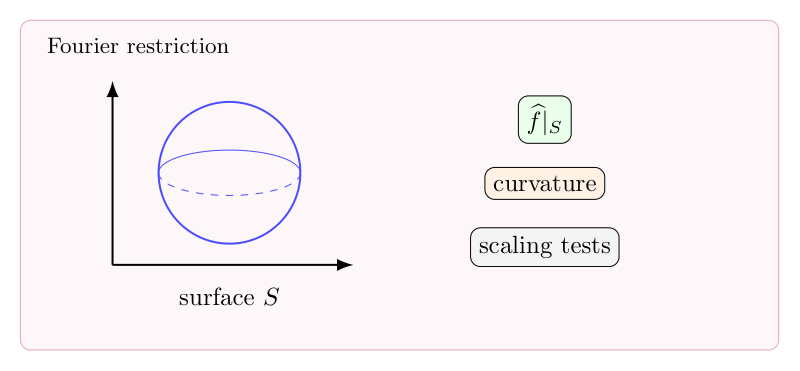
Fourier restriction problem 的自然性:从 Hausdorff-Young 到曲率
restriction problem 的关键是把 Fourier transform 有意义地限制到带曲率的零测曲面上。

1. 从 Hausdorff-Young 开始

Fourier transform 满足 Plancherel

$$\|\widehat f\|_2=\|f\|_2$$

和显然估计

$$\|\widehat f\|_\infty\le \|f\|_1.$$

插值得到 Hausdorff-Young inequality:

$$\|\widehat f\|_{p’}\le C\|f\|_p,\qquad 1\le p\le2.$$

2. 为什么限制到曲面不平凡

若 $S$ 是单位球面,想要估计

$$\|\widehat f|_S\|_{L^q(S)}\le C\|f\|_{L^p(\mathbb R^n)}.$$

因为 $S$ 是测度为零的集合,普通 $L^{p’}$ 控制不能直接给出 restriction。曲率让 Fourier transform 在曲面附近具有额外振荡结构。

3. Scaling test

任何 restriction estimate 必须通过 scaling 检验。用集中在小球或细 tube 上的 test functions,可以得到 $p,q$ 的必要关系。这些反例说明,restriction 问题不是纯函数分析问题,而是几何问题。

4. Extension operator

对偶形式是 extension estimate:

$$Eg(x)=\int_S e^{ix\cdot\xi}g(\xi)\,d\sigma(\xi).$$

它研究曲面上的振荡波如何在物理空间中叠加。曲率越强,波包方向越分散,越可能得到好的估计。

5. 与 Kakeya 的联系

restriction、Kakeya、Bochner-Riesz 和 wave packet decomposition 深度相连。曲面上的频率 cap 对应物理空间中的 tube;估计 extension operator 等价于控制这些 tubes 的重叠。

评论

发表回复

您的邮箱地址不会被公开。 必填项已用 * 标注