旧博客原文
原题:Kakeya Conjecture
Last year I read a nice blog articles Recent progress on the Kakeya conjecture and have several questions with this article.
follows the proof strategy called Multiscale analysis,although we can use the estimate with large 


the new cubes with scale
this type of estimate is easy to attain because it is very similar to the “principle of close packing of spheres”.
in general ,we should not expect this claims:
the new tubes with scales
but if we can proof in some sense most of new tubes comes from this way maybe we can make progress on the original problem.
roughly speaking,we should partition the whole set of 

补充说明
以下是新整理的中文说明;上方旧博客原文保持不变。
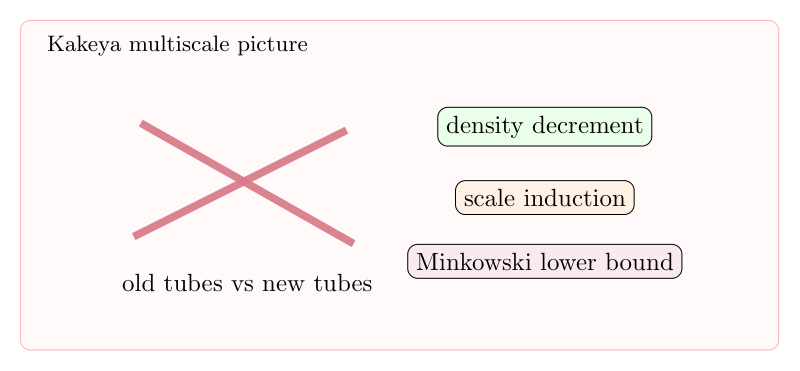
Kakeya 猜想的多尺度分析试图把一个尺度上的 tube 结构传递到更小尺度。真正困难在于:新尺度上的 tubes 不一定整齐地包含在旧 tubes 中,必须区分继承结构和新出现结构。
1. 多尺度想法
设 $E_\delta$ 是 Kakeya set 的 $\delta$-neighborhood。若从尺度 $\delta$ 过渡到更小尺度 $\rho\delta$,希望旧尺度的每个有效 tube 都包含足够多的新尺度结构。
2. 一个理想但错误的图像
最天真的想法是:所有新 tubes 都来自旧 tubes 的细分。若如此,体积下界可以通过 close packing 直接传递。但实际情况中,新 tubes 可能跨越旧结构,产生新的重叠模式。
3. 密度递降
一种策略是把集合分成两类:继承旧结构的部分,以及真正新的部分。前者用尺度归纳处理;后者若太大,则会产生密度递降或结构性矛盾。
4. 与 Katz-Tao 的关系
Katz-Tao 方法中的 multiscale 思想正是利用尺度之间的结构约束。若某个尺度上 tubes 过度集中,会诱导出 additive/multiplicative 结构;sum-product 现象阻止这种结构无限持续。
5. 关键问题
多尺度方法的核心不是简单地把 tubes 变细,而是证明大部分新结构可以被旧结构解释;无法解释的部分必须带来额外 expansion。这个二分是 Kakeya 维数改进中的基本逻辑。
发表回复