分类: Kakeya conjecture

  • Wolff 的 Kakeya maximal estimate:X-ray 估计与三维障碍

    旧博客原文

    原题:Kakeya conjecture (Tomas Wolff 1995)

    There is a main obstacle to improve the kakeya conjecture,remain in dimension 3,and the  result established by Tomas Wolff in 1995 is almost the best result in R^3 even until now.the result establish by Katz and Tao can be view as a corollary of Wolff’s X-ray estimate.

    For f\in L_{loc}^1(R^d),for 0<\delta<1:

    f_{\delta}^*:P^{d-1}\longrightarrow R.f_{\delta}^*(e)=\sup_{T}\frac{1}{|T|}\int_{T}|f|.

    T is varise in all cylinders with length 1.radius \delta.axis in the e direction.

    f_{\delta}^{**}:R^d\longrightarrow R.f^{**}_{\delta}(x)=sup_{T}\frac{1}{|T|}\int_{T}|f|.

    T varise in cylinders contains x,length 1,radius \delta.

    Keeping this two maximal function in mind,we give the statement of the Kakeya maximal function conjecture:

    ||M_{\delta}f||_d\leq C_{\epsilon} \delta^{-\epsilon}||f||_d

    Where M_{\delta}=f_{\delta}^* or M_{\delta}=f_{\delta}^{**}.

    Because we have the obviously 1-\infty estimate:

    ||f^*_{\delta}||_{\infty}\leq\frac{||f||_1}{|T|}=\delta^{1-d}||f||_1.

    ||f^{**}_{\delta}||_{\infty}\leq\frac{||f||_1}{|T|}=\delta^{1-d}||f||_1.

    So by the Riesz-Thorin interpolation we have:

    ||M_{\delta}f||_{q}\leq C_{\epsilon}\delta^{-(\frac{d}{p}-1+\epsilon)}||f||_p.           (*)

    for 1\leq p\leq d,q\leq(d-1)p'.the task is establish (*) for (p,q) as large as posible in the range.

    for the 2 dimension case,the result is well know.the key estimate is:

    \sum_{j}|T_i\cap T_j|\leq log(\frac{1}{\delta})|T_i|

    for d\geq 3 case,the main result of Wolff is:

    ||M_{\delta}f||_q\leq C_{\epsilon}\delta^{-(\frac{d}{p}-1+\epsilon)}||f||_p

    hold for p=\frac{d+2}{2}.q=(d-1)p'. M_{\delta}=f_{\delta}^* or f_{\delta}^{**}.

    Now we sketch the proof.

    prove f_{\delta}^*,f_{\delta}^{**} cases together.

    We can make some reduction:

    the first one is we can assume the sup of f is in a fix compact set.

    the second is instead of consider f_{\delta}^{**},we can consider f_{\delta}^{***}(x)=\sup_{T}\frac{1}{|T|}\int_T|f|.

    where T varies in all cylinder with radius \delta,length 1,axis \frac{\pi}{100} with a fix direction.

    the first reduction is obvious(why?)

    the second reduction rely on a observe:

    ||f_{\delta}^{***}||_q\leq A(\delta)||f||_p          \Longrightarrow    ||f_{\delta}^{**}||_q\leq CA(\delta)||f|_p

    this is just finite cover by rotation of the coordinate and triangle inequality.

    now we begin to establish a frame and put the two situations f_{\delta}^*,f_{\delta}^{***} into it.

    Let M(d,1) be all line in R^d.

    then M(d,1)=R^d\times S^{d-1}/\sim is a 2d-2 dim manifold.

    M(d,1)\longrightarrow P^{d-1}

    l \longrightarrow  e_l

    e_l is the line parallel to l.and the middle point is original.

    dist(l_1,l_2)\sim \theta(l_1,l_2)+d_{mis}(l_1,l_2).


    Wolf axiom:

    (A,d) metric space.

    \mu(D(\alpha,\delta)) \sim \delta^m.\alpha\in A.\delta \leq diam(A).

    for certain m\in R^+.

    \forall \alpha\in A.F_{\alpha} \subset M(d,1) is given.and \bar{\cup_{\alpha}F_{\alpha}} is compact.

    d(\alpha,\beta)\lesssim inf_{l\in F_{\alpha};m\in F_{\beta}}dist(l,m) for all \alpha,\beta \in A.

    If f:R^d\longrightarrow R then we define M_{\delta}f:A\longrightarrow R by

    M_{\delta}f(\alpha)=\sup_{l\in F(\alpha)}\frac{1}{|T_{l}^{\delta}|}\int_{|T^{\delta}_l|}|f|.

    Property (**):

    If l_0\in \cup_{\alpha F_{\alpha}}. \Pi is a 2-plane.containing l_0and if \sigma \geq \delta and if \{\alpha_j\}_{j=0}^N is a \delta-seperated subset of A and for each j,there is l_j\in F_{\alpha_j} with dist(l_j,M(\Pi,l))<\delta and dist(l,l_0)<\sigma.then

    N\leq \frac{C\sigma}{\delta}


    补充说明

    以下是新整理的中文说明;上方旧博客原文保持不变。

    Wolff 1995 年的 Kakeya maximal estimate 是三维 Kakeya 理论中的经典结果。它把 tubes 的重叠问题转化为 maximal function 和 X-ray transform 的估计。
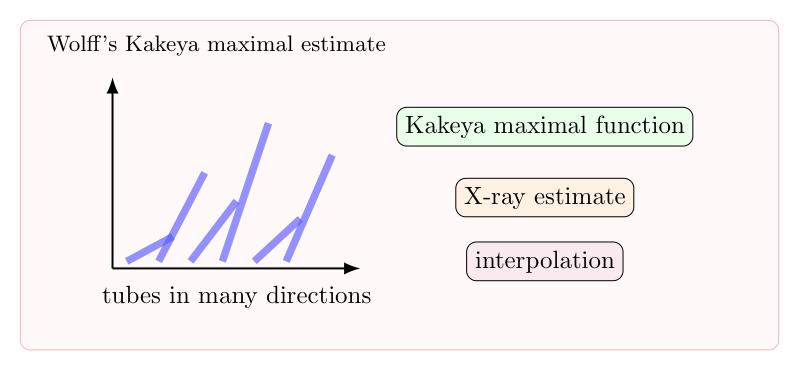
    Wolff 的 Kakeya maximal estimate:X-ray 估计与三维障碍
    Wolff 的 Kakeya maximal estimate 通过 X-ray 型平均和 incidence 几何控制 tubes 的重叠。

    1. Kakeya maximal function

    给定方向 $\omega$,考虑沿 $\omega$ 方向、半径 $\delta$、长度 $1$ 的 tube。Kakeya maximal function 粗略写为

    $$f_\delta^\ast(\omega)=\sup_{T\parallel\omega}\frac1{|T|}\int_T |f(x)|\,dx.$$

    猜想要求在尽可能大的 $p$ 范围内控制 $\|f_\delta^\ast\|_{L^q(S^{n-1})}$。

    2. 平凡估计与插值

    最直接的 $L^1$ 或 $L^\infty$ 估计通常太弱。通过 Riesz-Thorin interpolation 可以得到一些中间结果,但要接近 Kakeya 猜想,需要利用 tubes 的几何排列。

    3. X-ray transform

    X-ray transform 沿直线积分函数。Kakeya maximal function 可以看作对有限厚度 tubes 的 X-ray 型平均。Wolff 的估计用几何 incidence 控制这些平均的重叠。

    4. 归约步骤

    证明中可以把 tubes 限制在固定紧区域,并把方向分成有限个坐标 patch。这样 maximal function 可由有限方向族上的 tube averages 控制。

    5. 三维障碍

    三维最大的困难是 tubes 可以形成复杂 ruled surface 或 hairbrush 结构,普通 pairwise intersection 估计不够。Wolff 的结果抓住了这类结构的第一层几何约束,为 Katz-Tao 的后续改进提供了基础。

  • 三维 Kakeya 猜想:hairbrush、密度递降与 Katz-Tao 思路

    旧博客原文

    原题:Kakeya conjecture in R^3

    Kakeya conjecture in R^3 is very subtle.in fact wolff stay the best(but not very difficult to get,just use the structure so-called hairbrush)result \frac{5}{2} until the result of Katz and Tao \frac{5}{2}+\epsilon.Where \epsilon is a constant independent with kakeya set.and in the article of Tao,they proved \epsilon>\frac{1}{10^{10}}.

    Two-dimensional case

    first we overview the case of dimension 2,these is the only case that is proved.and the key point is the estimate:

    \mu(T_{i}\cap (\cup_{j\in I,j\neq i}T_j))<log(\frac{1}{\delta})\mu(T_i).

    where T_i=T_i(x_i,\theta_i) satisfied \cap_{i\in I}T_i is a \delta-neibeihood of kakeya set X.to remember one thing:this is equivalent to the maximal function version of kakeya conjecture,but for the minkoski version,there is a extra structure for the group I_{\delta} in different scales(this can be view as a multi-scale apporoach).

    this inequality is easy to proof.just observed that \mu(T_i\cap T_j)\sim \frac{1}{\theta_i-\theta_j}\delta^2.and to remember one thing:the inequality can be view as a uniformly estimate of overlap of the kakeya set,that is just mean the overlap would not concentrate to much at a lonely stick.this is enough to get a proof of the 2 dimension case just by a density decrement trick:we just not consider about the whole set I,but a low density subset \hat I\subset I,where \frac{|\hat I|}{|I|}\sim \delta^{\lambda},and make \lambda\to 0^+.

    Kakeya estimates

    Let \sigma\leq \delta\leq \theta<<1,and let T_{\delta} be a collection of \delta-tubes.whose set of directions all lie in a cap of radius \theta. Let 2<d<3 be fixed.
    • If we have a Kakeya estimate at some dimension d, and if the collection     T_{\delta} is direction-separated, then


    ||\sum_{i\in I}\chi_{T_i}||_{d'}\lesssim \delta^{\frac{d-3}{d}}\theta^{\frac{d+1}{d}}(1)
    • If we have an X-ray estimate at some dimension d, and if T_{\delta} consists ofessentially distinct tubes, then


     ||\sum_{i\in I}\chi_{T_i}||_{d'}\lesssim \delta^{\frac{d-3}{d}}\theta^{\frac{d+1}{d}}m^{1-\beta}
    for some β > 0, where m is the directional multiplicity of T_{\delta}.(2)

    So obviously the X-ray estimate is stronger than the kakeya estimate.it is just give the information of the overlap of the sticks with the same direction.

    in fact wolff have establish the X-ray estimate at dimension \frac{5}{2},so (2) just come from a rescaling argument.

    The sticky reduction

    renormalization process,just consider the process to make the thin sticks to be fat.and to proof this structure nearly has Markov property.but with a very small error term when change the scale.this is proved by the X-ray estimate.

    Triple intersection estimate

    Use Hardy-Litterwood-Soblev inequality,we can get a so called triple intersection estimate in general,said the triple intersection is smaller than the situation the 3 lines move together.and we just accosiate this to the cap-cup principle to get some information of the volume of X_{\delta}=\mu(\cup_{i\in I}T_i).img_0012

    Reduce to additive combination problem

    The right problem is just you have a n\times n cubes,and there is some sticks according them,if the distance of sticks is
    img_0011


    补充说明

    以下是新整理的中文说明;上方旧博客原文保持不变。

    Kakeya 猜想问:包含每个方向单位线段的集合是否必须有 full Hausdorff 或 Minkowski dimension?二维情形已经解决,三维情形则出现了 hairbrush、multiscale 和 sum-product 等深层结构。

    三维 Kakeya 猜想:hairbrush、密度递降与 Katz-Tao 思路
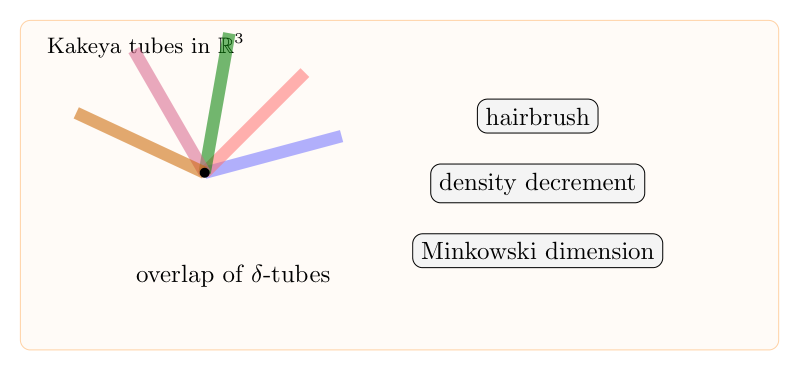
    三维 Kakeya 问题的困难来自不同方向细 tubes 的高重叠结构。

    1. Tube formulation

    令 $E_\delta$ 是 Kakeya set 的 $\delta$-neighborhood。Minkowski 维数问题等价于估计

    $$|E_\delta|\gtrsim_\varepsilon \delta^{\varepsilon}$$

    在合适维数归一化下的下界。更常用的语言是研究方向分离的 $\delta$-tubes 的重叠。

    2. 二维情形

    二维中,任意两个不同方向 tubes 的交叠容易控制。核心估计可以理解为:重叠不能集中在一根孤立 tube 附近。由此配合 density decrement,可推出二维 Kakeya 集合有 full dimension。

    3. Hairbrush 结构

    三维中,许多 tubes 可以围绕一根 tube 形成 hairbrush。Wolff 的观察是:如果很多 tubes 都与一根 tube 相交,那么它们的方向和位置仍然受到几何限制。这给出非平凡维数下界。

    4. Multiscale 难点

    Minkowski 版本比单尺度 maximal function 更微妙,因为不同尺度之间的结构会相互传递。一个尺度上的高重叠可能在下一尺度分裂,反过来又影响全局维数。

    5. Katz-Tao 方向

    Katz-Tao 的改进把 Kakeya 问题与 sum-product 现象联系起来。大致图像是:若 tubes 太集中,会诱导出同时具有加法和乘法结构的集合;sum-product 阻止这种集合太小。这是三维 Kakeya 后续发展的关键思想。

  • Kakeya 猜想的多尺度分析:旧 tubes、新 tubes 与密度递降

    旧博客原文

    原题:Kakeya Conjecture

    Last year I read a nice blog articles Recent progress on the Kakeya conjecture and have several questions with this article.

    follows the proof strategy called Multiscale analysis,although we can use the estimate with large \delta_1 to get estimate with small \delta_2,(may be loss some \delta^c in the inequality in this way),but the main difficult is we should proof the new tubes with scales \delta_2 is contains in the the olders.as soon as we proof this ,to obtain a lower bound of minkwoski dimension with kakeya set, suffice to get following estimate :
    the new cubes with scale \delta_2 contains a positive constants volumes of every old cubes with scale \delta_1.
    this type of estimate is easy to attain because it is very similar to the “principle of close packing of spheres”.

    in general ,we should not expect this claims:
    the new tubes with scales \delta_2 is contains in the the older.

    but if we can proof in some sense most of new tubes comes from this way maybe we can make progress on the original problem.

    roughly speaking,we should partition the whole set of T_{\delta} into two part,comes from old ones or not,for the first kind i.e contains in a old one,use the way explained above to treat.the second kind we need to proof the influence is very some or we can sometimes use the cubes from the first kind to instead the cubes from second kind and the measure of |A|_{\delta} change little.


    补充说明

    以下是新整理的中文说明;上方旧博客原文保持不变。

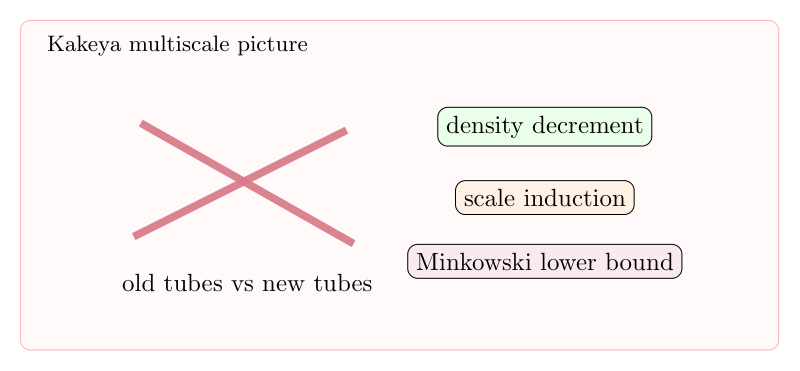
    Kakeya 猜想的多尺度分析试图把一个尺度上的 tube 结构传递到更小尺度。真正困难在于:新尺度上的 tubes 不一定整齐地包含在旧 tubes 中,必须区分继承结构和新出现结构。

    Kakeya 猜想的多尺度分析:旧 tubes、新 tubes 与密度递降
    Kakeya 多尺度分析的关键是判断小尺度 tubes 中哪些继承自旧尺度,哪些带来新结构。

    1. 多尺度想法

    设 $E_\delta$ 是 Kakeya set 的 $\delta$-neighborhood。若从尺度 $\delta$ 过渡到更小尺度 $\rho\delta$,希望旧尺度的每个有效 tube 都包含足够多的新尺度结构。

    2. 一个理想但错误的图像

    最天真的想法是:所有新 tubes 都来自旧 tubes 的细分。若如此,体积下界可以通过 close packing 直接传递。但实际情况中,新 tubes 可能跨越旧结构,产生新的重叠模式。

    3. 密度递降

    一种策略是把集合分成两类:继承旧结构的部分,以及真正新的部分。前者用尺度归纳处理;后者若太大,则会产生密度递降或结构性矛盾。

    4. 与 Katz-Tao 的关系

    Katz-Tao 方法中的 multiscale 思想正是利用尺度之间的结构约束。若某个尺度上 tubes 过度集中,会诱导出 additive/multiplicative 结构;sum-product 现象阻止这种结构无限持续。

    5. 关键问题

    多尺度方法的核心不是简单地把 tubes 变细,而是证明大部分新结构可以被旧结构解释;无法解释的部分必须带来额外 expansion。这个二分是 Kakeya 维数改进中的基本逻辑。