旧博客原文
原题:Kakeya conjecture in R^3
Kakeya conjecture in 


Two-dimensional case
first we overview the case of dimension 2,these is the only case that is proved.and the key point is the estimate:

where 


this inequality is easy to proof.just observed that 


Kakeya estimates
Let 


• If we have a Kakeya estimate at some dimension d, and if the collection 

• If we have an X-ray estimate at some dimension d, and if
for some β > 0, where m is the directional multiplicity of

So obviously the X-ray estimate is stronger than the kakeya estimate.it is just give the information of the overlap of the sticks with the same direction.
in fact wolff have establish the X-ray estimate at dimension
The sticky reduction
renormalization process,just consider the process to make the thin sticks to be fat.and to proof this structure nearly has Markov property.but with a very small error term when change the scale.this is proved by the X-ray estimate.
Triple intersection estimate
Use Hardy-Litterwood-Soblev inequality,we can get a so called triple intersection estimate in general,said the triple intersection is smaller than the situation the 3 lines move together.and we just accosiate this to the cap-cup principle to get some information of the volume of 

Reduce to additive combination problem
The right problem is just you have a 

补充说明
以下是新整理的中文说明;上方旧博客原文保持不变。
Kakeya 猜想问:包含每个方向单位线段的集合是否必须有 full Hausdorff 或 Minkowski dimension?二维情形已经解决,三维情形则出现了 hairbrush、multiscale 和 sum-product 等深层结构。
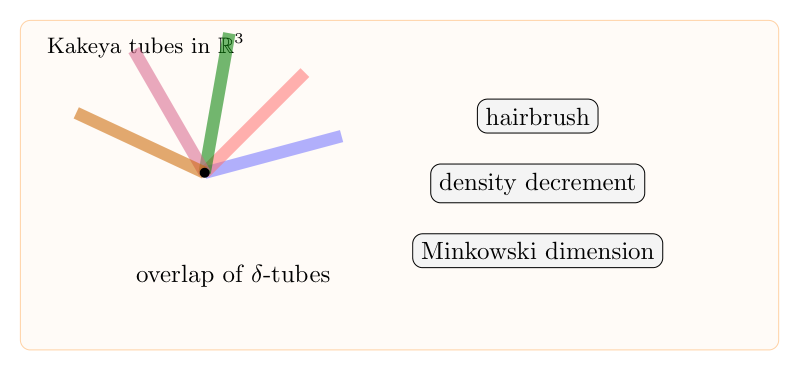
1. Tube formulation
令 $E_\delta$ 是 Kakeya set 的 $\delta$-neighborhood。Minkowski 维数问题等价于估计
$$|E_\delta|\gtrsim_\varepsilon \delta^{\varepsilon}$$
在合适维数归一化下的下界。更常用的语言是研究方向分离的 $\delta$-tubes 的重叠。
2. 二维情形
二维中,任意两个不同方向 tubes 的交叠容易控制。核心估计可以理解为:重叠不能集中在一根孤立 tube 附近。由此配合 density decrement,可推出二维 Kakeya 集合有 full dimension。
3. Hairbrush 结构
三维中,许多 tubes 可以围绕一根 tube 形成 hairbrush。Wolff 的观察是:如果很多 tubes 都与一根 tube 相交,那么它们的方向和位置仍然受到几何限制。这给出非平凡维数下界。
4. Multiscale 难点
Minkowski 版本比单尺度 maximal function 更微妙,因为不同尺度之间的结构会相互传递。一个尺度上的高重叠可能在下一尺度分裂,反过来又影响全局维数。
5. Katz-Tao 方向
Katz-Tao 的改进把 Kakeya 问题与 sum-product 现象联系起来。大致图像是:若 tubes 太集中,会诱导出同时具有加法和乘法结构的集合;sum-product 阻止这种集合太小。这是三维 Kakeya 后续发展的关键思想。
发表回复