旧博客原文
原题:Weyl law
In 1911 year, when Weyl is a young mathematician specticlizing in integrable system and PDE, He proved the important result about the asystomztion of eigenvalues of Dirichelet problem in 

Which in fact is a conjecture of *** in *** in published in 1910.
This is definitely a very amazing achievement of mathematician, The realist meaning we can actually charge with the spectrum asyspesion.
In fact, we know, the only thing we know is that the eigenfunction with different spectrum is orthogonal and we have are a cretition named maximum-minmum principle for the k eigenvalue. but how could we charge with the asymotum of them? It seems not to be chargeable, though we have a 
Yes, We can just look this phenomenon as there are two different world, one is the real world in the Ecliud space, there other is the a wave function world, in the second world it is composted by the unique of the solution 


Now let us see what is it, it is just need to be compatible with the boundary condition, so it need to be moduli space that the boundary map is a measure that is arrive able by only affine translation of the function (we look it as a obsevalbel) So it is a restriction from a high dimensional space to the boundary of it. and very fortunately it could assume a
补充说明
以下是新整理的中文说明;上方旧博客原文保持不变。
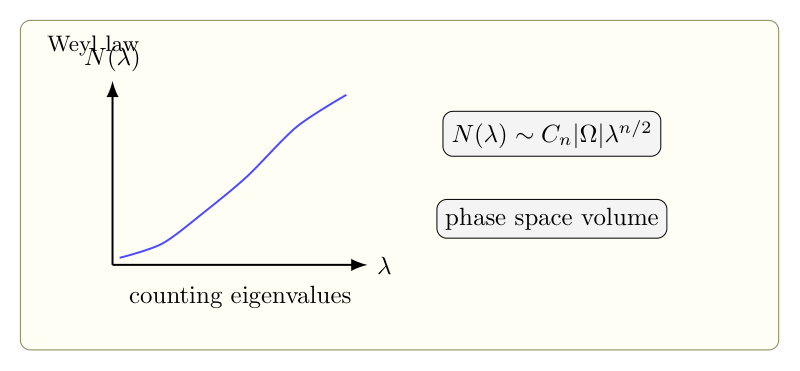
Weyl law 描述 Laplace 算子特征值的渐近分布。它说明高频谱的主要项只看区域体积和相空间体积,而不看边界的细节。
1. Dirichlet 特征值问题
设 $\Omega\subset\mathbb R^n$ 有界,考虑
$$-\Delta u=\lambda u,\qquad u|_{\partial\Omega}=0.$$
特征值排成
$$0<\lambda_1\le\lambda_2\le\cdots\to\infty.$$
定义计数函数 $N(\lambda)=\#\{j:\lambda_j\le\lambda\}$。
2. Weyl 渐近
Weyl law 说
$$N(\lambda)\sim \frac{\omega_n}{(2\pi)^n}|\Omega|\lambda^{n/2}.$$
右边正是相空间中
$$\{(x,\xi):x\in\Omega,\ |\xi|^2\le\lambda\}$$
的体积除以 $(2\pi)^n$。
3. 为什么是相空间体积
高频 eigenfunctions 局部上像平面波 $e^{ix\cdot\xi}$。频率满足 $|\xi|^2\le\lambda$,位置在 $\Omega$ 中。于是特征态数量近似等于可用 phase space cells 的数量。
4. 热核证明直觉
热 trace 为
$$\operatorname{Tr}(e^{t\Delta})=\sum_j e^{-t\lambda_j}.$$
当 $t\to0$,热核对角线主项为
$$K_t(x,x)\sim (4\pi t)^{-n/2}.$$
积分得到 trace 主项,再由 Tauberian theorem 推出 Weyl law。
5. 边界和低阶项
边界会出现在下一阶项中。主项只看体积,边界面积、曲率和动力学信息会在更细的谱渐近或余项估计中出现。这正是谱几何的入口。
发表回复