旧博客原文
原题:Note on Vinogradov main theorem
1.Introduction
Question:
Vinogradov mean value
Let 

How to estimate 

We assume 
![\int_{[0,1]^k}|f_k(x,N)|^{2s}dx_1...dx_k =\int_{[0,1]^k}|\sum_{1\leq n\leq N}e(nx_1+n^2x_2+...+n^kx_k)|^{2s}dx_1dx_2...dx_k &=\int_{[0,1]^k}\sum_{1\leq n_1,...,n_{2s}\leq N}e^{2\pi i[(n_1+...+n_{2s})x_1+...+(n_1^k+...+n_{2s}^k)x_k-(n_{s+1}+...+n_{2s})x_1-...-(n_{s+1}^k+...+n_{2s}^k)x_k]} &=|\{(n_1,...,n_{2s})| n_1^j+...+n_s^j=n_{s+1}^j+...+n_{2s}^j,\forall 1\leq j\leq k\}|](https://s0.wp.com/latex.php?latex=%5Cint_%7B%5B0%2C1%5D%5Ek%7D%7Cf_k%28x%2CN%29%7C%5E%7B2s%7Ddx_1...dx_k+%3D%5Cint_%7B%5B0%2C1%5D%5Ek%7D%7C%5Csum_%7B1%5Cleq+n%5Cleq+N%7De%28nx_1%2Bn%5E2x_2%2B...%2Bn%5Ekx_k%29%7C%5E%7B2s%7Ddx_1dx_2...dx_k+%26%3D%5Cint_%7B%5B0%2C1%5D%5Ek%7D%5Csum_%7B1%5Cleq+n_1%2C...%2Cn_%7B2s%7D%5Cleq+N%7De%5E%7B2%5Cpi+i%5B%28n_1%2B...%2Bn_%7B2s%7D%29x_1%2B...%2B%28n_1%5Ek%2B...%2Bn_%7B2s%7D%5Ek%29x_k-%28n_%7Bs%2B1%7D%2B...%2Bn_%7B2s%7D%29x_1-...-%28n_%7Bs%2B1%7D%5Ek%2B...%2Bn_%7B2s%7D%5Ek%29x_k%5D%7D+%26%3D%7C%5C%7B%28n_1%2C...%2Cn_%7B2s%7D%29%7C+n_1%5Ej%2B...%2Bn_s%5Ej%3Dn_%7Bs%2B1%7D%5Ej%2B...%2Bn_%7B2s%7D%5Ej%2C%5Cforall+1%5Cleq+j%5Cleq+k%5C%7D%7C+&bg=ffffff&fg=5e5e5e&s=0&c=20201002)
we have:
main conjecture:

![J_{s,k}(N)=\int_{[0,1]^k}|f_k(x,N)|^{2s}dx_1...dx_k](https://s0.wp.com/latex.php?latex=J_%7Bs%2Ck%7D%28N%29%3D%5Cint_%7B%5B0%2C1%5D%5Ek%7D%7Cf_k%28x%2CN%29%7C%5E%7B2s%7Ddx_1...dx_k+&bg=ffffff&fg=5e5e5e&s=0&c=20201002)

theorem(Bourgain-Demeter-Guth)
Main conjecture hold in general.
2.Application
We have following directly application:
1.Waring problem
2.Bound Weyl sums.\
3.Zero-free region for Riemann-zeta function.
3.Relate to the decoupling theorem
Now we discuss the decoupling theorem. This theorem describe the phenomenon when we are considering the “expension” operator ![E_{[0,1]}(g)](https://s0.wp.com/latex.php?latex=E_%7B%5B0%2C1%5D%7D%28g%29&bg=ffffff&fg=5e5e5e&s=0&c=20201002)

[B-D-G]
Let 


(
![[0,1]](https://s0.wp.com/latex.php?latex=%5B0%2C1%5D&bg=ffffff&fg=5e5e5e&s=0&c=20201002)

![||E_{[0,1]}g||_{L^{d(d+1)}(w_B)}<< \delta^{-\epsilon}(\sum_{J\subset [0,1],|J|=\delta}||E_Jg||^2_{L^{d(d+1)(w_B)}})^{\frac{1}{2}}](https://s0.wp.com/latex.php?latex=%7C%7CE_%7B%5B0%2C1%5D%7Dg%7C%7C_%7BL%5E%7Bd%28d%2B1%29%7D%28w_B%29%7D%3C%3C+%5Cdelta%5E%7B-%5Cepsilon%7D%28%5Csum_%7BJ%5Csubset+%5B0%2C1%5D%2C%7CJ%7C%3D%5Cdelta%7D%7C%7CE_Jg%7C%7C%5E2_%7BL%5E%7Bd%28d%2B1%29%28w_B%29%7D%7D%29%5E%7B%5Cfrac%7B1%7D%7B2%7D%7D&bg=ffffff&fg=5e5e5e&s=0&c=20201002)
Discretized version:
Now we discuss the discretization of decoupling type result. We could establish a relationship between the decoupling theorem and Vinogradov mean theorem. look at the sum:
This could be view as a 


![\int_{[0,1]^k}|\sum_{1\leq n\leq N}e(nx_1+n^2x_2+...+n^kx_k)|^{2s}dx_1dx_2...dx_n](https://s0.wp.com/latex.php?latex=%5Cint_%7B%5B0%2C1%5D%5Ek%7D%7C%5Csum_%7B1%5Cleq+n%5Cleq+N%7De%28nx_1%2Bn%5E2x_2%2B...%2Bn%5Ekx_k%29%7C%5E%7B2s%7Ddx_1dx_2...dx_n&bg=ffffff&fg=5e5e5e&s=0&c=20201002)

this is very similar with the restriction theorem:
[restriction theorem]
let 


So it seems like these are the same thing, but unfortunately they are not,there are two things distinct them:
1.the density is defferent, it is a discrete sum in:
but a continue integral in:
so we need to construct a rescaling way to make the discretization one coverage to the continue one.a suitable fexiable function seems like
2.there


补充说明
以下是新整理的中文说明;上方旧博客原文保持不变。
Vinogradov mean value theorem 控制 Weyl sums 的高阶矩,是 Waring problem、指数和估计和 zeta 函数零点区域中的基础工具。Bourgain-Demeter-Guth 用 decoupling theorem 证明了主猜想。
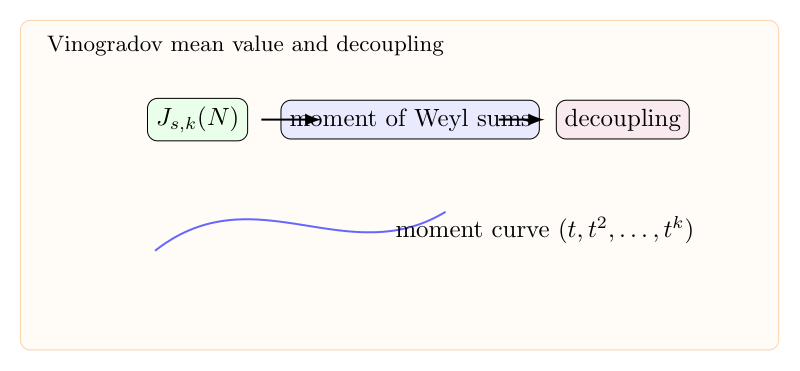
1. Mean value
设
$$S(\alpha)=\sum_{n\le N}e(\alpha_1n+\alpha_2n^2+\cdots+\alpha_kn^k).$$
Vinogradov mean value 研究
$$J_{s,k}(N)=\int_{[0,1]^k}|S(\alpha)|^{2s}\,d\alpha.$$
它也等于某个 Diophantine system 解的个数。
2. 主猜想
主猜想断言
$$J_{s,k}(N)\lesssim_\varepsilon N^\varepsilon\left(N^s+N^{2s-k(k+1)/2}\right).$$
两个项分别对应 diagonal solutions 和维数计数给出的主项。
3. 应用
这个估计直接用于 Waring problem,也给出 Weyl sums 的强上界。通过指数和控制,可以进一步进入 zeta 函数零点区域和等分布问题。
4. Decoupling 视角
考虑 moment curve
$$\gamma(t)=(t,t^2,\ldots,t^k).$$
decoupling theorem 描述 extension operator 在小区间分解后的 $L^p$ 几乎正交性。离散化后,它与 Vinogradov mean value theorem 精确相连。
5. 思想总结
Vinogradov mean value 把数论中的方程计数、调和分析中的 Fourier extension、以及几何中的曲率结构放到同一个问题里。这是现代解析数论和 decoupling 理论交汇的代表。
发表回复