旧博客原文
原题:Diophantine approximation
I explain some general ideal in the theory of diophantine approximation, some of them is original by myself, begin with a toy model, then consider the application on folklore Swirsing-Schmidt conjecture.
\tableofcontents
1. Dirichlet theorem, the toy model
The very basic theorem in the theory of Diophantine approximation is the well known Dirichlet approximation theorem, the statement is following.
Theorem 1 (Dirichlet theorem) for all
is a irrational number, we have infinity rational number
such that:
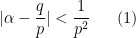
Remark 1 It is easy to see the condition of irrational is crucial. There is a best constant version of it, said, instead of
, the best constant in the suitable sense for the theorem 1 should be
and arrive by
at least. The strategy of the proof of the best constant version involve the Frey sequences.
Now we begin to explain the strategies to attack the problem.
\paragraph{Argument 1, boxes principle} We begin with a easiest one, i.e. by the argument of box principle, the box principle is following,
Theorem 2 (Boxes principle) Given
and two finite sets
, set
, if we have a map:
Then there exists a element
such that there exist at least two element
,
.

Proof: The proof is trivial.

Now consider, 

![{\{ix\}\in [0,1], \forall i\in \{1,2,...,n\}}](https://s0.wp.com/latex.php?latex=%7B%5C%7Bix%5C%7D%5Cin+%5B0%2C1%5D%2C+%5Cforall+i%5Cin+%5C%7B1%2C2%2C...%2Cn%5C%7D%7D&bg=ffffff&fg=000000&s=0&c=20201002)
![{[0,1]}](https://s0.wp.com/latex.php?latex=%7B%5B0%2C1%5D%7D&bg=ffffff&fg=000000&s=0&c=20201002)

![{[\frac{k-1}{N},\frac{k}{N}]}](https://s0.wp.com/latex.php?latex=%7B%5B%5Cfrac%7Bk-1%7D%7BN%7D%2C%5Cfrac%7Bk%7D%7BN%7D%5D%7D&bg=ffffff&fg=000000&s=0&c=20201002)

\paragraph{Argument 2, continue fractional} We know, for irrational number 


And we have,

Then 
\paragraph{Argument 3, Bohr set argument} We begin with some kind of Bohr set:

The key point is the shift of Bohr set, on the vertical line i.e. 

So:

in 
\paragraph{Argument 4, mountain bootstrap argument} This argument is more clever than 3, although both two arguments try to gain the property we want in 1 from investigate the whole space
Now I explain the main argument, it is nothing but sphere packing, with the set of balls

and define its subset

Then 

 , there is a subset
  of
of  such that
 ![{\cup_{i\in A_l}B_i=[0,1]}](https://s0.wp.com/latex.php?latex=%7B%5Ccup_%7Bi%5Cin+A_l%7DB_i%3D%5B0%2C1%5D%7D&bg=ffffff&fg=000000&s=0&c=20201002) .
. Remark 2 If we can proof 3, it is easy to see the theorem 1 follows.
Proof: The proof follows very standard in analysis, may be complex analysis? Key point is we start with a ball 


- The extension process could extension
to whole space.
- we can not use the extension argument to extension to the whole space.
If we are in the first situation, then we are safe, there is nothing need proof. If we are in second case, anyway we take a ball 
Remark 3 Argument 1 is too clever to be true in generalization, argument 2 is standard, by the power of renormalization. argument 3 and argument 4 have gap… I remember I have got a proof similar to argument 4 here many years ago, but I forgot how to get it…
2. Schimidt conjecture
The Schimidt conjecture could be look as the generalization of Dirchlet approximation theorem 1 to algebraic number version, to do this, we need define the height of a algebraic number.
Definition 4 We say a number
is a
order algebraic number if and only is the minimal polynomial of
have degree
.
Definition 5 (Height) Now we define the height of a
, Where

Now we state the conjecture:
Theorem 6 (Swiring-Schimidt conjecture) For all transendental number
, there is infinitely
Where
is a constant only related to
but not

I point out the conjecture is very related to the map:

Where 
Remark 4
is a map
, what we consider is its inverse,
, but
is not smooth, it occur singularity when
for some
. And the map, as we know, the singularity depend on the quantity
.
Remark 5 I then say something about the geometric behaviour of the map
is just the pullback of the canonical metric on
(morally) to
补充说明
以下是新整理的中文说明;上方旧博客原文保持不变。
Diophantine approximation 的基本问题是:一个无理数 $\alpha$ 能被有理数 $p/q$ 逼近到什么程度?Dirichlet 定理给出最基本的答案,而连分数告诉我们哪些分母是真正的最佳逼近。
1. Dirichlet 定理
对任意无理数 $\alpha$,存在无穷多个有理数 $p/q$,使得
$$\left|\alpha-\frac pq\right|<\frac1{q^2}.$$
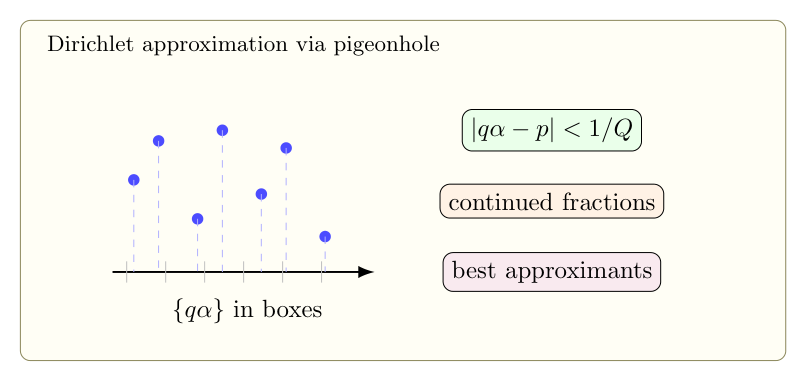
一个有限版本是:给定 $Q$,存在 $1\le q\le Q$ 和整数 $p$,使
$$|q\alpha-p|<\frac1Q.$$
2. 抽屉原理证明
看 $Q+1$ 个数的小数部分
$$0,\{\alpha\},\{2\alpha\},\ldots,\{Q\alpha\}.$$
把 $[0,1]$ 分成 $Q$ 个长度 $1/Q$ 的区间。两个小数部分落在同一区间,于是它们的差给出某个 $q\alpha$ 距离整数小于 $1/Q$。这就是 Dirichlet 定理最干净的证明。
3. 线性结构在哪里
抽屉原理本身只是计数,但这里真正起作用的是线性结构:两个点 $\{a\alpha\}$ 和 $\{b\alpha\}$ 接近,差就变成 $\{(a-b)\alpha\}$ 接近整数。没有这个差分结构,抽屉原理不会自动给出有理逼近。
4. 连分数与最佳逼近
连分数展开
$$\alpha=[a_0;a_1,a_2,\ldots]$$
给出 convergents $p_k/q_k$。它们满足
$$\left|\alpha-\frac{p_k}{q_k}\right|<\frac1{q_kq_{k+1}}.$$
这些分母 $q_k$ 是最佳逼近的自然尺度。若 $a_k$ 有界,则 $\alpha$ 是 badly approximable;若某些 $a_k$ 很大,就会出现异常好的逼近。
5. 更高维和 Schmidt 猜想的方向
高维 Diophantine approximation 会把一个数的逼近问题变成向量、线性形式或流形上的逼近问题。此时抽屉原理仍然给出基准结果,但最佳常数、例外集维数和代数数逼近会变得更深。许多问题最后会进入 geometry of numbers、dynamical systems on homogeneous spaces 或 Schmidt game 的语言。
发表回复