旧博客原文
原题:incidence combinatorics
the method from algebraic geometry and algebraic topology have a effect on incidence combinatorics this years.espatialy on finite field case.there is some examples of the achievement follow this idea.
Dvir-Finite Kakeya conjecture
Guth-Katz-Erdos Distance problem
there is a example with classical algebraic geometry,cubic curve in fact.
Ben Green:


A k-rich line is a line in 


there is a classical theorem:
Sylvester-Gallai theorem:if the points in 
this theorem is not true in other fields.
there is a lots of counterexample.
the original proof of sylvester-Galli theorem:
find the pair of point and line minimize the distance from the point to the line.if the line is not original we can get a contradiction!
this proof is very pretty,but too clever to extend to a system method to deal with similar problem in incidence geometry…
补充说明
以下是新整理的中文说明;上方旧博客原文保持不变。
Incidence combinatorics 研究点、线、曲线或更高维对象之间的相交关系。近年的一个重要趋势是:代数几何和拓扑方法进入组合问题,尤其在有限域 Kakeya、Erdos distance problem 和 rich lines 问题中非常有效。
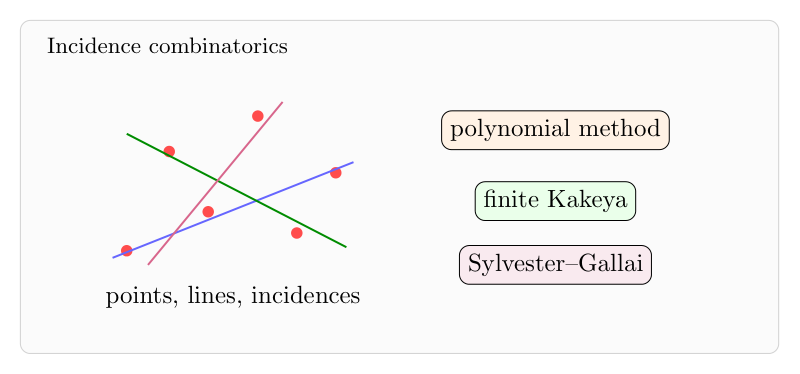
1. Rich lines
给定点集 $P$,若一条线包含至少 $k$ 个点,就称为 $k$-rich line。基本问题是估计这样的线有多少条。过多 rich lines 往往说明点集具有低维代数结构。
常用的计数对象是 incidence number
$$I(P,\mathcal L)=\#\{(p,\ell):p\in P,\ \ell\in\mathcal L,\ p\in\ell\}.$$
2. Sylvester-Gallai 定理
经典 Sylvester-Gallai theorem 说:实平面中有限点集若不共线,则存在一条 ordinary line,即恰好经过两个点的直线。
传统证明选取点到线的最小距离,十分漂亮,但也很“巧”。它揭示了实数域的序结构,而这正是有限域中定理失败的原因之一。
3. Polynomial method
Dvir 证明有限域 Kakeya 猜想的思想是:若点集太小,就存在一个低次数非零多项式在其上消失;但 Kakeya 集包含每个方向的一条线,于是多项式会在太多直线上消失,最后被迫恒为零,矛盾。
4. Guth-Katz 图像
在 Erdős distance problem 中,Guth-Katz 把距离问题转成三维空间中的线 incidence 问题,再用 ruled surfaces 和 polynomial partitioning 控制相交结构。这说明 incidence combinatorics 的核心不是数点,而是识别迫使 incidence 变多的代数几何原因。
发表回复