Gromov-Hausdorff 距离笔记:不同维球面之间能多近?

旧博客原文

原题:How to compute the Gromov-Hausdorff distance between spheres $latex S_n$ and $latex S_m$?

There is the question, because when we consider the Gromov-Hausdorff distance, we must fix the metric, so we use the natural metric induced from the embedding \mathbb{S}_n \to \mathbb{R}^{n+1}. Is it possible for us to compute the Gromov-Hausdorff distance d_{G-H}(\mathbb{S}_n,\mathbb{S}_m) for two different spheres \mathbb{S}_n and \mathbb{S}_m, m\neq n?

For example if we want to calculate d_{G-H}(\mathbb{S}_2,\mathbb{S}_3)=\inf_{M,f,g}d_{M}(\mathbb{S}_2,\mathbb{S}_3), where M ranges over all possible metric space and f:\mathbb{S}_2\to M and g:\mathbb{S}_3\to M range over all possible isometric (distance-preserving) embeddings.

At least we can embed \mathbb{S}_2,\mathbb{S}_3 into \mathbb{R}^3 in a canonical way. This will lead to a upper bound: d_{G-H}(\mathbb{S}_2,\mathbb{S}_3)\leq \sqrt{2}. And in general case we have d_{G-H}(\mathbb{S}_m,\mathbb{S}_n)\leq d_{G-H}(point,S_m)+d_{G-H}(point,S_n)\leq 2,\forall 0\leq n\leq m. But it is difficult to get a lower bound control for me. Because we need to take the inf in all possible metric spaces M. Especially I conjecture d_{G-H}(\mathbb{S}_m,\mathbb{S}_n)\geq \lambda_{m,n}\frac{m-n}{m},\forall 0\leq n\leq m, where \liminf_{m,n\to \infty}\lambda_{m,n}>0.

I only know the knowledge of Gromov-Hausdorff from Peterson’s Riemann Geometry. Unfortunately there is not enough information to compute the Gromov-Hausdorff distance, so this problem may be very stupid, I will appreciate any pointer.


And we know for the case S_n,S_m, if n,m is very near to each other,then the two space should be more near, and there is a canonical embed S_0\subset S_1 \subset S_2 ....\subset S_n \subset .... So it is natural to conjecture if m,n is very near then the distance d_{G-H}(S_n,S_m) is very small. I have a very rough strategy to prove the conjecture, that is inspired by the Nash embedding theorem. I just mean if we consider the problem in this frame d_{G-H}(S_n,S_m)=\inf_{M,g,f}(d_M(f(S_n),g(S_m))) then the difficult is the deformation space of M,g,f is too large. so the first step is to establish a regular lemma, to prove the function d_M(f(S_n),g(S_m)) is continues under the small perbutation of M and reduced to the situation of space $M,g,f$ with very nice regularity. the second part is to embed M to a big euclid space R^N as subspace, and the embedding stay the length of geodesic.locally this is determine by a group of pde:u_i(x)u_j(x)=g_{ij}(x),at least in the cut locus.but there should be some critical point,and I do not know how to deal with them.the third,i.e. the last step is to calculate d_{G-H}(S_n,S_m) in the very some deformation space M,f,g.

@Mark Sapir,Appreciate for help!I am reading the article you point out,it seems this article mainly focus on investigating the Gromov-Hausdorff limit space of a sequence of hyperbolic group equipped with modified G-H metric defined in 2.A with some special condition to ensure the limit space exists.and take a sequences corvarage to the limit space,the hyperbolic property and some other thing is stayed by the process of take limit.
@Mark Sapir,So it is natural for us to investigate the original space by some information from the limit space.there is a series of bi-product state in 3.B.but I do not see where the author exactly calculate some groom-hausdorff distance of two different space,may you point out it?appreciate again!
@MarianoSuárez-Álvarez,Corrected, thanks.

Y:
I fixed numerous typos. In particular, you should use spacing after each punctuation mark; capitals to begin sentences and names.

H:
Thank you very much for helping me to correct the mistakes! I will know how to write in a correct style.

Y:
23.1k
Your conjecture would imply that the GH distance is unbounded. But it’s clearly bounded, since the GH distance of any sphere to a point is equal to 2 (when the sphere is endowed with the restriction of Euclidean distance, as you seem to assume, or \pi when endowed with geodesic distance) and hence the GH distance between any two spheres is \le 4.

H:
73
You are right,In fact if we use the canonical embed, then we can get d_{G-H}(S_n,S_m)\leq 2 by another equivalent definition of GH distance.I confuse the geometry picture of the pairs T_n,S_n with the pairs S_n,S_m,for S_n,S_m case,I thick the seems correct conjecture will be d_{G-H}(S_n,S_m)\sim \frac{m-n}{m},0\leq n\leq m,m,n\to \infty.

Y:
16:37
Clearly from standard embeddings we get d_{GH}(S_n,S_m)\le\sqrt{2} for all n,m\ge 0. Would it be reasonable to simply conjecture that it’s an equality whenever n\neq m?

H:
73
Yeah, you are right,d_{G-H}(S_n,S_m)\leq \sqrt{2} for all n,m\geq 0.I find the interesting problem when I want to find a toy model of a kind of problem,roughly speaking is to investigate a map f:X\to Y from low-dimensions space X to high-dimension space Y stay some affine structure of the low-dimension space X. This structure could have some control by the distance function on the low-dimension space, so if we can get some control on the variation of the Energy of distance function, this will share some line on the original problem I consider.
And we know for the case S_n,S_m, if n,m is very near to each other,then the two space should be more near, and there is a canonical embed S_0\subset S_1 \subset S_2 ....\subset S_n \subset .... So it is natural to conjecture if m,n is very near then the distance d_{G-H}(S_n,S_m) is very small. .
I have a very rough strategy to prove the conjecture, that is inspired by the Nash embedding theorem. I just mean if we consider the problem in this frame d_{G-H}(S_n,S_m)=\inf_{M,g,f}(d_M(f(S_n),g(S_m))) then the difficult is the deformation space of M,g,f is too large. so the first step is to establish a regular lemma, to prove the function d_M(f(S_n),g(S_m)) is continues under the small perbutation of M and reduced to the situation of space M,g,f with very nice regularity.
The second part is to embed M to a big euclid space R^N as subspace, and the embedding stay the length of geodesic.locally this is determine by a group of pde:u_i(x)u_j(x)=g_{ij}(x),at least in the cut locus.but there should be some critical point,and I do not know how to deal with them.the third,i.e. the last step is to calculate d_{G-H}(S_n,S_m) in the very some deformation space M,f,g.
I need come back to explain why we expect the groom-hausdorff distance d_{G-H}(S_d,S_m),0\leq n\leq m should be much small than \sqrt 2 when frac{n}{m} is small.

Let consider a toy model of the problem,in a graph model,i.e. now we do not consider to take the Infimum in all space but in discrete space endow with metric. this can be view as a complete graph equipped metric, i.e. M=\{(G,d_G)\}. So there is also some space very like S_n,$S_m$ in the Euclid space, Let remark them as G_{S_n},G_{S_m}.
, oberseve that (G,d_G)\in M then (G,\hat d_{G})\in M,\hat d_{G} is a scaling of d_Gso it is natural to consider a cut off of M,called M_{\lambda} which is just a subset of M and satisfied if (G,d_G)\in M_{\lambda},then \inf_{x\neq y}d_{G}(x,y)\geq d.
Now,in the space M_{\lambda} let us consider a Distance distribution:\mu_G((a,b))=\frac{\#\{x,y\in G|a<d_G(x,y)<b\}}{\#G\times G}. Then this distribution will give us some information of the distance of the two different set G_1,G_2 in M_{\lambda}.
(removed)
Now,in the space M_{\lambda} let us consider a Distance distribution:\mu_G((a,b))=\frac{\#\{x,y\in G|a<d_G(x,y)<b\}}{\#G\times G}. Then this distribution will give us some information of the distance of the two different set G_1,G_2 in M_{\lambda}.
and obviously we will see that if n,m is close,then the distribution of fuzzy approximation G_{S_n},G_{S_m} is near, and the reverse is also true. I think this can explain why the conjecture d_{G-H}(S_n,S_m) =O(\frac{m-n}{m}) may be right.


by the way,it is a very good exercise to proof d_{G-H}(S_n,S_0)=1,\forall n\in N^*.



补充说明

以下是新整理的中文说明;上方旧博客原文保持不变。

问 $S^n$ 和 $S^m$ 的 Gromov-Hausdorff 距离,第一步必须先固定 metric。球面可以带内蕴测地距离,也可以带作为欧氏空间子集的 chordal distance;不同选择会给出不同数值。真正稳定的对象不是某个嵌入,而是所有可能 correspondences 的 distortion。
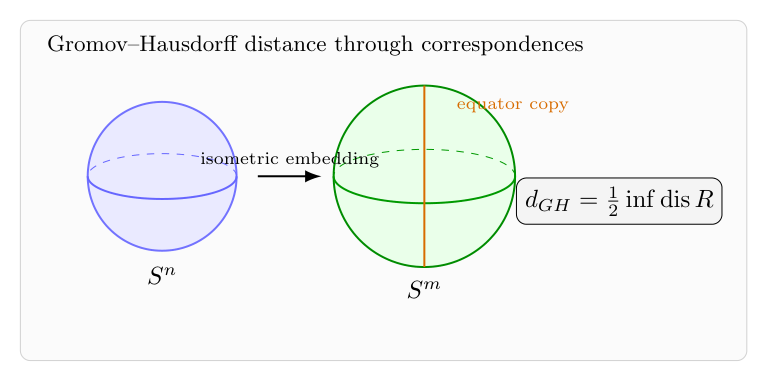
Gromov-Hausdorff 距离笔记:不同维球面之间能多近?
比较不同维球面时,标准嵌入只给出上界;真正的 GH 距离要在所有 correspondences 上取最优。

1. 定义提醒

紧 metric spaces $X,Y$ 的 Gromov-Hausdorff 距离可以用 correspondences 表示:

$$d_{GH}(X,Y)=\frac12\inf_R \operatorname{dis}(R),$$

其中 $R\subset X\times Y$ 是 correspondence,distortion 定义为

$$\operatorname{dis}(R)=\sup_{(x,y),(x’,y’)\in R}
\bigl|d_X(x,x’)-d_Y(y,y’)\bigr|.$$

这一定义强调:我们不是只比较两个空间在某个欧氏空间中的位置,而是允许把它们同时嵌入任意 metric space,再取最优比较。

2. 先用标准嵌入给上界

若 $n

$$d_{GH}(S^n,S^m)\le \sqrt2.$$

若用 geodesic metric,对应上界是 $\pi/2$。这只是上界,不自动说明最优。

3. 为什么不能猜它随维数增长

一个容易犯的错误是认为维数差越大,距离越大。但 GH 距离由直径控制。对任意紧空间 $X$,

$$d_{GH}(X,\{\ast\})=\frac12\operatorname{diam}(X).$$

因此两单位球面之间的 GH 距离总是被一个统一常数控制,不可能随着 $m-n$ 无界增长。维数差体现为拓扑和覆盖数的差异,但 GH 距离本身仍然是 metric 层面的量。

4. 下界为什么难

要证明 equator 嵌入给出的上界是最优,需要排除所有更聪明的 correspondences。这通常要找一个 metric invariant,例如 covering number、packing number、waist phenomenon 或同调信息,说明低维球面无法在小 distortion 下模拟高维球面。

例如,如果 $S^m$ 中有许多两两相距较远的点,而 $S^n$ 在同样尺度下容纳不了这么多点,就可以得到下界。这类 argument 本质上是把维数信息转化成 packing 数据。

5. 一个合理的 toy problem

这个问题真正有意思的地方在于,它是“低维空间如何嵌入高维空间并保留距离结构”的 toy model。若把球面换成带变形 metric 的流形,还会涉及 Nash embedding、cut locus、距离函数能量的变化以及正则性问题。

所以比较 $S^n$ 和 $S^m$ 不只是为了得到一个数值;它逼迫我们区分三件事:具体嵌入给出的 Hausdorff 上界、抽象 GH 距离的最优 correspondence、以及维数信息如何通过 metric invariant 被读出来。

评论

发表回复

您的邮箱地址不会被公开。 必填项已用 * 标注





