旧博客原文
原题:Schauder estimate and Sobelov inequality
In this note we discuss the Schauder theory for uniformly elliptic linear equations and Sobelov inequality.
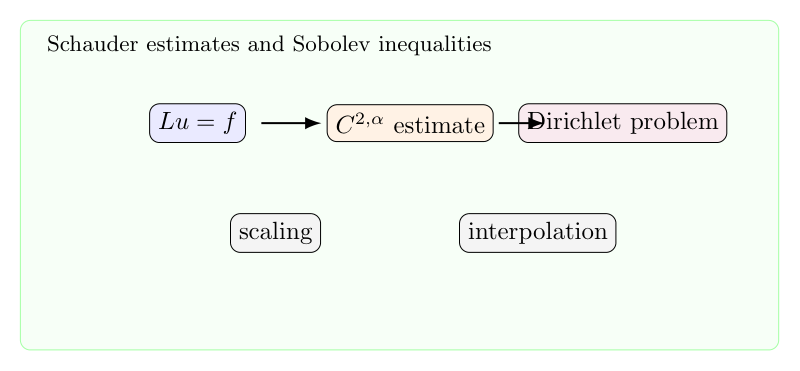
the three main topics ars a priori estimate in Holder norms,regularity of arbitrary solutions and the solvability of the Dirichlet problem.Among these topics,a priori estimates are the most fundamental and the basis of the follows two.we will discuss both the interior Schauder estimate and global Schauder estimate.
-Schauder Theory-
1. Interior Schauder Theory


we consider the operator 

easy to see 

the operator

for any 

1.1. Interior Schauder Estimate
define the weighted 
![\displaystyle |u|^*_{C^{k,\alpha}(B_R)}=\sum_{i=0}^k R^i|D^iu|_{L^{\infty}(B_R)}+R^{k+\alpha}[D^ku]_{C^{\alpha}(B_R)}](https://s0.wp.com/latex.php?latex=%5Cdisplaystyle+%7Cu%7C%5E%2A_%7BC%5E%7Bk%2C%5Calpha%7D%28B_R%29%7D%3D%5Csum_%7Bi%3D0%7D%5Ek+R%5Ei%7CD%5Eiu%7C_%7BL%5E%7B%5Cinfty%7D%28B_R%29%7D%2BR%5E%7Bk%2B%5Calpha%7D%5BD%5Eku%5D_%7BC%5E%7B%5Calpha%7D%28B_R%29%7D&bg=ffffff&fg=000000&s=0&c=20201002)
easy to see 
consider the PDE.

we want to proof this type estimate,

where
we first deal with a easy case,

Lemma 1 





then ,
![\displaystyle |u|^*_{C^{2,\alpha}(B_{\frac{R}{2}})}\leq C[|u|_{L^{\infty}(B_R)}+R^2|f|^*_{C^{\alpha}(B_R)}]](https://s0.wp.com/latex.php?latex=%5Cdisplaystyle+%7Cu%7C%5E%2A_%7BC%5E%7B2%2C%5Calpha%7D%28B_%7B%5Cfrac%7BR%7D%7B2%7D%7D%29%7D%5Cleq+C%5B%7Cu%7C_%7BL%5E%7B%5Cinfty%7D%28B_R%29%7D%2BR%5E2%7Cf%7C%5E%2A_%7BC%5E%7B%5Calpha%7D%28B_R%29%7D%5D&bg=ffffff&fg=000000&s=0&c=20201002)
Proof: 
Lemma 2 Let 


![\displaystyle \mu^{\alpha}R^{\alpha}[u]_{C^{\alpha}(B_R)}\leq C[\mu R |\nabla u|_{L^{\infty}(B_R)}+|u|_{L^{\infty}(B_1)}]](https://s0.wp.com/latex.php?latex=%5Cdisplaystyle+%5Cmu%5E%7B%5Calpha%7DR%5E%7B%5Calpha%7D%5Bu%5D_%7BC%5E%7B%5Calpha%7D%28B_R%29%7D%5Cleq+C%5B%5Cmu+R+%7C%5Cnabla+u%7C_%7BL%5E%7B%5Cinfty%7D%28B_R%29%7D%2B%7Cu%7C_%7BL%5E%7B%5Cinfty%7D%28B_1%29%7D%5D&bg=ffffff&fg=000000&s=0&c=20201002)
(2)for any
![\displaystyle \mu R |\nabla u|_{L^{\infty}(B_R)} \leq C[\mu^{1+\alpha}R^{1+\alpha}|\nabla u|_{C^{\alpha}(B_R)}+|u|_{L^{\infty}(B_1)}]](https://s0.wp.com/latex.php?latex=%5Cdisplaystyle+%5Cmu+R+%7C%5Cnabla+u%7C_%7BL%5E%7B%5Cinfty%7D%28B_R%29%7D+%5Cleq+C%5B%5Cmu%5E%7B1%2B%5Calpha%7DR%5E%7B1%2B%5Calpha%7D%7C%5Cnabla+u%7C_%7BC%5E%7B%5Calpha%7D%28B_R%29%7D%2B%7Cu%7C_%7BL%5E%7B%5Cinfty%7D%28B_1%29%7D%5D&bg=ffffff&fg=000000&s=0&c=20201002)
(3)for any 
![\displaystyle \mu R|\nabla u|_{L^{\infty}(B_R)}\leq C[\mu^2R^2|\nabla^2 u|_{L^{\infty}(B_R)}+|u|_{L^{\infty}(B_R)}]](https://s0.wp.com/latex.php?latex=%5Cdisplaystyle+%5Cmu+R%7C%5Cnabla+u%7C_%7BL%5E%7B%5Cinfty%7D%28B_R%29%7D%5Cleq+C%5B%5Cmu%5E2R%5E2%7C%5Cnabla%5E2+u%7C_%7BL%5E%7B%5Cinfty%7D%28B_R%29%7D%2B%7Cu%7C_%7BL%5E%7B%5Cinfty%7D%28B_R%29%7D%5D+&bg=ffffff&fg=000000&s=0&c=20201002)
where 

Proof:
Corollary 3 Let 

![\displaystyle \sum_{i=0}^2(\mu R)^i|\nabla^i u|_{L^{\infty}(B_R)}+\sum_{i=0}^1(\mu R)^{i+\alpha}[\nabla^i u]_{C^{\alpha}(B_R)}\leq C[(\mu R)^{2+\alpha}[\nabla^2 u]_{C^{\alpha}(B_R)}+|u|_{L^{\infty}(B_R)}]](https://s0.wp.com/latex.php?latex=%5Cdisplaystyle+%5Csum_%7Bi%3D0%7D%5E2%28%5Cmu+R%29%5Ei%7C%5Cnabla%5Ei+u%7C_%7BL%5E%7B%5Cinfty%7D%28B_R%29%7D%2B%5Csum_%7Bi%3D0%7D%5E1%28%5Cmu+R%29%5E%7Bi%2B%5Calpha%7D%5B%5Cnabla%5Ei+u%5D_%7BC%5E%7B%5Calpha%7D%28B_R%29%7D%5Cleq+C%5B%28%5Cmu+R%29%5E%7B2%2B%5Calpha%7D%5B%5Cnabla%5E2+u%5D_%7BC%5E%7B%5Calpha%7D%28B_R%29%7D%2B%7Cu%7C_%7BL%5E%7B%5Cinfty%7D%28B_R%29%7D%5D&bg=ffffff&fg=000000&s=0&c=20201002)
Proof:
Now we are ready to prove an interior estimate for 
Lemma 4
2. Global Schauder Theory
-Sobelov inequality-
Theorem 5

moreover,we have: 


Proof:

suffice to proof:

obvious we have:

so 
so


use the similar argument as 

suffice to prove 
obvious we have:

4.




![{\leq \frac{c}{n}\sum_{i=1}^n\tilde C p[(\int_{\Omega} (|u|^{p-1})^{\frac{p}{p-1}})^{\frac{p-1}{p}}+(\int_{\Omega} |D_iu|^p)^{\frac{1}{p}}]^{\frac{1}{p}} }](https://s0.wp.com/latex.php?latex=%7B%5Cleq+%5Cfrac%7Bc%7D%7Bn%7D%5Csum_%7Bi%3D1%7D%5En%5Ctilde+C+p%5B%28%5Cint_%7B%5COmega%7D+%28%7Cu%7C%5E%7Bp-1%7D%29%5E%7B%5Cfrac%7Bp%7D%7Bp-1%7D%7D%29%5E%7B%5Cfrac%7Bp-1%7D%7Bp%7D%7D%2B%28%5Cint_%7B%5COmega%7D+%7CD_iu%7C%5Ep%29%5E%7B%5Cfrac%7B1%7D%7Bp%7D%7D%5D%5E%7B%5Cfrac%7B1%7D%7Bp%7D%7D+%7D&bg=ffffff&fg=000000&s=0&c=20201002)

moreover,we have:

![{\mu\in (0,1]}](https://s0.wp.com/latex.php?latex=%7B%5Cmu%5Cin+%280%2C1%5D%7D&bg=ffffff&fg=000000&s=0&c=20201002)

then 
Lemma 6 


furthermore,for any

Proof: 

now follows young inequality and this priori estimate we have:




and by the priori estimate,we have:
Q.E.D.
Lemma 7 


![\displaystyle \int_{\Omega} exp[\frac{g}{c_1||f||_p}]^{p^`}dx\leq c_2|\Omega|,p^`=\frac{p}{p-1}](https://s0.wp.com/latex.php?latex=%5Cdisplaystyle+%5Cint_%7B%5COmega%7D+exp%5B%5Cfrac%7Bg%7D%7Bc_1%7C%7Cf%7C%7C_p%7D%5D%5E%7Bp%5E%60%7Ddx%5Cleq+c_2%7C%5COmega%7C%2Cp%5E%60%3D%5Cfrac%7Bp%7D%7Bp-1%7D&bg=ffffff&fg=000000&s=0&c=20201002)
Proof: we have


then take 
Lemma 8 let


a.e. in
Proof: frist zero extended 


forall 

Q.E.D.
Theorem 9 let 
![\displaystyle \int_{\Omega}exp[\frac{|u|}{c_1||Du||_n}]^{\frac{n}{n-1}}dx\leq c_2|\Omega|](https://s0.wp.com/latex.php?latex=%5Cdisplaystyle+%5Cint_%7B%5COmega%7Dexp%5B%5Cfrac%7B%7Cu%7C%7D%7Bc_1%7C%7CDu%7C%7C_n%7D%5D%5E%7B%5Cfrac%7Bn%7D%7Bn-1%7D%7Ddx%5Cleq+c_2%7C%5COmega%7C&bg=ffffff&fg=000000&s=0&c=20201002)
Proof: a
Theorem 10 


moreover


Proof: a
补充说明
以下是新整理的中文说明;上方旧博客原文保持不变。
Schauder 理论和 Sobolev 理论是椭圆方程正则性的两套基本语言。前者追踪 Holder 范数,适合系数和右端足够连续的情形;后者追踪积分可积性,适合弱解和变分方法。
1. 线性一致椭圆算子
考虑
$$Lu=a^{ij}(x)\partial_{ij}u+b^i(x)\partial_i u+c(x)u=f.$$
一致椭圆性是指存在 $\lambda>0$,使
$$a^{ij}(x)\xi_i\xi_j\ge \lambda|\xi|^2.$$
这是所有先验估计的起点。
2. Interior Schauder estimate
若系数和 $f$ 都在 $C^\alpha$ 中,则局部有
$$\|u\|_{C^{2,\alpha}(B_{1/2})}\le C\bigl(\|u\|_{C^0(B_1)}+\|f\|_{C^\alpha(B_1)}\bigr).$$
常系数情形可以先通过 Newton potential 或 Fourier 方法得到,再用冻结系数和 perturbation 推广到变系数情形。
3. Scaling 与 weighted norms
Schauder 估计的形状由 scaling 决定。若把球 $B_r$ 缩放到单位球,二阶导数带来 $r^{-2}$,Holder seminorm 还会多出 $r^{-\alpha}$。weighted norm 正是为了把这些尺度因子记录清楚。
4. Sobolev inequality
Sobolev 不等式给出
$$\|u\|_{L^{p^\ast}}\le C\|\nabla u\|_{L^p},\qquad p^\ast=\frac{np}{n-p}.$$
它不直接给出经典二阶 Holder 正则性,但能建立弱解存在性、能量估计和 bootstrapping。
5. 两种理论的关系
Schauder 理论适合光滑数据的 classical solution,Sobolev 理论适合弱解和变分框架。椭圆正则性常常先用 Sobolev 得到弱解,再通过 De Giorgi-Nash-Moser 或 Schauder 估计提升正则性。
发表回复