热核证明指标定理(一):Dirac 算子、supertrace 与 Chern-Weil

旧博客原文

原题:Heat Kernel proof of Index Theory 1


1. framework of atiyah singer index theory

1.1. A genus form

{(M,g)} campact,complete,Riemann manifold without boundary,dim { M=2m ,m \in N^* }. {\bigtriangledown^g} is the Levi-civita connection on {TM},{R=R_g\in \Omega^2(End(TM))}.
{\widehat A} genus form:

\displaystyle \widehat A(M,g)=det^{\frac{1}{2}}(\frac{\frac{i}{4\pi}R_g}{sinh(\frac{i}{4\pi}R_g)})\in \Omega(M).

by chern-weil theory,we know:
{ 1. \widehat A } is closed.
{ 2. \widehat A_{g1}-\widehat A_{g2} } is exact.
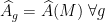
so we can def {\widehat A_g =\widehat A(M) \ \forall g} is a metric on M.
1.2. dirac bundle

{(E,\bigtriangledown^E)} is a dirac bundle.
{D: C^\infty(E^+) \rightarrow C^\infty(E^-)} is dirac operator.
{F^{E/S}\in End_{Cl(M)}(E)} the twisting curvature of {E}.

1.3. supertrace

{Str^{E / S}: End_{cl(M)} \rightarrow C_M}. induce map:

\displaystyle Str^{E/S} : \Omega(End_{cl(M)} (E) )\rightarrow \Omega(M) \otimes C

determined by:
\displaystyle Str^{E / S}( w \otimes T) = w \otimes Str^{E / S}(T). \ \forall w \in \Omega (M). \ \forall T \in End_{cl(M)} E.

1.4. chern class

\displaystyle ch^{E / S}(E) = Str^{E /S}[exp(\frac{i}{2\pi}F^{E/S})] \in \Omega(M).

by chern-weil theory,we know:
1. {ch^{E/S}(E)} closed form.
2. {ch^{E \ S}(E)} only depend on the topology of E.
\displaystyle F^{E \widehat\otimes W/S =F^{E/S} }\otimes 1_W + 1_E \otimes F^W.

\displaystyle F^W = F^{W^+} \oplus F^{W^-}.

\displaystyle ch^{(\widehat E \otimes W)/S} ,ch(E \widehat\otimes W)=ch^{E/S}(E/S)(ch(F^{W^+})-ch(F^{W^-})).

Whitney product formula.
1.5. Atiyah-singer index theorem

\displaystyle Ind D_E=Dim(ker D_E)-Dim(ker D^*_E)=\int\limits_M \widehat A(M,g)ch^{E/S}(E/S).

2. heat kernel

2.1. basic setting

Assume M is a general Riemann manifold ,assume

\displaystyle \Phi(d)= \{f\in C^\infty(M) | \|f \| _1< +\infty\}

Where {\ \|f\|_1^2 = \int f^2+\int|df|^2}.
complete {\Phi(d) } with the norm {\| . \|_1} is the sobolev space {H^1(M) < L^2(M)}.
The extension of operator {d} in {H^1(M)} is called {\overline d},assume {d_c} is {d} restrict on { C_0^\infty(M)},{d_c} extend to {H_0^1(M)} called {\overline d_c},{H_0^1(M)} is {C_o^\infty(M)} complete with the norm {\|.\|_1}, of course {H_0^1(M)\subset H^1(M)}.
Sobelev theory tell us, if {M} is a complete Riemann manifold,then {H_0^1(M)=H^1(M)}.
Operator {\delta=-*d*},satisfied {<df,w>=<f,\delta w>},where * is the Hodge-star operator ,{w} is the {C^\infty} 1-form, iff one of {f,w} is compact supp.
\displaystyle \Phi(\delta)=\{ w \in C^\infty 1-form | \int |w|^2 + \int |\delta w|^2 < +\infty \}


By a lemma from Gaffney (Ann. of Math , 60,1954,458-466) we have { \overline \delta = \overline d_c^*, \overline \delta_c =\overline d^* }.

the laplace operator(with Direchlet boundary condition or Neumann boundary condition) is {\Delta_D = \overline \delta \overline d_c,\Delta_N =\overline \delta_C \overline d}, When M is with smooth boundary,then {\Delta =\Delta_N =general \Delta oprator},assume M is complete ({H_0^1(M)=H^1(M)}),then because {\overline d_C =\overline d,\overline \delta_C =\overline \delta},Gaffney proved(Ann. of Math , 60 ,1954,140-145),
\displaystyle \Delta=\Delta_D=\Delta{\mathbb N}=\overline \delta \overline d

.
As we all known, {\Delta} is self-adjoint operator,so {e^{-\Delta t}} make up a bounded self-adjoint operator semi group,by the self-adjoint operator theory,if {dE_ {\lambda} } is the spectrum measure of {\Delta},then
\displaystyle e^{-\Delta t} = \int \limits_0^\infty d^{\lambda t}dE_{\lambda} , t>0

.
And for {t>0},{e^{-\Delta t}:L^2(M) \longrightarrow \bigcap_0^\infty D(\Delta^i) \subset C^\infty(M) }.when {f \in L^2(M)},
\displaystyle \Delta^i(e^{-\Delta t}) = \int \limits_0^\infty \lambda^i e^{-\Delta t} dE_{\lambda}(f).

where { \bigcap_{i=1}^\infty D(\Delta^i) \subset C^\infty(M)} is basic on Weyl theory.
2.2. existence of heat kernel

Now we proof the basic fact:
{Thm 2.1}: assume {M} is a complete manifold,then there exist a heat kernel {H(x,y,t) \in C^\infty(M \times M \times R^+)},and { (e^{-\Delta t}f)(x) = \int_M H(x,z,t-s)H(z,y,s)dz},{\forall f\in L^2(M)},satisfied:
{(1) H(x,y,t)=H(y,x,t).\\ (2) \lim\limits_{t \rightarrow 0^+} H(x,y,t)= \delta_x(y).\\ (3) (\Delta - \frac{\partial}{\partial t})H=0.\\ (4) H(x,y,t) = \int H(x,y,t-s) H(z,y,s)dz. }
Proof:
(A) first proof, {\forall f \in L^2(M), e^{-\Delta t} f\in C^\infty(M \times R^+)}.to proof this,we first proof,in weak sense:

\displaystyle \frac{\partial}{\partial t}(e^{-\Delta t} f) = \int\limits_0^\infty -\lambda e^{-\lambda t} dE_{\lambda}(f).


in fact,we have:
{ \frac{\partial}{\partial t} (e^{-\Delta t} f) \\=\lim\limits_{\epsilon \rightarrow 0} \frac{1}{\epsilon} [\int \limits_0^\infty e^{-\lambda(t+\epsilon)}dE_{\lambda}(f)-\int\limits_0^\infty e^{-\lambda t} dE_{\lambda}(f)] \\=\lim\limits_{\epsilon \rightarrow 0}[\int\limits_0^A \frac{e^{-\lambda \epsilon}-1}{\epsilon} e^{-\lambda t} dE_{\lambda}(f)+\int\limits_A^\infty \frac{e^{-\lambda\epsilon}-1}{\lambda\epsilon} \lambda e^{-\lambda t}dE_{\lambda}(f)] \\=\int\limits_0^A -\lambda e^{-\lambda t} dE_{\lambda}(f) + O(Ae^{-At} \|f\|) \\ \longrightarrow \int\limits_0^\infty -\lambda e^{-\lambda t} dE_{\lambda}(f) \ as\ {A \ \rightarrow +\infty} \dotfill (\star).}
rmk: the limit is take in the {L^2} space,every step in the caculate make sence because of the dominating convergence theorem.
so what have we proved ,in fact we proved in the classical sence, { \frac{\partial}{\partial t} (e^{-\Delta t} f) } exist. and our strategy is to proof any order of weak derivatives of it exist and then use the embedding theorem to prove it is smooth.
in fact to proof {\frac{\partial}{\partial t}(e^{-\Delta t} f)=\int\limits_0^\infty -\lambda e^{-\lambda}dE_{\lambda}(f)} (in weak sence),we need only to proof:{\forall \psi \in C_0^\infty(M \times R^+)} we have:
\displaystyle \int \frac{\partial \psi}{\partial t}(e^{-\Delta t}f) = -\int \psi(\int\limits_0^\infty -\lambda e^{-\lambda t}dE_{\lambda}(f))


but because of {(\star)},this is obvious,and similar we can proof that (in the weak sence):
\displaystyle (\Delta+\frac{\partial^2}{\partial t^2})^i(e^{-\lambda t} f)= \int\limits_0^\infty (\lambda+\lambda ^2)^i e^{-\lambda t} dE_{\lambda}(f)

rmk: there is some thing to explain,why {\Delta(e^{-\lambda t} f)= \int\limits_0^\infty \lambda e^{-\lambda t} dE_{\lambda}(f)} .
anyway,we observe that {L= \Delta+ \frac{\partial^2}{\partial t^2}} is the laplace operator on {M \times R^+}.and we have proved {e^{-\lambda t}f \in \bigcap^\infty \Phi(L^i)},and we know that { \bigcap^\infty \Phi(L^i) \subset C^\infty }.so we proved { e^{-\lambda t}f \in C^\infty( M \times R^+).}
and now we easy to observe that,
if {f_1(x,t)=e^{-\lambda t} f},then:
\displaystyle \frac{\partial}{\partial t} f_1 = - \int\limits_0^\infty \lambda e^{-\lambda t} dE_{\lambda}(f) = -\Delta( e^{-\lambda t} f)=\Delta f_1

.
so
\displaystyle ( \Delta - \frac{\partial}{\partial t}) f_1(x,t) = 0

.
Rmk:{f_1(x,t) \in C^\infty},so derivatives is in classical sense.
(B) to proof { e^{-\lambda t} f =\int\limits_M H(x,y,t)f(y)dy}.
by the decomposition of unity,we can assume {f \in C_0^\infty(M)},and {supp f } sufficed small.
consider the operator { \circ=\Delta +\frac{\partial}{\partial t}} and its quasi fundamental solution (paramatrix) {\longrightarrow} see next section for the serious definition {\longrightarrow P(x,y,t),P(x,y,t) \in C^\infty (M \times M \times R^+)},
\displaystyle \lim \limits_{t \rightarrow 0} P(x,y,t) = \delta_y

. and {\forall N > 0, \lim\limits_{t \rightarrow 0} \circ_x P(x,y,t) =O(t^N)},and when {d(x,y)} suffice small,{t \rightarrow +0 },we have expansion:
\displaystyle P(x,y,t) \sim \frac{exp(-d(x,y)^2/4t)}{(4\pi t)^{n/2}} \sum\limits_i a_i(x,y)t^i.

where {n =dim M, d(x,y)= x,y} Riemann distance.{a(x,y) \in C^\infty(M \times M), a_0(x,y) =1},for {0< \epsilon<s<t-s},

{ e^{-\Delta\epsilon}P(x,y,t-\epsilon)-e^{-\Delta(t-\epsilon)}P(x,y,\epsilon)\\ = \int\limits_{\epsilon}^{t-\epsilon} \frac{d}{ds}(e^{-\Delta(t-s)} P(x,y,s))ds\\ =\int\limits_{\epsilon}^{t-\epsilon} [ \Delta e^{ -\Delta(t-s)P(x,y,s)} + e^{-\Delta(t-s)} \frac{\partial P}{\partial s}(x,y,s)]ds\\ =\int\limits_{\epsilon}^{t-\epsilon} e^{-\Delta(t-s)} \circ _xP(x,y,s)ds.}
use {t} instead of {t-\epsilon},and assume {\epsilon \rightarrow 0},
\displaystyle \lim\limits_{\epsilon \rightarrow 0} e^{-\Delta t} P(x,y,\epsilon) = P(x,y,t)-\int\limits_0^t e^{-\Delta(t-s)} \circ_x P(x,y,s)ds =\limits_{def} H(x,y,t).


assume { F(x,y,s) = \circ _x P(x,y,s)},then
{ \Delta^i \int\limits_0^t e^{- \Delta(t-s)} (x,y,s)ds\\ =\int\limits_0^t\int\limits_0^\infty \lambda^i e^{-\lambda(t-s)} dE_{\lambda}(F(x,y,s))ds\\ =\int\limits_{s_0}^t \int\limits_0^\infty \lambda^i e^{-\lambda(t-s)}dE_{\lambda}(F(x,y,s))ds\\ + \int\limits_0^{s_0}\int\limits_0^\infty \lambda^i e^{-\lambda(t-s)} dE_{\lambda}(F(x,y,s))ds\\ =\int\limits_{s_0}^t\int\limits_0^\infty \lambda^i e^{-\lambda(t-s)}dE_{\lambda}(F(x,y,s))ds+\int\limits_0^{s_0}O(s^N)ds. }
this is because {F(x,y,s) =O(s^N)},when {s \rightarrow 0},so {H(x,y,t) \in \Phi(\Delta^i)},so {H(x,y,t) \in C^\infty(M \times M \times R^+)}.because:
\displaystyle |e^{-\Delta(t-s)} \circ_x P(x,y,s)| = O(s^N).

so {H(x,y,t)} and {P(x,y,t)} have the same expansion .because{H(x,y,t) = \lim\limits_{\epsilon \rightarrow 0} e^{-\Delta t} P(x,y,\epsilon)} so {\forall f(y)\in C_0^\infty(M)},we have:
\displaystyle \int H(x,y,t)f(y)dy=\lim\limits{\epsilon \rightarrow 0} \int\limits_M e^{-\Delta t} P(x,y,\epsilon)f(y)dy\\ =e^{-\Delta t}\lim\limits_{\epsilon \rightarrow 0} \int \limits_M P(x,y,\epsilon)f(y)dy\\ =e^{-\Delta t}f(x).


the equality arrive is because of the prop of {P(x,y,t)}.
on the other hand ,by the definition of {H(x,y,t)},we can check:
when {y} is fix and {t>0},{H(x,y,t) \in L^2(M)}, so
\displaystyle e^{-\Delta t} f(x) = \int H(x,y,t)f(y) , \ \forall f\in L^2(M)........................................(\star\star).


we call {H(x,y,t)} is the kernel of {e^{-\Delta t}}.

for prop (1),{H(x,y,t)=H(y,x,t)} is from the operator {\Delta} is self-adjoint,prop (2) is just {(\star\star)}.

now we proof prop (3),by definition:
\displaystyle H(x,y,t)=\lim\limits_{\epsilon \rightarrow 0} e^{-\Delta t-\epsilon} P(x,y,\epsilon), \ \forall \epsilon >0.


and we know { (\Delta_x - \frac{\partial}{\partial t})(e^{-\Delta t} P(x,y,t)) =0} so{ (\Delta_x -\frac{\partial}{\partial t})H(x,y,t) = 0}.
proof prop (4),by {e^{-\Delta s}e^{-\Delta(t-s)} = e^{-\Delta t}}and {(\star\star)} wo know:
\displaystyle H(x,y,t) = \int\limits_M H(x,z,t-s)H(z,y,s)dz..


QED.
rmk: for the manifold with bounded,we can also proof the existence of heat kernel with Dirchlet or Neumann boundary condition.(L.Chavel. Eigenvalues in Riemannian Geometry,Academic Press,1984)
2.3. quasi fundamental solution of heat equation

it is well known that for {R^n}, the fundamental solution of heat equation {(\Delta - \frac{\partial}{\partial t})u=0} is { exp(-\frac{r^2}{4t})/(4\pi t)^{n/2}}.
for general Riemann manifold {M},we want to find the fundamental solution of heat equation with this form:

\displaystyle U(x,y,t) \sim (4 \pi t)^{-\frac{n}{2}} e^{\frac{-d(x,y)^2}{4t} }{\sum\limits_{i \geq 0} \phi_i(x,y) t^i}.

where {d(x,y)} is the Riemann distance of two point of M. take the normal coordinate around point {x}, { y^i(i= 1,2,....,n),r=d(x,y)}.(the length of geodesic connect {x,y}).
it is well known that there exist functions {\psi(r) , \phi(r)} only depend on {r} :
\displaystyle \Delta \psi = \frac{d^2 \psi}{dr^2} + (\frac{d \ log(\sqrt g)}{dr})\frac{d \psi}{dr}.

\displaystyle \Delta( \phi \psi) = \phi \Delta \psi +\psi \Delta \phi +2 \frac{d \phi}{dr}\frac{d \psi}{dr}.

take:
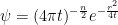
\displaystyle \psi =(4 \pi t) ^{-\frac{n}{2}} e^{-\frac{r^2}{4t}}

\displaystyle \phi = \phi_0+\phi_1 t+...+\phi_N t^N,

and
\displaystyle u_N =\psi \phi =(4 \pi t) ^{-\frac{n}{2}} e^{-\frac{r^2}{4t}} \sum\limits_{i=0 ... N} \phi_i t^i.

then
\displaystyle (\Delta - \frac{\partial}{\partial t}) u_N= \phi(\Delta \psi -\frac{\partial}{\partial t} \psi)+\psi(\Delta \phi -\frac{\partial}{\partial t}\phi)+2\frac{d\phi}{dr}\frac{d \psi}{dr}.

because of
\displaystyle \Delta \psi - \frac{\partial}{\partial t}\psi =\frac{d\ log\sqrt{g}}{dr}\frac{d \psi}{dr},

\displaystyle \frac{d \psi}{dr}=-\frac{r}{2t}\psi.

we know:
\displaystyle (\Delta -\frac{\partial}{\partial t})u_N = \frac{\psi}{t}\sum\limits_{k = 0 ... N} [ \Delta \phi_{k-1} -(k+\frac{r}{2}\frac{d \ log\sqrt{g}}{dr})\phi_k -r\frac{d \phi_k}{dr}]t^k ,

problem become to solve the equations:

\displaystyle r\frac{d\phi_k}{dr} =(k+\frac{r}{2}\frac{d\ log\sqrt{g}}{dr})\phi_k =\Delta \phi_{k-1} , k=0,1...N.

which is equivalent to:
\displaystyle \frac{d}{dr}(r^k g^{\frac{1}{4}}\phi_k)=r^kg{\frac{1}{4}}\Delta\phi_{k-1},k\geq 1.

\displaystyle \frac{d \phi_0}{dr}+\frac{d \ log\sqrt{g}}{\partial dr}\phi_0=0 (take\ \ \phi_{-1} =0).

solve it:
\displaystyle \phi_0= g^{\frac{1}{4}}

\displaystyle \phi_k(x,y) =g^{\frac{1}{4}} r^{-k} \int\limits_0^{r(x,y)} r^{k-1}(\Delta \phi_{k-1})g^{\frac{1}{4}}dr.

so {\phi_k \in C^\infty(M),\forall k \in N}. and:
\displaystyle (\Delta - \frac{\partial}{\partial t})u_N=(4 \pi t)^{- \frac{n}{2}} e^{-\frac{r^2}{4t}} \Delta \phi_N t^N.

take the cut function{ \theta \in C_0^\infty},{s.t}:
\displaystyle \theta(r)=1, when |r| \le \frac{1}{2}.

\displaystyle \theta(r)=0, when |r| \geq 1 .

take:
\displaystyle P_N(x,y,t) =\theta (r(x,y)) u_N(x,y,t),

of course:
\displaystyle Pn(x,y,t) \in C^\infty(M \times M \times R^+),and \ \\\ \lim\limits_{\epsilon \rightarrow 0} P(x,y,\epsilon) = \delta_x(y), (\Delta - \frac{\partial}{\partial t})P_N = O(t^N),

this is to say:
{P_N(x,y,t)} is the quasi fundamental solution of heat equation. from the equation:
\displaystyle (\Delta - \frac{\partial}{\partial t})u =G,

\displaystyle u|_{t=0} = 0,

we know if {G} has suffise high zero ,then so is the solution of heat equation,so {P_n(x,y,t)} can approximate heat equation to any order.
2.4. basic proposition of heat kernel

{Lemma 4.1}:

\displaystyle H(x,y,t) >0 , \ \forall \ t > 0.

proof strategy : begin with expansion of heat kernel and integral on a geodesic sphere and take the radius {r \rightarrow 0},use the stokes formula and maximal value principle to proof {H(x,y,t)} is always positive.

{Lemma 4.2}: assume {M} is a constant curvature complete riemann manifold (space form),then {H(x,y,t)} only depends on {r=d(x,y)},and{\frac{\partial H(r,t)}{\partial r} <0}. proof is similar to {Lemma 4.1}.

{Thm 4.1}(heat kernel comparision theorem,Cheeger-Yau).:
assume {M} is a complete riemann manifold ,{Ric \geq (n-1)k},{ \forall x \in M,r_0 >0}, heat kernel of { B(x,r_0), H(x,y,t)} and heat kernel {\varepsilon(r(x,y),t)} of geodesic ball {V(k,r_0)} in space form satisfied:
\displaystyle \varepsilon(r(x,y),t) \leq H(x,y,t).

(bounded condition is Derichlet condition or Neumann condition).
proof strategy: basically we use the formula {\frac{1}{2}\Delta(|\bigtriangledown u|^2)=\sum\limits_{i , j} u_{ij}^2+\sum\limits_i u_i(\Delta u)_i+Ric (\bigtriangledown u,\bigtriangledown u)}.and the two lemma. {Thm 4.2}: assume {M} is a compact reimann manifold ,{f_i} is a orthonormal basis of special function on {M},{ \lambda_i} is the corresponding spectrum,then the fundamental solution (heat kernel) has the expansion:
\displaystyle H(x,y,t)= \sum e^{-\lambda_i t} f_i(x)f_i(y)

in particular,
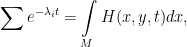
\displaystyle \sum e^{-\lambda_i t} =\int\limits_M H(x,y,t)dx,

when { t \rightarrow +0},
\displaystyle H(x,y,t) \sim (4 \pi t)^{\frac{n}{2}}e^{\frac{d^2(x,y)}{4t}}\sum\limits_{i \geq 0} \phi_i(x,y) t^i .

rmk:this thm is well known.


补充说明

以下是新整理的中文说明;上方旧博客原文保持不变。

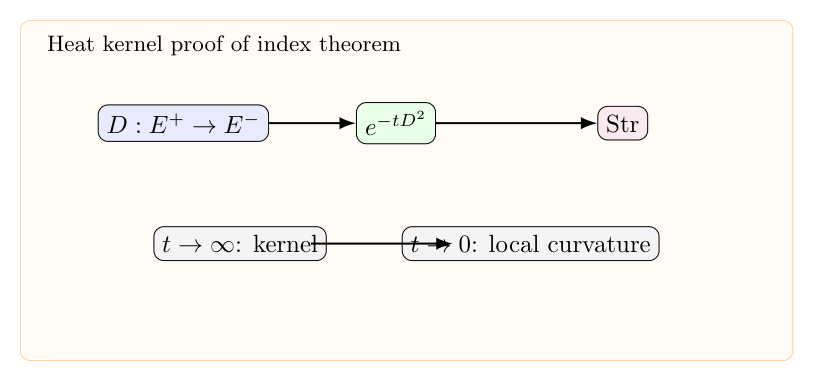
Atiyah-Singer 指标定理把一个分析对象的 Fredholm index 与流形上的拓扑特征类联系起来。热核证明的美妙之处在于:同一个量 $\operatorname{Str}(e^{-tD^2})$ 在 $t\to\infty$ 时看见 kernel,在 $t\to0$ 时看见局部曲率。
热核证明指标定理(一):Dirac 算子、supertrace 与 Chern-Weil
热核证明中,同一个 supertrace 在大时间看到 kernel,在小时间看到局部曲率。

1. Dirac bundle 与 Dirac operator

设 $M$ 是紧 Riemannian manifold,$E=E^+\oplus E^-$ 是 $\mathbb Z_2$-graded Clifford module。Dirac operator 写成

$$D:C^\infty(E^+)\to C^\infty(E^-).$$

它的 index 是

$$\operatorname{ind}D=\dim\ker D^+-\dim\ker D^-.$$

这个数在连续扰动下不变,所以天然应该由拓扑量表达。

2. Chern-Weil 背景

给定连接 $\nabla$ 和曲率 $F_\nabla$,Chern-Weil 理论告诉我们,形如

$$\operatorname{tr}\exp\left(\frac{i}{2\pi}F_\nabla\right)$$

的闭形式代表 Chern character。改变连接只会改变 exact form,因此上同调类只依赖 bundle 的拓扑。

Dirac 指标公式中的局部密度由 $\widehat A(M)$ 和 twisting bundle 的 Chern character 组成。

3. Supertrace

在 graded bundle 上,supertrace 定义为

$$\operatorname{Str}(A)=\operatorname{Tr}(A|_{E^+})-\operatorname{Tr}(A|_{E^-}).$$

热核证明的核心量是

$$\operatorname{Str}(e^{-tD^2}).$$

McKean-Singer 公式说它与 $t$ 无关,并且等于 $\operatorname{ind}D$。

4. 热半群与自伴算子

在完备 Riemannian manifold 上,合适的 Laplace 型算子可以取自伴扩张。谱定理给出热半群

$$e^{-tD^2}=\int e^{-t\lambda}\,dE_\lambda.$$

当 $t$ 很大时,正特征值贡献指数衰减,只剩零特征空间;于是 supertrace 给出 index。当 $t$ 很小时,热核有局部渐近展开,曲率项浮现出来。

5. 这条证明的路线

热核证明要完成两件事:第一,证明 supertrace 不依赖 $t$;第二,计算 $t\to0$ 的局部极限。前者是谱理论和 graded commutator 的结果;后者是 heat kernel asymptotics 和 Clifford algebra 的局部计算。二者合在一起,就把分析 index 变成了积分公式。

评论

发表回复

您的邮箱地址不会被公开。 必填项已用 * 标注