旧博客原文
原题:Flat surface 1
Topological point of view:
in topological point of view a flat surface is a topological space 

and the map satisfied:

Geometric-analytic point of view:
we begin with compact connected oriented surface 
translation surface of type 
translation structure:
complex structure:
补充说明
以下是新整理的中文说明;上方旧博客原文保持不变。
flat surface 可以从两个角度理解。拓扑上,它像一个带有限分歧点的覆盖空间;几何分析上,它是一个曲面,除有限个锥点外局部都与欧氏平面等距。
1. 拓扑观点
给定紧致定向曲面 $M$ 和有限集合 $\Sigma$。在 $M\setminus\Sigma$ 上,局部坐标变换若都是平移
$$z\mapsto z+c,$$
就得到 translation structure。若绕 $\Sigma$ 中的点一圈,角度可能是 $2\pi(k+1)$,这些点就是锥奇点。
2. 多边形模型
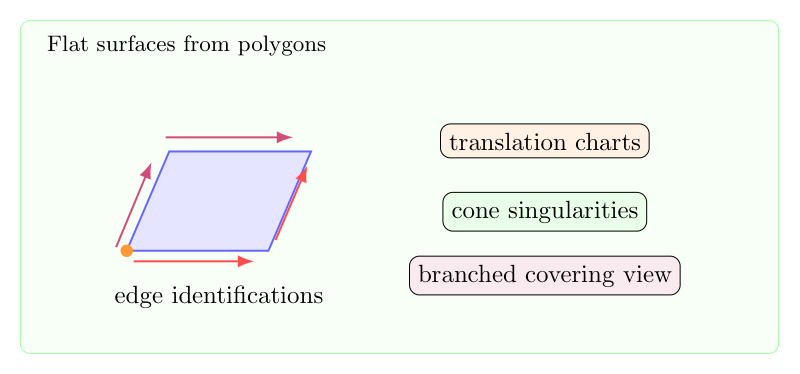
最直观的构造是取平面中的多边形,把平行且等长的边按平移粘起来。粘合后,内部仍然平坦,边也消失,只有若干顶点合并成锥点。
3. 复分析观点
translation surface 等价于 Riemann surface 上的 holomorphic 1-form $\omega$。在 $\omega$ 非零处,局部坐标由
$$z(p)=\int^p\omega$$
给出;在 $\omega$ 的零点处出现锥角。
4. 动力系统入口
在 flat surface 上沿固定方向走直线,会得到 translation flow。它连接了 billiards、Teichmuller flow、interval exchange transformation 和模空间动力系统,是后续研究的基本对象。
发表回复