旧博客原文
原题:Sarnak conjecture, understand with standard model
Sarnak conjecture is a conjecture lie in the overlap of dynamic system and number theory. It is mainly focus on understanding the behavior of entropy zero dynamic system by look at the correlation of an observable and the Mobius function .
We state it in a rigorous way:
let 


Then for any continuous function 



I mainly focus on the special cases when dynamic system 

![[0,1]](https://s0.wp.com/latex.php?latex=%5B0%2C1%5D&bg=ffffff&fg=5e5e5e&s=0&c=20201002)
Skew product
For the first one, 



by Bourgain-Ziegelar-Sarnak theorem we know the difficulties is focus on deal with the exponent

for all 
and a much simper case is the affine map:




Interval exchange map
For the interval exchange map, we can explain it by a composition of rotation of some part of 
Now let us explain a little with this interesting dynamic system. We focus in the simplest nontrivial case, which is the 3-interval exchange map. In this case, just consider the permutation of intervals 

When 


Which is trivial because 
For the case $I_1\to I_2, I_2\to I_1, I_3\to i_3$ the map 


Now we focus on the most difficult situation. It is annoying but it is the obstacle we must get over to go far. Fortunately it could be explained as in the following picture.

Now we explain what happen in the picture, it is mainly say one identity, which explain how to look 3-interval exchange map as a composition of rotation map with a renormalization map to glue them. Rotation is a kind of map we have good understanding but we do not understand very well with the renormalization map which is glue the two endpoints of 

Now we roughly could think about what is the thing we need to charge with, it is just:

Now we do some calculate with this geometric explain of interval exchange map.
Let 
![A\cap B=\emptyset, A\cup B=[0,1]](https://s0.wp.com/latex.php?latex=A%5Ccap+B%3D%5Cemptyset%2C+A%5Ccup+B%3D%5B0%2C1%5D&bg=ffffff&fg=5e5e5e&s=0&c=20201002)




Standard model
Is there a standard model of entropy zero dynamic system?
This problem seems to be too ambitious. But it occur naturally when I an trying to have a global understand of the Sarnak conjecture.
补充说明
以下是新整理的中文说明;上方旧博客原文保持不变。
Sarnak 猜想位于动力系统和解析数论的交界处。它说零熵动力系统产生的确定序列,应该和莫比乌斯函数这样的算术随机序列正交。
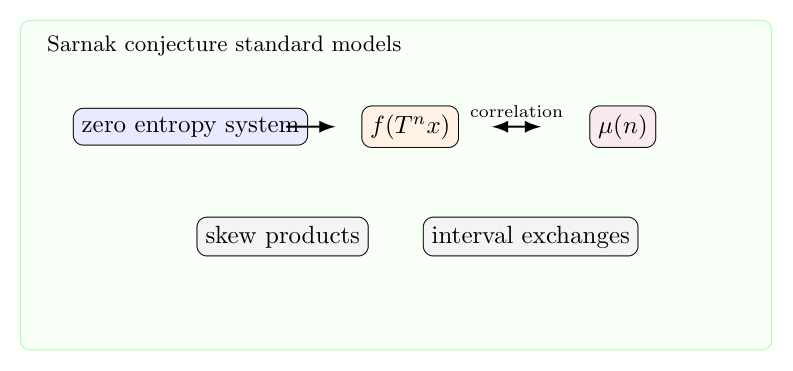
1. 基本陈述
设 $(X,T)$ 是零拓扑熵系统,$f\in C(X)$。Sarnak 猜想断言
$$\frac1N\sum_{n\le N}\mu(n)f(T^n x)\to0.$$
这里 $\mu(n)$ 是 Mobius function。零熵表示轨道复杂度低,而 $\mu(n)$ 预期具有强随机性。
2. Skew product 模型
典型例子是
$$T(x,y)=(x+\alpha,y+h(x))\pmod1.$$
对 Fourier character 展开后,问题会变成
$$\sum_{n\le N}\mu(n)e(P(n))$$
或更一般的旋转 Birkhoff sum 相位。Bourgain-Sarnak-Ziegler 准则可以把莫比乌斯相关转为不同素数伸缩下的双线性相关。
3. Affine nilsystem 情形
若环面自同态由上三角 unipotent 矩阵给出,例如 $A=I+B$ 且 $B$ nilpotent,那么 $T^n$ 的坐标是 $n$ 的多项式。因此 Sarnak 猜想可归约到 Davenport 型多项式指数和估计。
4. Interval exchange maps
interval exchange map 可以看作把区间切成有限段后重排。它通常是零熵,但没有简单的光滑结构。它的 renormalization 来自 Rauzy induction,类似连续分数在旋转中的作用。
这里的困难是:相位不再是一个光滑多项式,而是经过多次 induction 拼接出来的低复杂度序列。
5. 标准模型的意义
skew product 展示了“低熵加光滑结构”如何导出指数和;interval exchange 展示了“低熵但不光滑”的困难。理解这两个模型,就能看清 Sarnak 猜想里动力系统复杂度与数论随机性之间的真正接口。
发表回复