Wolff 的 Kakeya maximal estimate:X-ray 估计与三维障碍

旧博客原文

原题:Kakeya conjecture (Tomas Wolff 1995)

There is a main obstacle to improve the kakeya conjecture,remain in dimension 3,and the  result established by Tomas Wolff in 1995 is almost the best result in R^3 even until now.the result establish by Katz and Tao can be view as a corollary of Wolff’s X-ray estimate.

For f\in L_{loc}^1(R^d),for 0<\delta<1:

f_{\delta}^*:P^{d-1}\longrightarrow R.f_{\delta}^*(e)=\sup_{T}\frac{1}{|T|}\int_{T}|f|.

T is varise in all cylinders with length 1.radius \delta.axis in the e direction.

f_{\delta}^{**}:R^d\longrightarrow R.f^{**}_{\delta}(x)=sup_{T}\frac{1}{|T|}\int_{T}|f|.

T varise in cylinders contains x,length 1,radius \delta.

Keeping this two maximal function in mind,we give the statement of the Kakeya maximal function conjecture:

||M_{\delta}f||_d\leq C_{\epsilon} \delta^{-\epsilon}||f||_d

Where M_{\delta}=f_{\delta}^* or M_{\delta}=f_{\delta}^{**}.

Because we have the obviously 1-\infty estimate:

||f^*_{\delta}||_{\infty}\leq\frac{||f||_1}{|T|}=\delta^{1-d}||f||_1.

||f^{**}_{\delta}||_{\infty}\leq\frac{||f||_1}{|T|}=\delta^{1-d}||f||_1.

So by the Riesz-Thorin interpolation we have:

||M_{\delta}f||_{q}\leq C_{\epsilon}\delta^{-(\frac{d}{p}-1+\epsilon)}||f||_p.           (*)

for 1\leq p\leq d,q\leq(d-1)p'.the task is establish (*) for (p,q) as large as posible in the range.

for the 2 dimension case,the result is well know.the key estimate is:

\sum_{j}|T_i\cap T_j|\leq log(\frac{1}{\delta})|T_i|

for d\geq 3 case,the main result of Wolff is:

||M_{\delta}f||_q\leq C_{\epsilon}\delta^{-(\frac{d}{p}-1+\epsilon)}||f||_p

hold for p=\frac{d+2}{2}.q=(d-1)p'. M_{\delta}=f_{\delta}^* or f_{\delta}^{**}.

Now we sketch the proof.

prove f_{\delta}^*,f_{\delta}^{**} cases together.

We can make some reduction:

the first one is we can assume the sup of f is in a fix compact set.

the second is instead of consider f_{\delta}^{**},we can consider f_{\delta}^{***}(x)=\sup_{T}\frac{1}{|T|}\int_T|f|.

where T varies in all cylinder with radius \delta,length 1,axis \frac{\pi}{100} with a fix direction.

the first reduction is obvious(why?)

the second reduction rely on a observe:

||f_{\delta}^{***}||_q\leq A(\delta)||f||_p          \Longrightarrow    ||f_{\delta}^{**}||_q\leq CA(\delta)||f|_p

this is just finite cover by rotation of the coordinate and triangle inequality.

now we begin to establish a frame and put the two situations f_{\delta}^*,f_{\delta}^{***} into it.

Let M(d,1) be all line in R^d.

then M(d,1)=R^d\times S^{d-1}/\sim is a 2d-2 dim manifold.

M(d,1)\longrightarrow P^{d-1}

l \longrightarrow  e_l

e_l is the line parallel to l.and the middle point is original.

dist(l_1,l_2)\sim \theta(l_1,l_2)+d_{mis}(l_1,l_2).


Wolf axiom:

(A,d) metric space.

\mu(D(\alpha,\delta)) \sim \delta^m.\alpha\in A.\delta \leq diam(A).

for certain m\in R^+.

\forall \alpha\in A.F_{\alpha} \subset M(d,1) is given.and \bar{\cup_{\alpha}F_{\alpha}} is compact.

d(\alpha,\beta)\lesssim inf_{l\in F_{\alpha};m\in F_{\beta}}dist(l,m) for all \alpha,\beta \in A.

If f:R^d\longrightarrow R then we define M_{\delta}f:A\longrightarrow R by

M_{\delta}f(\alpha)=\sup_{l\in F(\alpha)}\frac{1}{|T_{l}^{\delta}|}\int_{|T^{\delta}_l|}|f|.

Property (**):

If l_0\in \cup_{\alpha F_{\alpha}}. \Pi is a 2-plane.containing l_0and if \sigma \geq \delta and if \{\alpha_j\}_{j=0}^N is a \delta-seperated subset of A and for each j,there is l_j\in F_{\alpha_j} with dist(l_j,M(\Pi,l))<\delta and dist(l,l_0)<\sigma.then

N\leq \frac{C\sigma}{\delta}


补充说明

以下是新整理的中文说明;上方旧博客原文保持不变。

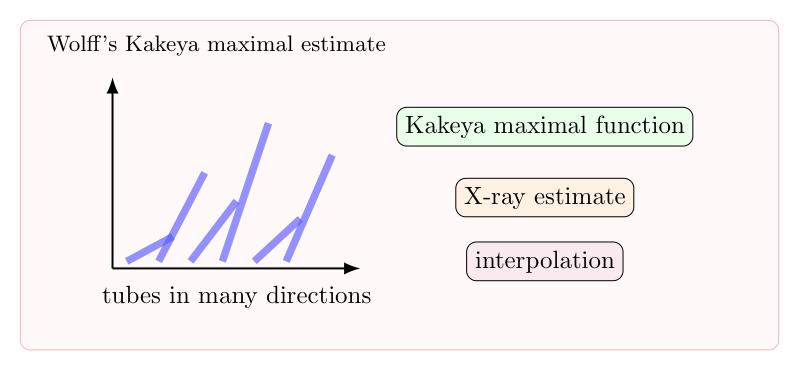
Wolff 1995 年的 Kakeya maximal estimate 是三维 Kakeya 理论中的经典结果。它把 tubes 的重叠问题转化为 maximal function 和 X-ray transform 的估计。
Wolff 的 Kakeya maximal estimate:X-ray 估计与三维障碍
Wolff 的 Kakeya maximal estimate 通过 X-ray 型平均和 incidence 几何控制 tubes 的重叠。

1. Kakeya maximal function

给定方向 $\omega$,考虑沿 $\omega$ 方向、半径 $\delta$、长度 $1$ 的 tube。Kakeya maximal function 粗略写为

$$f_\delta^\ast(\omega)=\sup_{T\parallel\omega}\frac1{|T|}\int_T |f(x)|\,dx.$$

猜想要求在尽可能大的 $p$ 范围内控制 $\|f_\delta^\ast\|_{L^q(S^{n-1})}$。

2. 平凡估计与插值

最直接的 $L^1$ 或 $L^\infty$ 估计通常太弱。通过 Riesz-Thorin interpolation 可以得到一些中间结果,但要接近 Kakeya 猜想,需要利用 tubes 的几何排列。

3. X-ray transform

X-ray transform 沿直线积分函数。Kakeya maximal function 可以看作对有限厚度 tubes 的 X-ray 型平均。Wolff 的估计用几何 incidence 控制这些平均的重叠。

4. 归约步骤

证明中可以把 tubes 限制在固定紧区域,并把方向分成有限个坐标 patch。这样 maximal function 可由有限方向族上的 tube averages 控制。

5. 三维障碍

三维最大的困难是 tubes 可以形成复杂 ruled surface 或 hairbrush 结构,普通 pairwise intersection 估计不够。Wolff 的结果抓住了这类结构的第一层几何约束,为 Katz-Tao 的后续改进提供了基础。

评论

发表回复

您的邮箱地址不会被公开。 必填项已用 * 标注






