旧博客原文
原题:Interval map
1.period 3 induce chaos
theorem:if a interval map 


proof:
n=1 case. trivial

the key point is to consider the structure of monotone interval contain previous one with fix length.
this will easy to lead a proof.
2.a work of J.Milnor and W.Thurston.


theorem:
3.monotone Markov map
this structure have two property:
1.piesewise monotone and $C^1$,the derive has control!
there is a relative dynamic system with this map.is a shift map with a relative 

this two dynamic system have a lot of relation,the key one is:
the topological entropy of monotone Markov map is just the unique maximum eigenvalue of
and some byproduct…
补充说明
以下是新整理的中文说明;上方旧博客原文保持不变。
区间映射是一维动力系统中最能体现“简单空间产生复杂轨道”的模型。一个连续映射 $f:I\to I$ 若有周期三点,就已经含有所有周期的影子,这就是 Li-Yorke 定理背后的核心图像。
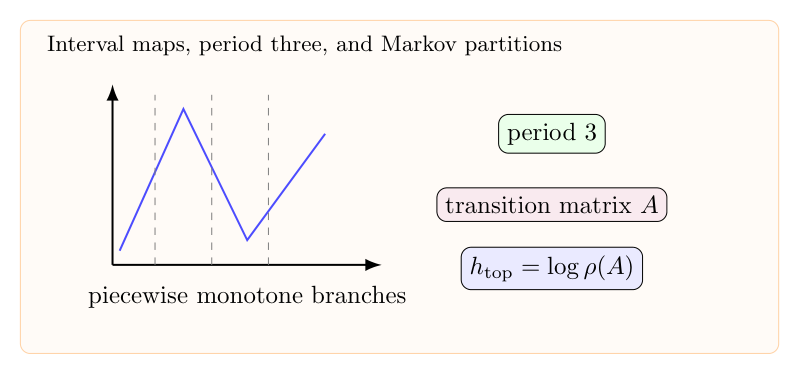
1. 周期三为什么特别
设存在 $x$ 使得 $x,f(x),f^2(x)$ 互不相同且 $f^3(x)=x$。三个点在区间上的顺序会迫使某些子区间被映到包含另一些子区间的位置。利用介值定理,可以构造嵌套区间,从而得到任意周期点。
2. 分段单调与 lap number
Milnor-Thurston 的一个基本量是 $f^n$ 的单调区间个数,常记作 $\ell(f^n)$。拓扑熵可以由增长率给出:
$$h_{\rm top}(f)=\lim_{n\to\infty}\frac1n\log \ell(f^n).$$
这把轨道复杂度转化成组合增长。
3. Markov 映射
若区间被分成有限个小区间,且每个小区间在 $f$ 下覆盖若干小区间,就得到一个 transition matrix $A$。对应的符号动力系统是一个 subshift of finite type。
4. 熵与最大特征值
在 Markov 情形下,长度为 $n$ 的允许轨道数由 $A^n$ 控制,因此
$$h_{\rm top}(f)=\log \rho(A),$$
其中 $\rho(A)$ 是矩阵最大特征值。这样一维动力系统的混沌程度就被线性代数读出来了。
发表回复